Loading activity…

@konstructivizm
Only New Content, news, articles, images, videos, and discussion #space,#FollowMe, #Nature, #astronomy, #Nasa, #astrophotography, #science
 Science
All five nucleobases were detected in both Ryugu samples, in roughly similar amounts across the five bases.

Science
NASA's Hubble Space Telescope studied 37 dwarf galaxies and found less oxygen than models predicted, possibly lost to galactic winds.

Science
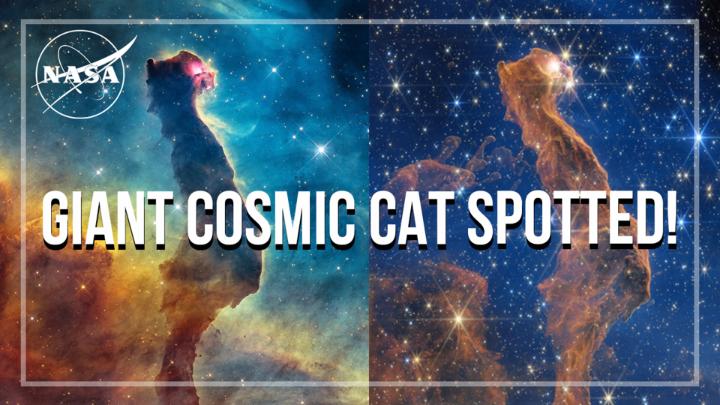
The Cat’s Head nickname refers to a small area within the Carina Nebula; Webb’s infrared views accompany Hubble’s visible-light image.
 X
Science
The Vera C. Rubin Observatory estimates 2026 ED138 at 600 to 1,500 kilometers across; infrared observations are needed.

Science
Space.com says people witnessed the supernova that left the relic around 850 years ago.

Science
ESA says the find is impressive: Euclid is meant to image distant galaxies, not fast-moving tiny objects.

Science
A post describing NYU researchers’ experiment says cell nuclei expanded, while the nuclear envelope remained unchanged.

Science
Science News reports Voyager 1 will reach 25.9 billion kilometers on November 18, 2026, requiring two days for round-trip communication.

Science
ScienceDaily describes a surprising link between scattered starlight and dark matter that could aid studies of the early cosmos.

Science
A post says brightness anomalies in 29 JWST-observed lensed quasars favor self-interacting dark matter models with collapsed halos.

Science
Space.com reports that NASA’s Mars rover passed its smaller cousin Opportunity.

Science
A supplied post describes Voyager 1 as still operating from roughly 15.9 billion miles away, with about 69 kilobytes of memory and a signal that reportedly takes nearly a day to reach Earth.

Science
A post says Overview Energy secured U.S. Army funding to build a targeting beacon for orbital solar power.

Science
A post says early observers mistook it for a supernova remnant, but its expansion, chemistry and lack of a central neutron star pointed elsewhere.

Science
A post says engineers heated the test article to 869°F (465°C) over an hour to simulate a Venus descent.
Science
A post describing Jewell and colleagues’ study says researchers classified 546 of 2,435 sampled disk galaxies as bulgeless.

Science
A post describes carbon, oxygen and silicon signatures in gas around three distant galaxies.
Science
A post says supernova explosions cleared paths through gas, allowing light from the dwarf galaxy to escape.

Science
NASA said Crew-13’s Dragon reached the International Space Station at 7:05 p.m. EDT on Oct. 1, 2026, after a 7-hour, 55-minute launch-to-docking interval that the agency said was the fastest for a U.S. spacecraft in ISS history.

 Technology
NASA's SpaceX Crew-13 mission launched Oct 1 from Cape Canaveral carrying commander Jessica Watkins, pilot Luke Delaney, CSA's Joshua Kutryk, and Roscosmos' Sergey Teteryatnikov. Targeted for ~7-hour launch-to-docking to ISS.


