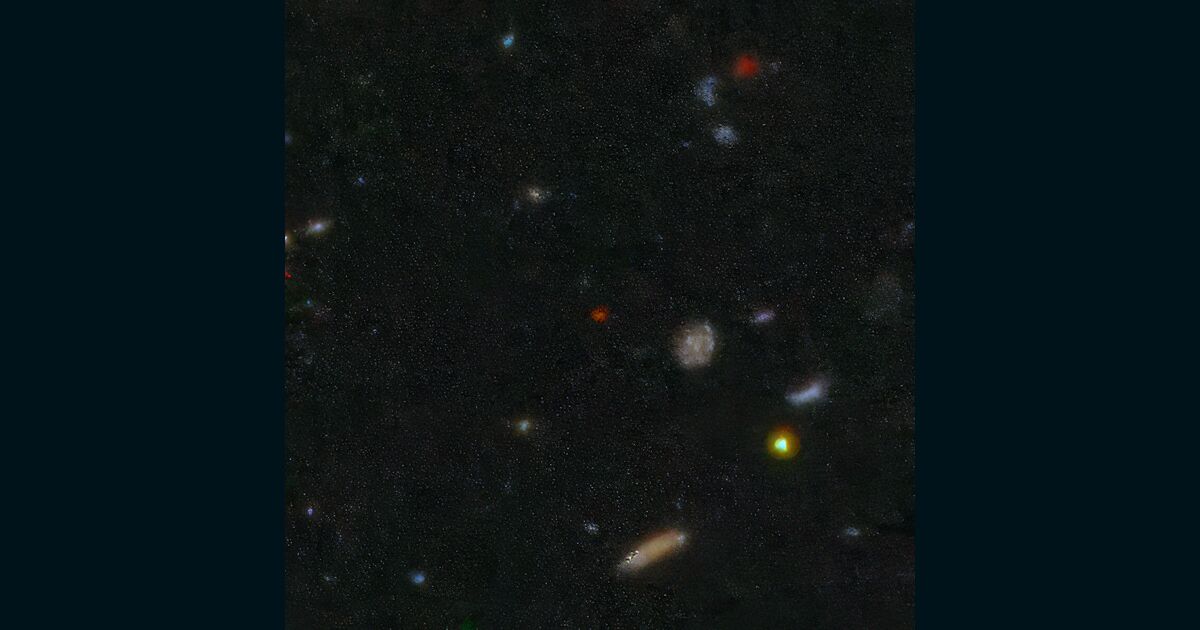
ESA says its Euclid space telescope has discovered the most distant known quasar, seen as it was just 630 million years after the Big Bang. In its November 24, 2026 announcement, the agency identified the object as J1504+6252, nicknamed Dún Aonghasa. It pushes Euclid’s previous record 40 million years further back in cosmic history. Source
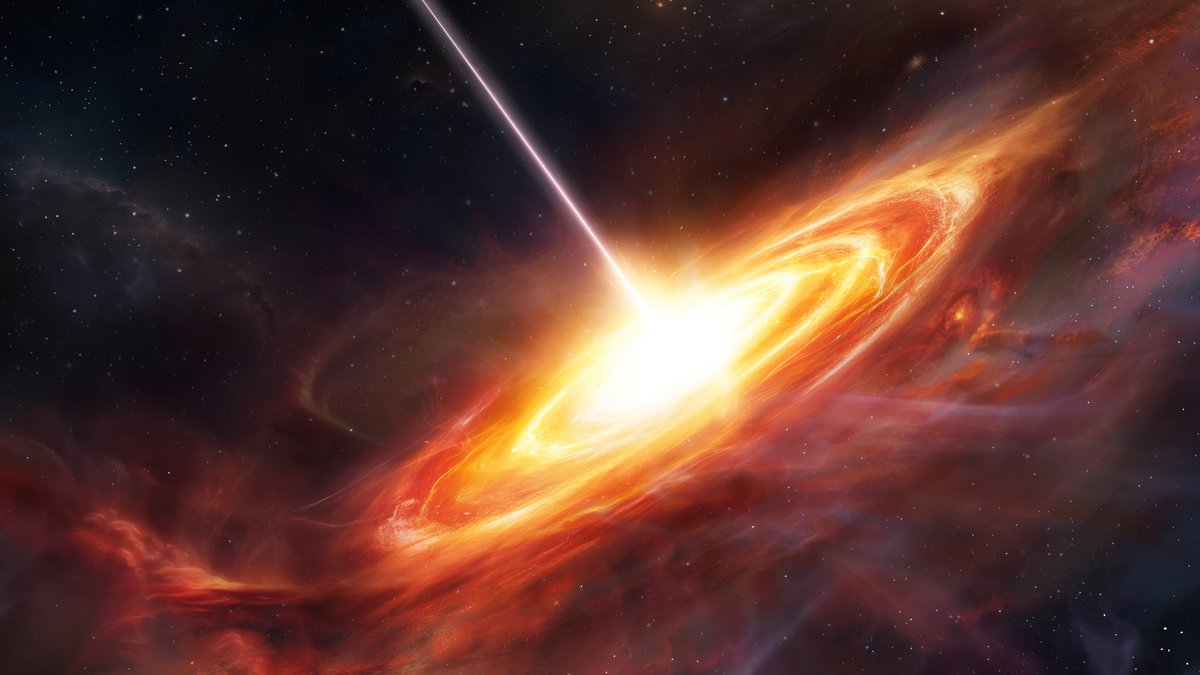
A quasar is the intensely bright core of a galaxy, powered by gas falling into a supermassive black hole. That process can make the core outshine the rest of its galaxy. Webb observations put the black hole’s mass at roughly 360 million times the Sun’s, ESA says. That is a lot of growing up for such a young universe. Source
For all that bulk, the black hole was consuming material relatively slowly at the ancient epoch we’re observing, according to ESA. The agency argues that it must have undergone earlier episodes of extremely rapid growth, putting pressure on models of early black-hole formation and growth. Source
Researchers identified Dún Aonghasa among millions of objects in about 18 months of Euclid data. Confirmation was a group project: follow-up observations involved the W. M. Keck Observatory, the Large Binocular Telescope Observatory, Hubble and, ultimately, Webb, ESA says. Source
ESA reports a redshift of 8.13, meaning we see the quasar as it was roughly 13.1 billion years ago, when the universe was about 5% of its current age. Dún Aonghasa is the first quasar identified beyond redshift 8, the agency says. Source
ESA credits Euclid’s sensitive infrared imaging and wide sky coverage for its ability to find rare, distant sources. At redshift 8, the agency expects at most a few tens of quasars across the telescope’s entire survey. That’s an extravagant amount of detective work for one little red dot in ESA’s image. Source




Comments