Hera has checked on the asteroid NASA deliberately crashed into, and the damage report is not subtle. In a November 25, 2026 announcement, the European Space Agency said its spacecraft found a stadium-sized crater flattening one face of Dimorphos and extending across its entire width. Source
Dimorphos, which ESA describes as 151 meters across, is a moonlet orbiting the larger asteroid Didymos. NASA’s DART spacecraft deliberately struck it on September 26, 2022, shortening the time it takes to orbit Didymos by 33 minutes. Earth-based telescopes measured that change; Hera is now investigating what happened to the asteroid itself. Source
The crater answers a question that wasn’t as straightforward as “spacecraft hits rock, leaves hole.” Hera principal investigator Patrick Michel said scientists had debated whether Dimorphos would sustain a crater, change shape or remain unchanged. “Much to our surprise the answer turns out to be all three at once!” he said in ESA’s announcement. The struck face is flattened, but other regions show no evidence of major visible changes: their boulder fields still resemble those in DART’s 2022 images. That’s a rather selective renovation. Source
Hera mission scientist Michael Kueppers said the images show that DART left Dimorphos “tumbling wildly in its orbit.” The moonlet is rotating chaotically while continuing to orbit Didymos. Source
Hera also detected hundreds of previously unknown boulders a few meters in size orbiting the asteroid pair. The mission team says it will need to account for those objects as the spacecraft moves closer for higher-resolution images. The follow-up inspection has traffic to consider. Source
Mission manager Ian Carnelli said in ESA’s announcement: “NASA’s DART mission demonstrated that we can change an asteroid’s orbit. Hera is now revealing what happened to the asteroid itself.” He described the combined missions as a step toward making asteroid deflection a reliable way to protect Earth. Source
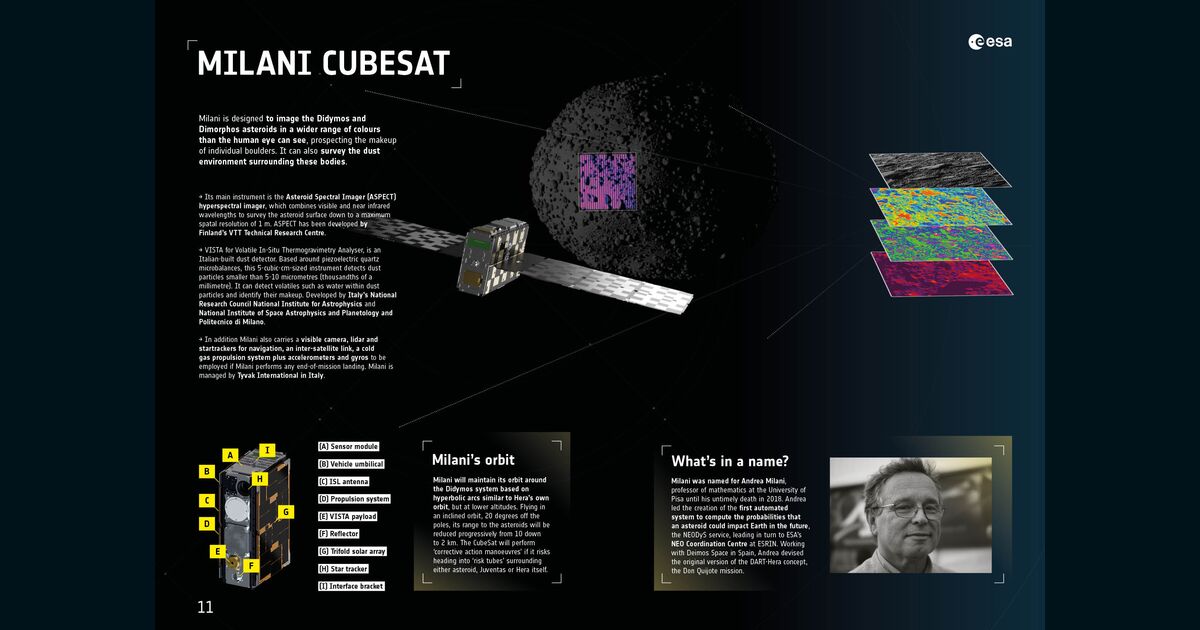
At the time of the announcement, Hera was operating about 25–30 kilometers from the pair. ESA’s plans called for an approach to around 13 kilometers in December 2026, followed by deployment of two shoebox-sized CubeSats in January 2027. Juventas would probe an asteroid’s interior with low-frequency radar and eventually attempt a landing; Milani would investigate asteroid materials and surrounding dust. Source




Comments