A James Webb Space Telescope follow-up study estimates that tiny galaxy LAP2 has an oxygen abundance below about 0.5% of the sun’s, placing it among the most oxygen-poor galaxies known, according to Phys.org. But the calculation extrapolates beyond tested methods at those extreme levels, carrying real uncertainty. Source
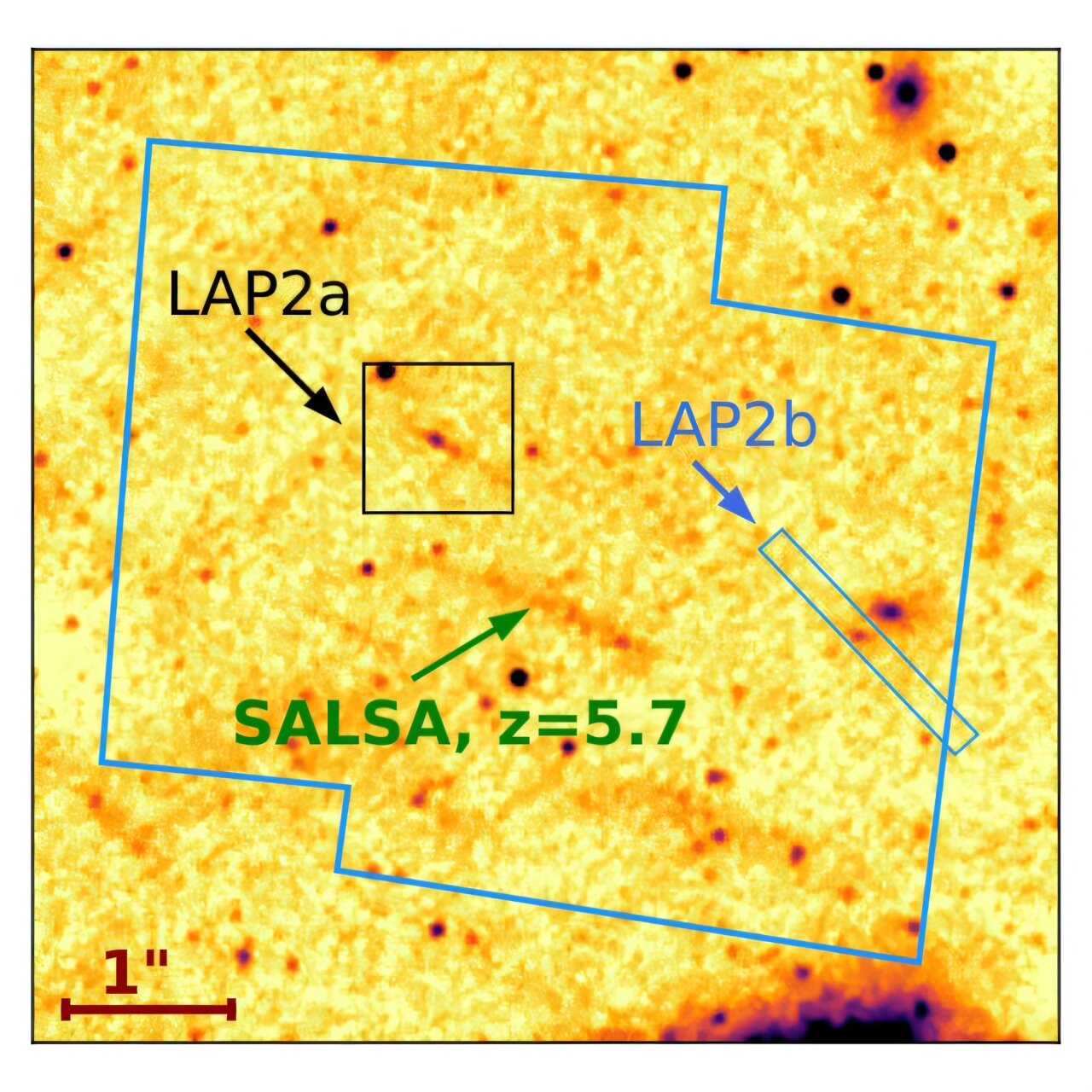
The work was led by Matteo Messa of the INAF Astrophysics and Space Science Observatory of Bologna. Phys.org’s November 26 report describes it as a preprint posted to arXiv on November 3, 2026. The team used Webb’s NIRSpec integral field spectroscopy to cover both gravitationally lensed images of LAP2 in full, extending earlier observations that sampled only a small part of the galaxy. Source
Even Webb gets a magnifying assist
LAP2 was first identified in MUSE observations in 2021. A foreground galaxy cluster, Abell 2744, magnifies its light roughly 50 times through gravitational lensing, allowing astronomers to examine its structure and chemistry. Source
We see LAP2 as it was around 12.2 billion years ago. Modeling puts its stellar mass at approximately 80,000 times the sun’s, comparable to a massive star cluster. That’s the mass of its stars—not a measurement of everything the galaxy contains. Source
The oxygen percentage compares chemical abundance with the solar value, not the objects’ total oxygen inventories. This isn’t a galaxy-versus-sun weigh-in. Source
Missing from the combined spectrum, faintly present in the core
According to Phys.org, the team did not detect the oxygen emission line designated [O III] λ5007 in the integrated spectrum, which combines light across the galaxy. Yet faint oxygen emission appeared in the small, dense core. The lack of a detected signal elsewhere doesn’t establish that those regions contain no oxygen. Source
Conditions in the core might make oxygen glow more strongly even if its abundance matches the surrounding regions. Alternatively, exploding stars may have enriched the core locally. A brighter oxygen signal isn’t, by itself, a settled map of where more oxygen lives. Source
LAP2 could help astronomers study early cosmic chemistry. It isn’t a confirmed discovery of Population III stars—the first generation thought to have formed from pristine hydrogen and helium. Phys.org reports that LAP2’s inferred oxygen abundance remains above the levels expected for Population III star formation. Source





Comments