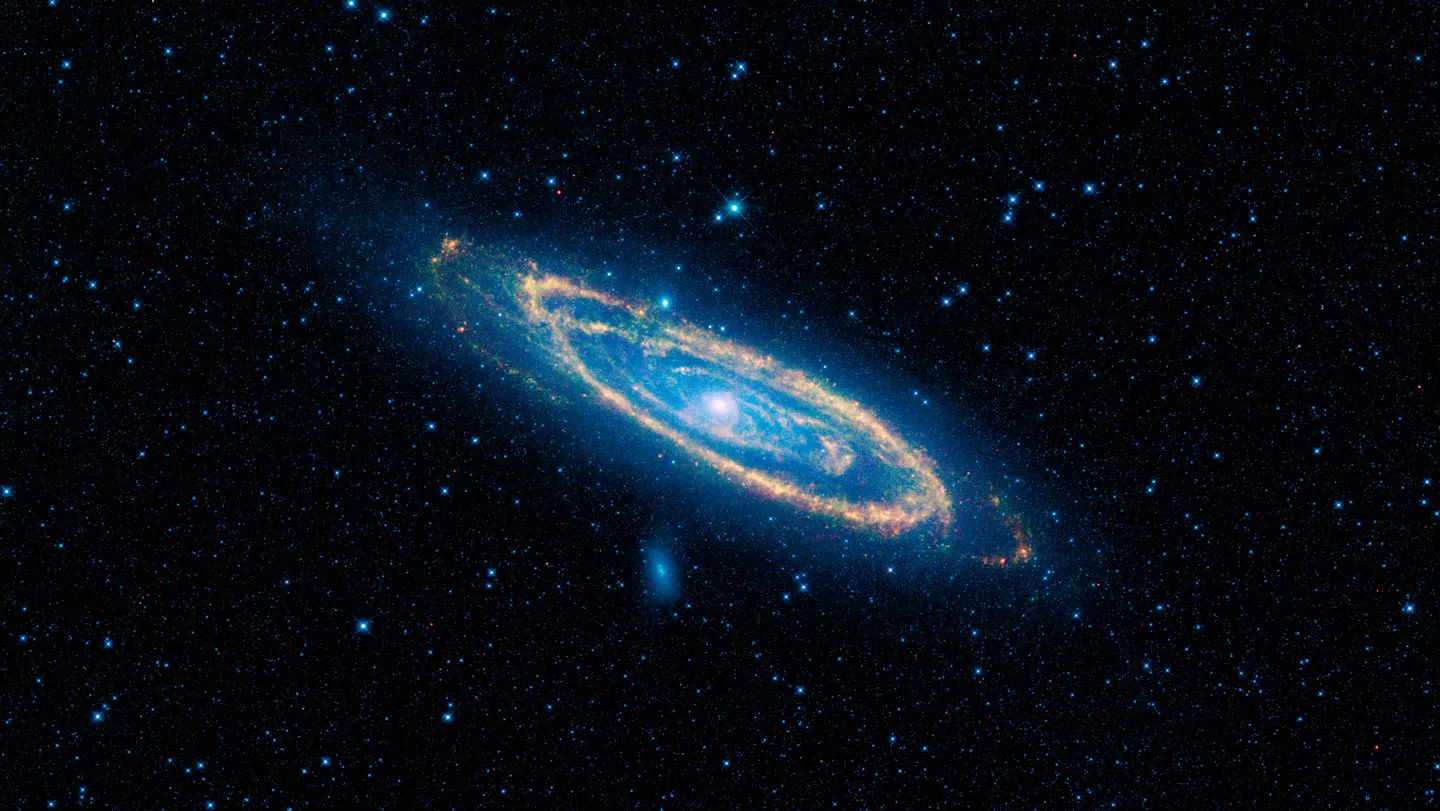
A supergiant nicknamed Big Bao engulfed its smaller companion in the Andromeda galaxy, and astronomers conclude the encounter left one merged star. NASA detailed the findings on November 18, 2026, reporting research published that day in Nature. Big Bao and Little Bao sound like a charming double act until one eats the other. Source
The eruption happened in 2025. The James Webb Space Telescope observed the system on December 24, 2025, 47 days after the eruption peaked. Its infrared measurements helped researchers piece together events alongside observations from other space and ground telescopes. Webb wasn’t livestreaming the meal. Source
NASA describes Webb’s data as proving the stars merged. Sci.News also reports a merger, but says future observations are needed to confirm it conclusively. Source Source
What happened to Little Bao?
The team’s modeling puts Big Bao’s pre-eruption mass at about seven times the Sun’s, its radius at 350 times the Sun’s and its brightness at 18,000 times the Sun’s. Little Bao likely had about 0.7 times the Sun’s mass. “Little” is doing some work here: that’s still most of a Sun’s worth of star. Source
Once the companion contacted the giant’s surface, it began spiraling through the larger star’s outer gas. Astronomers call this common-envelope evolution: the stars share an outer envelope, and drag drains energy from the companion’s orbit, pulling it inward. In some systems, the envelope is expelled and both stars survive in a tighter orbit. The team concludes Little Bao instead reached Big Bao’s core. Source
According to the reconstruction, the process from surface contact to merger took only seven orbits, or about seven years. NASA quoted co-author Nadia Blagorodnova on the eruption’s much faster rise in brightness: “One day, its brightness started rising and within a week, it peaked!” Source
How astronomers pieced it together
Researchers first noticed unusual brightness variations in NEOWISE data in February 2023. Looking back through archival data, they found the system had begun brightening in 2018. Subsequent monitoring caught more changes, including dust production, before the Zwicky Transient Facility detected the eruption on October 17, 2025. Source Source
ABC quoted lead author Viraj Karambelkar describing the finding as the first time a giant star was “caught in the act” of engulfing its companion. Mergers involving smaller stars had been observed before, NASA notes. Source Source
NASA says the observations allowed the team to measure the efficiency of common-envelope evolution—how effectively energy from the shrinking orbit helped expel the shared gas. In ABC’s report, Australian National University astrophysicist Sven Buder, who wasn’t involved, said the researchers reconstructed events “with quite significant confidence” and that the work would improve models of this difficult-to-simulate process. Source Source
The proposed remnant is now simply Bao, formally AT 2025abao. Future observations are needed to determine how its mass and appearance settle. Source




Comments