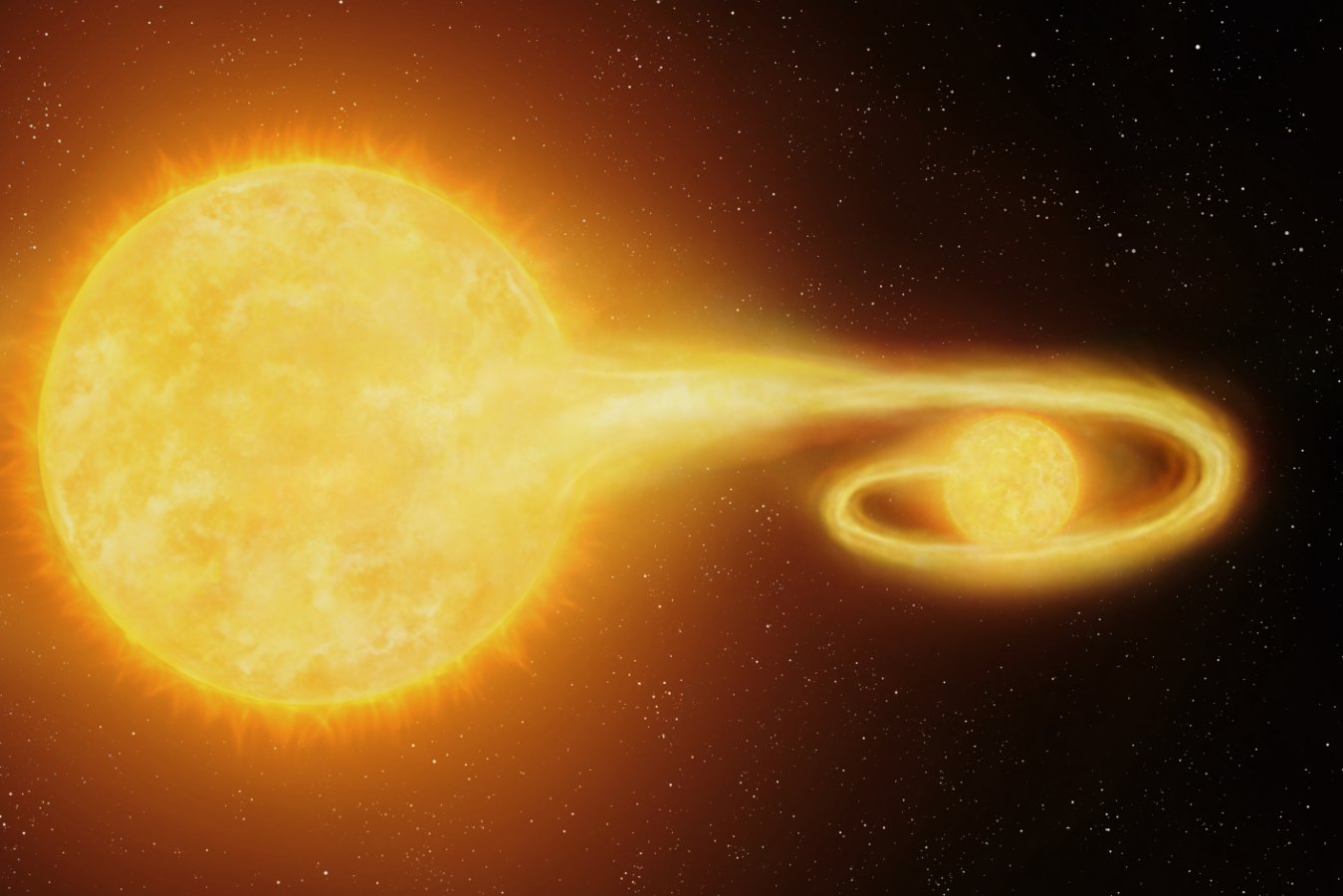
Astronomers have reconstructed a dying supergiant engulfing its smaller companion and ultimately merging with it, about 2.5 million light-years away on the outskirts of Andromeda, according to Reuters reporting carried by GMA News. The larger star expanded to 350 times the sun’s diameter. An extreme violation of personal space, even by stellar standards. Source
Lead author Viraj Karambelkar, a Columbia University postdoctoral researcher and NASA Hubble Fellow, told Reuters the study, published in Nature, marks “the first time a giant star engulfing its companion was caught in the act.” Astronomers have seen stellar mergers before; here, merging wasn’t the only possible outcome. Source
A seven-year inward spiral
The pair formed a binary system: two stars bound together by gravity. The larger star had seven times the sun’s mass. Aging large stars can swell as their cores run low on fuel. This one expanded around a companion orbiting at roughly the distance between Mars and the sun. The smaller star’s diameter was about 70% of the sun’s. Source
Researchers detected brightening associated with the engulfment in 2018. Over the following seven years, the smaller star spiraled inward toward the giant’s core. Toward the end of 2025, the observations showed the final merger with that core, triggering an eruption a million times brighter than the sun. Source
“This violent collision set off a bomb inside the star, producing the bright eruption that we saw,” Karambelkar told Reuters. Source
It took more than Webb to piece together this stellar disaster. The researchers used data from the WINTER telescope at California’s Palomar Observatory and NASA’s NEOWISE space telescope, alongside observations from SPHEREx, the James Webb Space Telescope and ground-based observatories. According to the report’s image caption, Webb observations in December 2025 supplied the final evidence needed to reconstruct the merger. Source
Swallowing doesn’t always mean merging
The giant’s loosely bound outer layers made the outcome uncertain, study co-author and Columbia astrophysicist Kishalay De explained to Reuters. In some systems, an engulfed companion can release enough energy to throw off those layers, leaving the giant’s exposed core and the smaller star orbiting each other instead of combining. Source
Here, the stars did merge. The result may be a rejuvenated star, the researchers say. They nicknamed it Bao, drawing from the eruption’s designation, AT2025abao, and encouraged by the name’s resemblance to Chinese steamed buns. Source
An awfully cozy name for a seven-year inward spiral.




Comments