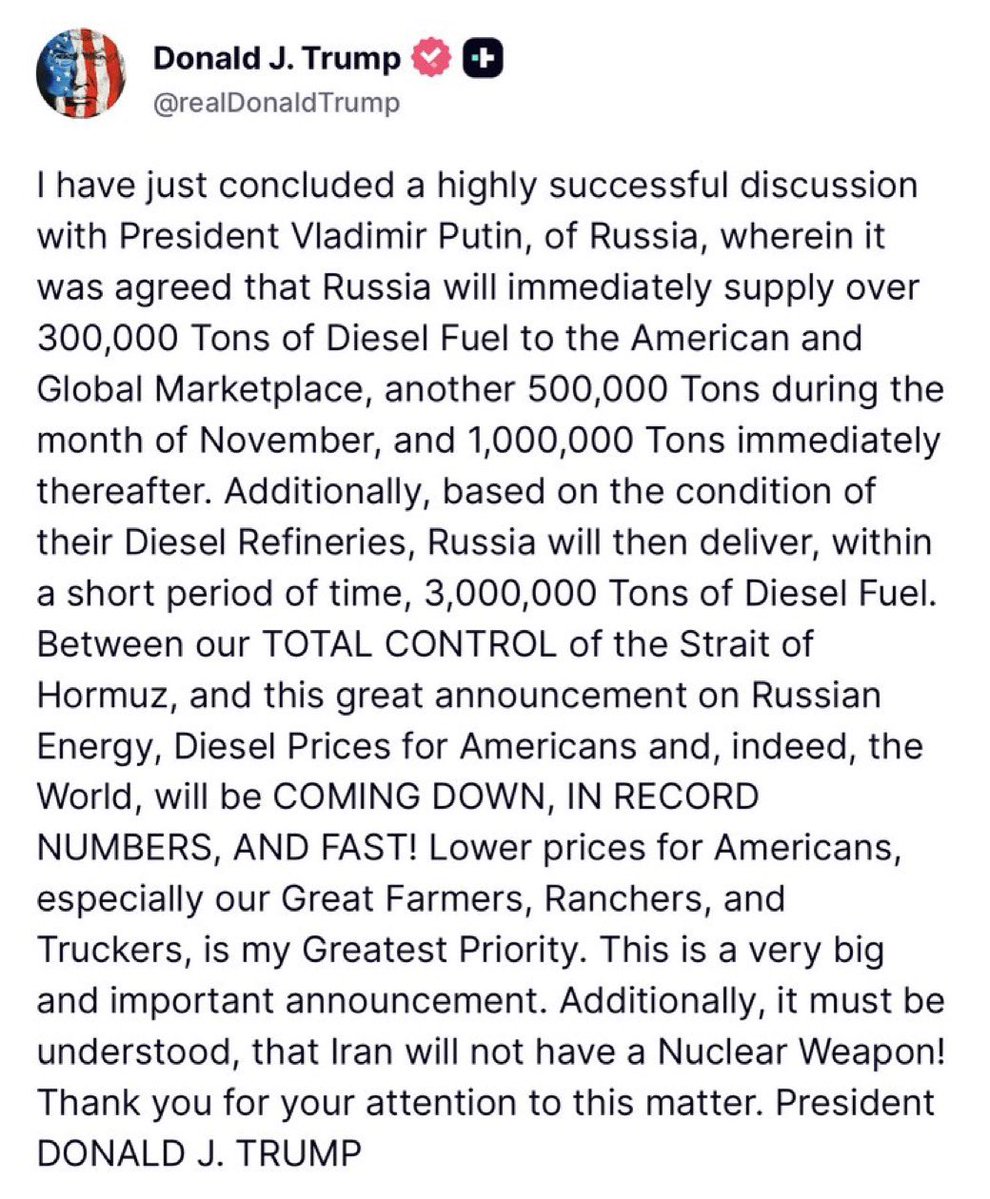
President Donald Trump announced that Russia had agreed to release diesel to the United States and global markets after a phone call with Russian President Vladimir Putin, with planned shipments that could eventually total as much as 4.8 million tons.
The first batch would exceed 300,000 tons, according to Reuters. Trump said Russia would then provide 500,000 tons in November and 1 million tons immediately afterward. A final 3 million tons would follow “within a short period of time,” he said, but only as the condition of Russian refineries allowed.
That distinction matters. The 300,000-plus tons is the immediate tranche, while the larger figure combines several planned deliveries and a final, conditional amount. The announcement describes a supply plan, not completed deliveries.
The sanctions question
The plan marked a sharp change in a relationship constrained by sanctions and the war in Ukraine. The Associated Press reported that the Treasury Department would issue a temporary license allowing Russian diesel onto the global market. AP also reported, citing the U.S. Energy Information Administration, that the United States had not imported Russian oil or gas since 2022, when the Biden administration imposed a ban after Russia’s full-scale invasion of Ukraine.
Trump had signed a broad Russia sanctions law in September. According to AP, that law targets Russian officials, banks and a shadow fleet of tankers, bans new U.S. investment in Russia, and directs the administration to impose tariffs on major buyers of Russian oil or gas.
Just eight days before the call, Putin had said Russia would not supply diesel to world markets until sanctions were lifted. Reuters reported that Russia had extended a ban on diesel exports by producers through the end of October. Putin also said Ukrainian strikes on Russian refineries had partly achieved their objectives and cost Russia 1% of its gross domestic product. Trump tied the final 3 million tons to the condition of those refineries.
What remains unclear
The announcement left important commercial and logistical details unanswered. AP said the White House did not immediately explain who would pay for the fuel, when the first supplies would become available, or whether the November tranche would arrive before the Nov. 3 midterm elections.
Trump presented the arrangement as a way to lower fuel costs for Americans, particularly farmers, ranchers and truckers. That outcome remains an objective rather than an established result. AP, citing AAA, reported that the national average price for diesel was $6.23 a gallon on Oct. 9, after reaching a record $6.52 on Sept. 22.
Russian presidential envoy Kirill Dmitriev called the Putin-Trump conversation successful and said energy cooperation would benefit global markets. His statement shows the Kremlin envoy’s support for the plan. Payment and delivery timing remained unanswered, while Trump made the final 3 million tons conditional on Russian refinery capacity.