Voyager 1 is estimated to have become the first human-made object one light-day from Earth on November 18, 2026. Engadget reports that NASA calculated the crossing for 5:16:07 a.m. Eastern, after more than 49 years in space. That puts the probe about 16 billion miles from home. Source Source
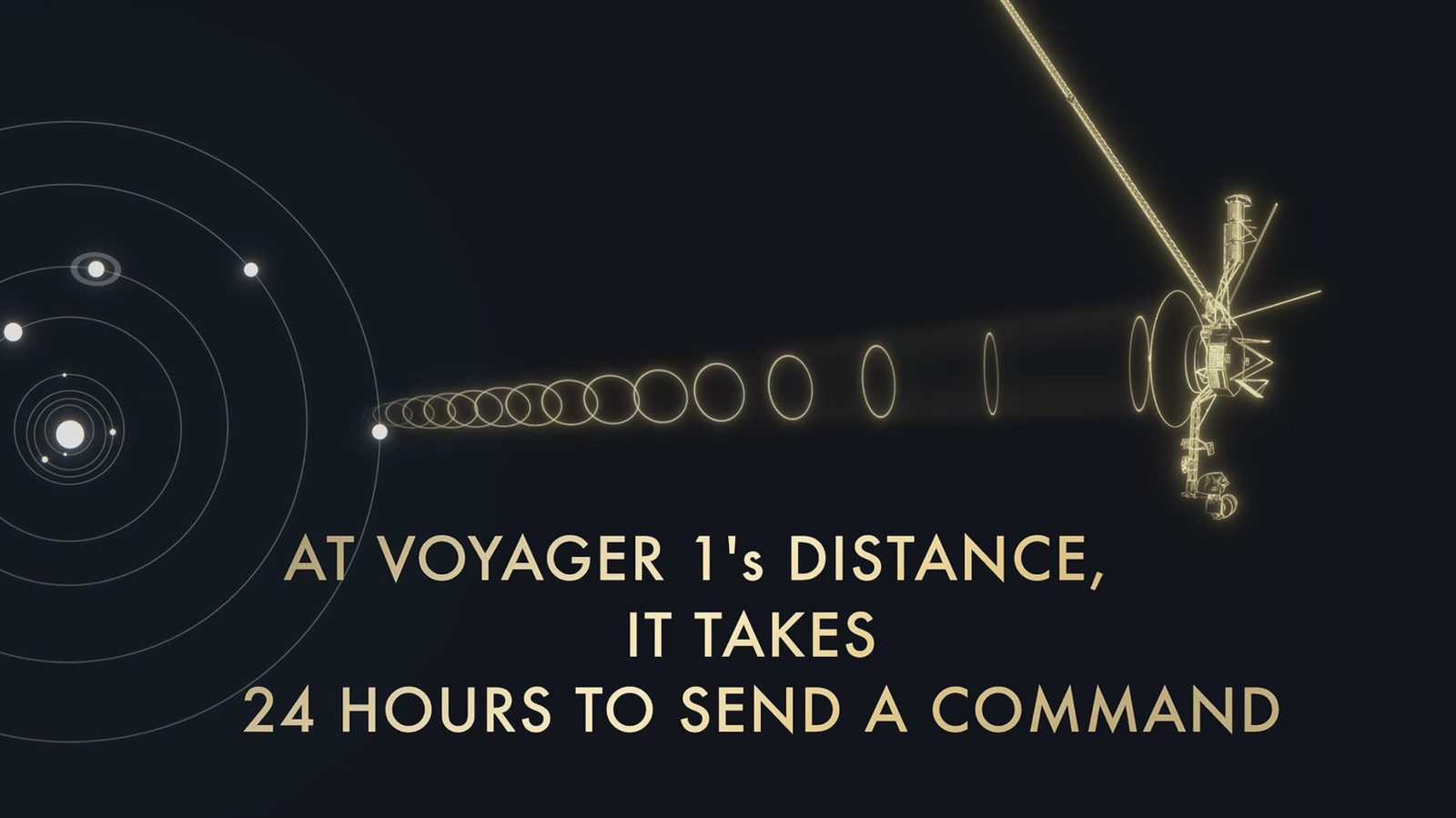
A light-day measures distance: how far light travels in 24 hours, or approximately 25.9 billion kilometers. Radio signals travel at the same speed, so a command to Voyager 1 now needs about a day to arrive. A returning response needs another day, making roughly 48 hours of signal travel alone, before allowing for processing or communications scheduling. Space is unhelpfully large. Source Source Source
Even confirmation of the milestone has to make that trip. Engadget reported that NASA could not confirm the exact crossing time before November 19, when the spacecraft’s message was expected to arrive. Source
Still doing science, not just setting distance records
This marker isn’t Voyager 1’s arrival in interstellar space. It crossed beyond the Sun’s bubble of charged particles in 2012, decades after its September 5, 1977 launch. Source Source
“It’s not a scientific milestone, but it is an engineering milestone,” Caltech senior research scientist Alan Cummings told the Los Angeles Times, calling it “a tribute to the engineers who designed something that can last that long.” Cummings has worked on the mission since before launch. Source
In an interview published November 17, Voyager Project Scientist Linda Spilker told Sky & Telescope that two science instruments remain operational: the magnetometer and plasma wave subsystem. They continue measuring magnetic fields and plasma waves in interstellar space. Receiving those transmissions depends on antenna coverage from NASA’s Deep Space Network. Source
Spilker said the probe loses about four watts of electrical power each year, forcing the team to turn off systems over time. She also recalled engineers rewriting code to work around a damaged chip and restoring readable data in April 2024. Troubleshooting hardware billions of miles away is impressive enough without having to sleep on every reply. Source
Asked when Voyager 1 would stop communicating, Spilker said: “We don't know. It could happen today; it could happen several years from now.” Source





Comments