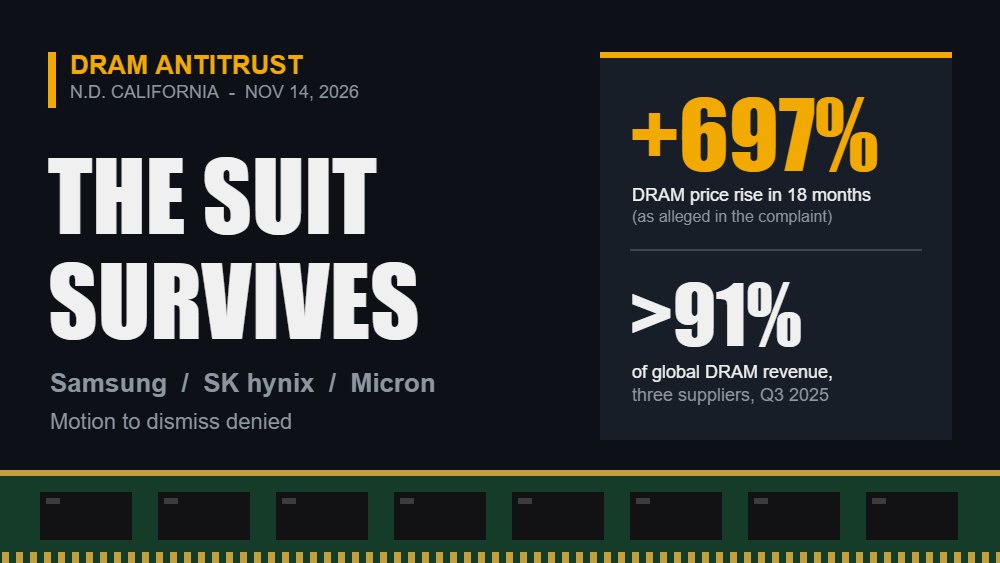
Samsung, Micron and SK hynix have lost their bid to get a proposed DRAM supply-conspiracy class action thrown out. According to LitNews, U.S. District Judge Noël Wise of the Northern District of California denied their joint motion to dismiss in full on November 14, 2026. Source Source
That’s a procedural win for the plaintiffs, not a verdict against the chipmakers. The allegations are accepted as true at this stage and remain unproven. Source
The dispute concerns conventional dynamic random-access memory, or DRAM, used in computers, phones and servers. The complaint, as summarized by LitNews, alleges the companies began cutting production in late 2022 and shifting capacity toward high bandwidth memory, or HBM, for AI accelerators in 2023. The alleged agreement behind those decisions is what the lawsuit seeks to establish. Source
Why the case survived
Similar business decisions don’t automatically establish a conspiracy. In LitNews’s account, Wise examined whether additional alleged conduct supported a plausible inference of a prior agreement rather than competitors independently making similar moves. Source
A pivot to HBM alone “might not be sufficient,” Wise wrote, as quoted by LitNews. The complaint also alleges that all three companies signed long-term HBM supply contracts, while Samsung and SK hynix refused long-term contracts with major conventional DRAM buyers. Source
Wise also weighed Micron’s announced closure of Crucial, its consumer-memory brand, alongside the companies’ alleged failure to expand conventional DRAM capacity despite record prices, according to LitNews. Allegations of near-identical customer-vetting practices added to her reasoning. Source
On customer vetting specifically, the companies offered booming AI demand as a non-conspiratorial explanation. Wise rejected that explanation at this stage because the practices allegedly began after the AI boom and HBM shift were already underway, according to the report. Source
According to LitNews, Wise gave no weight to investor statements about “supply discipline,” conference meetings without specifics about what was exchanged or agreed, or the market’s concentrated structure. Having three dominant manufacturers wasn’t, by itself, a point in the plaintiffs’ favor. Source
At the hearing, the companies invoked a line about competitors watching each other “like hawks.” Wise kept the birds and changed the comparison in a passage quoted by LitNews:
But Plaintiffs’ allegations go beyond hawks watching each other; their contentions are more akin to hawks flying in formation – an activity that hawks ordinarily do not do. Source
What happens next
According to LitNews, the companies must answer the complaint by December 7, 2026. An initial case management conference is scheduled for January 12, 2027. That’s a case-planning date, not a trial date. Source
Whether buyers will receive any relief remains unresolved. A court-calendar update is not a checkout discount. Source





Comments