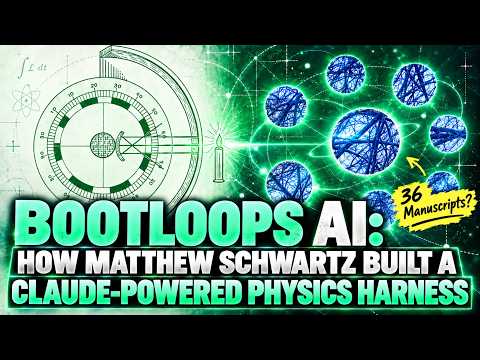
In a guest account published by Anthropic, Schwartz says he used Claude and BootLoops with 19 coauthors to develop 36 manuscripts across 18 fields in three months, after considering roughly 400 candidate problems. Science Magazine described the output as 36 preprints.
Moving methods between fields
The premise is that very different disciplines can share the same mathematical structure. A method developed for particle physics might also help calculate evidence for an evolutionary tree, while techniques from numerical analysis can make other calculations precisely checkable.
Schwartz says the project began with Feynman integrals, the multidimensional calculations used in particle physics. His team completed 30 integrals end to end with BootLoops, including 15 reproductions of known results and 15 that he described as previously uncomputed. The work later spread into ecology, population genetics, linguistics, sunspot research, cosmology and statistics.
Some projects moved beyond the toolkit’s original emphasis on exact calculations. Schwartz reports that one collaboration produced a word-stress database covering 6,072 languages, while another used methods from mathematical physics to analyze billions of pairs of nearby genetic mutations. Those results remain claims from the researchers and their manuscripts, rather than independent confirmation of every conclusion.
Human judgment stayed in the loop
The project’s own account makes the limits unusually clear. Schwartz writes that Claude often found technically correct results that domain experts considered uninteresting. Specialists helped redirect the work toward questions their fields cared about, and the manuscripts were produced with human collaborators rather than by an autonomous system working alone.
Schwartz also warns that automated checks cannot be trusted by themselves. He says researchers still need to inspect plots, challenge conclusions and verify that a claimed solution is actually complete. Several highlighted projects were still undergoing further exploration and verification when he published his account.
That leaves BootLoops as a demonstration of a workflow, not a verdict on the quality of 36 papers. Its central idea is narrower: language models can help carry mathematical techniques across disciplinary boundaries, while people supply the scientific taste, validation and accountability.