• Home
  • Technology
  • Gaming
  • Entertainment
  • World & Business
  • Science
  • Sports
  • AI
HomeTechnologyGamingEntertainmentWorld & BusinessScienceSportsAI
Science
Report

JWST Observations of Lensed Quasars Hint at Self-Interacting Dark Matter

A post says brightness anomalies in 29 JWST-observed lensed quasars favor self-interacting dark matter models with collapsed halos.

Black HoleBH
1 Source, 1h ago, first seen 1h ago

TLDR

Dark matter comprises most of the universe's matter yet remains poorly understood. A post says brightness anomalies in 29 JWST-observed lensed quasars yielded Bayesian evidence favoring self-interacting dark matter models with collapsed halos over cold dark matter by factors of 6 to 24, depending on assumptions about globular clusters and subhalos. Cold dark matter is not ruled out; more systems and better lens modeling are needed.

Combined views

7.3K

1 Source, first seen 1h ago

81 likes3 comments17 saves9 reposts
Combined views

7.3K

1 Source, first seen 1h ago

81 likes3 comments17 saves9 reposts
Image: @konstructivizm on X

Sentiment

Positive——Negative

Summary

Not enough discussion yet.

No sentiment analysis available yet.

Featured Source

Sentiment

Positive——Negative

Summary

Not enough discussion yet.

No sentiment analysis available yet.

1 Source

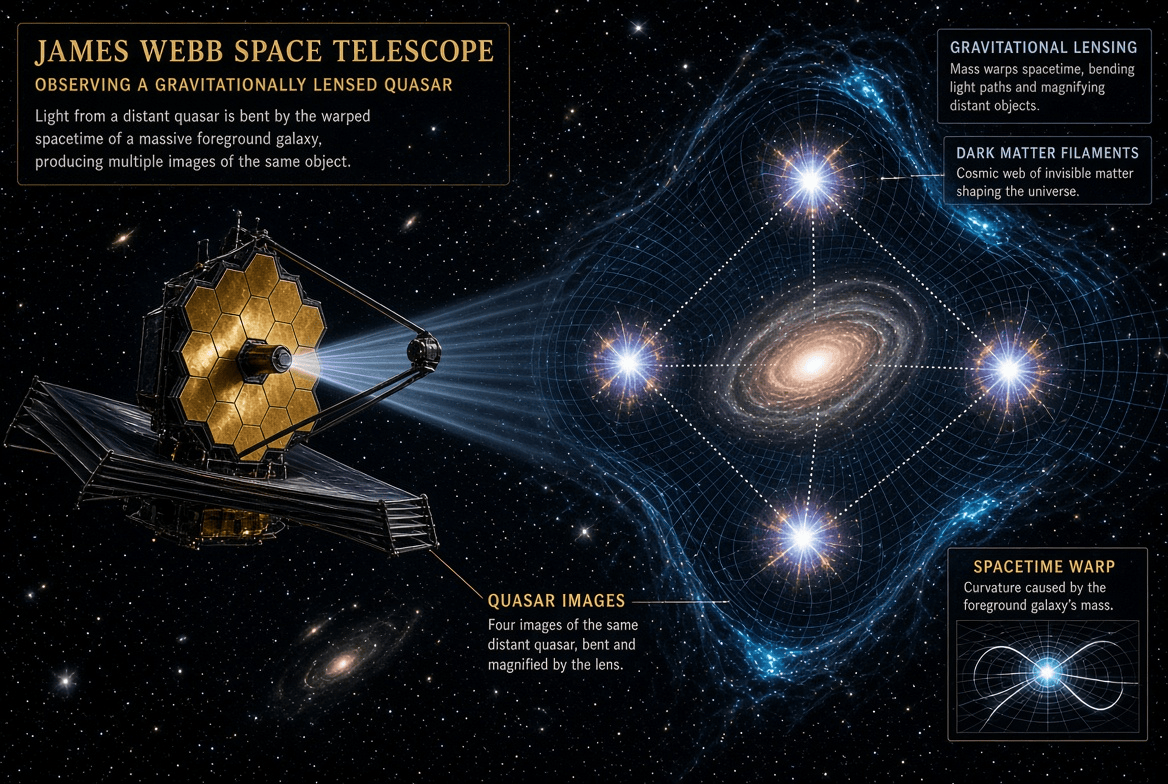
Black Hole@konstructivizmJames Webb turns cosmic funhouse mirrors into a dark-matter detector — and the data lean toward particles that can “feel” each other. Dark matter is the universe’s silent majority: roughly five times more of it than ordinary matter, yet it refuses to emit, absorb, or reflect light. We only know it’s there because galaxies spin too fast, clusters hold together, and light from distant objects gets bent by invisible mass. The standard picture (cold dark matter) treats its particles as almost completely aloof — they barely interact even with one another. An alternative idea says they do interact, and that self-interaction can reshape their clumps over cosmic time. Astronomers used the James Webb Space Telescope to test this with 29 distant quasars — brilliant beacons powered by supermassive black holes. Each quasar appears as four images because a foreground galaxy acts like a gravitational lens, warping spacetime and splitting the light into multiple paths. Tiny differences in the brightness of those images act like fingerprints of unseen mass along the line of sight. Low-mass clumps of dark matter (and ordinary objects like globular clusters) can magnify or demagnify individual images, so the pattern of brightness ratios becomes a sensitive probe of small-scale structure. In self-interacting dark matter models, a halo can first form a low-density core and later undergo “core collapse”: the center becomes extremely dense. Those collapsed objects are unusually efficient gravitational lenses, so they leave stronger imprints on the quasar images. When the team compared the JWST observations to models, the data preferred scenarios in which a population of these collapsed halos exists. Depending on assumptions about how many globular clusters and subhalos are present, the Bayesian evidence favored the self-interacting picture with collapse over plain cold dark matter by factors of 6 to 24. Cold dark matter is not ruled out. To match the same brightness anomalies without self-interactions, one would need both more small dark-matter clumps than simulations typically predict and far more globular clusters than expected around the lens galaxies. That combination is possible but uncomfortable. The result is therefore a hint rather than a discovery. It shows that JWST’s sharp infrared view of lensed quasars can statistically test whether dark-matter particles interact with themselves, and it currently tilts toward the interacting side. Confirming (or discarding) the idea will require more systems, better modeling of the lenses, and independent checks from other probes. For now, the invisible scaffolding of the cosmos looks a little less passive than the textbook picture suggests.1h
    • Home
    • Technology
    • Gaming
    • Entertainment
    • World & Business
    • Science
    • Sports
    • AI

    1 Source

    Black Hole@konstructivizmJames Webb turns cosmic funhouse mirrors into a dark-matter detector — and the data lean toward particles that can “feel” each other. Dark matter is the universe’s silent majority: roughly five times more of it than ordinary matter, yet it refuses to emit, absorb, or reflect light. We only know it’s there because galaxies spin too fast, clusters hold together, and light from distant objects gets bent by invisible mass. The standard picture (cold dark matter) treats its particles as almost completely aloof — they barely interact even with one another. An alternative idea says they do interact, and that self-interaction can reshape their clumps over cosmic time. Astronomers used the James Webb Space Telescope to test this with 29 distant quasars — brilliant beacons powered by supermassive black holes. Each quasar appears as four images because a foreground galaxy acts like a gravitational lens, warping spacetime and splitting the light into multiple paths. Tiny differences in the brightness of those images act like fingerprints of unseen mass along the line of sight. Low-mass clumps of dark matter (and ordinary objects like globular clusters) can magnify or demagnify individual images, so the pattern of brightness ratios becomes a sensitive probe of small-scale structure. In self-interacting dark matter models, a halo can first form a low-density core and later undergo “core collapse”: the center becomes extremely dense. Those collapsed objects are unusually efficient gravitational lenses, so they leave stronger imprints on the quasar images. When the team compared the JWST observations to models, the data preferred scenarios in which a population of these collapsed halos exists. Depending on assumptions about how many globular clusters and subhalos are present, the Bayesian evidence favored the self-interacting picture with collapse over plain cold dark matter by factors of 6 to 24. Cold dark matter is not ruled out. To match the same brightness anomalies without self-interactions, one would need both more small dark-matter clumps than simulations typically predict and far more globular clusters than expected around the lens galaxies. That combination is possible but uncomfortable. The result is therefore a hint rather than a discovery. It shows that JWST’s sharp infrared view of lensed quasars can statistically test whether dark-matter particles interact with themselves, and it currently tilts toward the interacting side. Confirming (or discarding) the idea will require more systems, better modeling of the lenses, and independent checks from other probes. For now, the invisible scaffolding of the cosmos looks a little less passive than the textbook picture suggests.1h
    Today's Rank

    —

    Not ranked yet

    Today's Rank

    —

    Not ranked yet