NASA's Goddard Space Flight Center released the narrated visualization in February 2025, even though the video is making another trip around social media now. Called Perpetual Ocean 2: Western Boundary Currents, it turns a model of ocean circulation into a moving, three-dimensional map of some of the planet's strongest flows.
The animation is based on output from ECCO-2, part of NASA's Estimating the Circulation and Climate of the Ocean project. The model incorporates observations from spacecraft, buoys and other in-situ measurements. The sequence covers model output from 2021 through 2023, so it is a scientific visualization of a defined period rather than a live view of today's ocean.
Turning model output into motion
The visualization releases virtual particles into ECCO-2's three-dimensional velocity field, then gives each particle a trail so viewers can follow its direction. Particles initialized above 600 meters carry three-day trails, while those starting deeper carry six-day trails.
In the primary "beauty" version, flows from the surface down to 600 meters appear white. Deeper flows use blue, cyan and white. That color split makes it easier to see how surface circulation connects with movement below it without suggesting that the ocean itself has those colors.
NASA's earlier Perpetual Ocean animation, published in 2011, showed only surface currents. The sequel's use of the full 3D velocity field is what lets it reveal strong currents below the surface.
Three major current systems
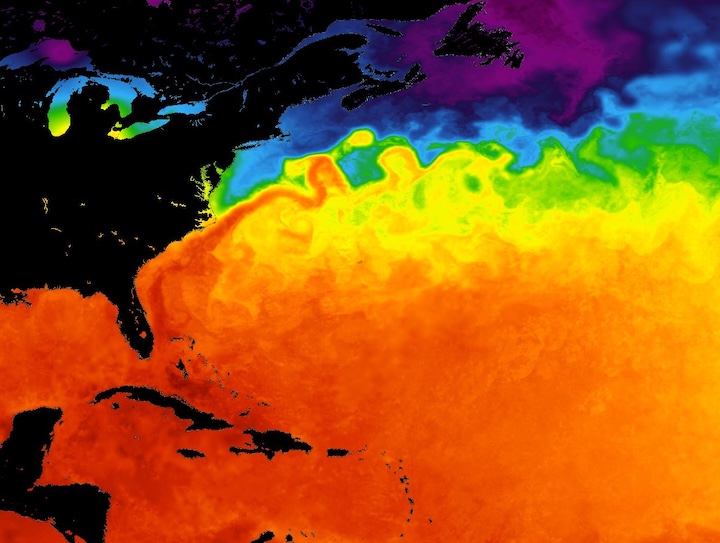
The camera visits the Kuroshio off Japan, the Agulhas Current near southern Africa and the Gulf Stream along eastern North America. These are western boundary currents, narrow, fast-moving systems found on the western sides of ocean basins.
The visualization also shows how meanders can spin off into eddies. Near southern Africa, warm and salty Agulhas rings can separate from the current and travel across the South Atlantic for more than two years. In the North Atlantic, NASA says the Gulf Stream can reach surface speeds of up to 2.5 meters per second, while a colder return flow below roughly 500 meters moves southward.
The point is not only to make circulation look dramatic. NASA says models such as ECCO-2 help scientists study the characteristics of major currents and how heat moves through the global ocean.