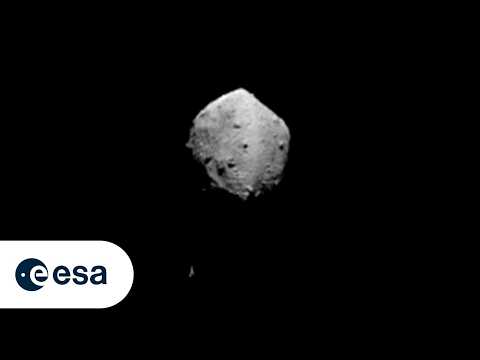
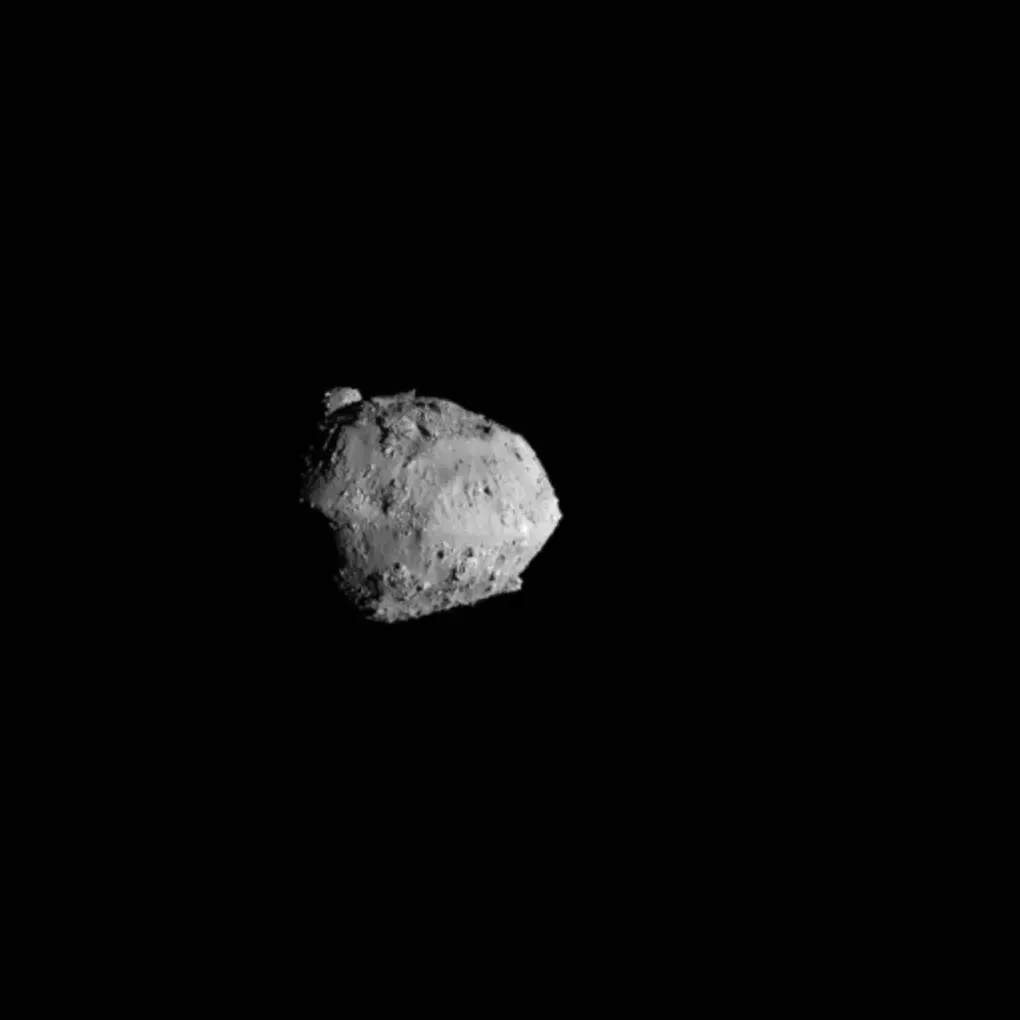
The European Space Agency’s Hera spacecraft is surveying asteroid Didymos from just 28.5 km away, combining visible-light, multispectral and thermal infrared observations to investigate its surface, composition and temperature. ESA described the views in a November 17, 2026 update. SourceSource
According to ESA, Didymos’ smaller companion, Dimorphos, is almost entirely in shadow in these images, with only a small speck caught in sunlight. Yet the entire moonlet appears in the thermal infrared view. So much for staying off-camera with the lights out. Source
Hera will investigate how NASA’s DART impact changed Dimorphos, helping researchers better understand asteroid deflection as a planetary-defence technique. Source
Three instruments, three different jobs
ESA describes Didymos as dominated by a prominent equatorial ridge. Source
- Asteroid Framing Camera: Used for navigation and science, it captured the published monochrome image at approximately 2.7 metres per pixel. Source
- HyperScout H: It measures reflected sunlight in 25 spectral hues, spanning visible red through near-infrared wavelengths that human eyes cannot see. Researchers can compare those measurements with laboratory measurements of meteorites and minerals to investigate the asteroid’s composition. Source
- Thermal Infrared Imager, or TIRI: Supplied and operated by the Japan Aerospace Exploration Agency, it detects thermal infrared radiation. ESA says tracking temperatures across Dimorphos over time can help distinguish solid, porous or broken rock from loose material, down to dust. It also supplies that view of the shadowed moonlet. Source
This isn’t just the same asteroid with three different filters slapped on it.
Following up on DART
ESA gives the larger body’s diameter as 780 metres and its orbiting moonlet’s as 151 metres. DART struck Dimorphos, not Didymos, on September 26, 2022. The collision shortened the moonlet’s orbital period around Didymos by about 33 minutes, according to ESA. Source
Hera will investigate whether the impact left a crater or reshaped the whole body. It will also examine Dimorphos’ precise makeup, structure and mass. Source
ESA plans a closer investigation over the coming months, including deploying two small CubeSats for additional surveying. Source
ESA had already reported Hera’s arrival at the system and the start of its initial survey phase by November 11. The agency plans to unveil detailed images of both asteroids on November 25. SourceSource




Comments