• Home
  • Technology
  • Gaming
  • Entertainment
  • World & Business
  • Science
  • Sports
  • AI
HomeTechnologyGamingEntertainmentWorld & BusinessScienceSportsAI
Science
Announcement

Webb reveals stars of different ages in a dusty nebula

NASA says infrared light let Webb peer through the nebula’s dust, helping scientists study how stars change over time.

World and ScienceWA
NASANA
SVSV
4 Sources, 4h ago, first seen 4h ago

TLDR

NASA says its Webb telescope used infrared light to peer through dust in a nebula, revealing many stars of different ages. The agency says the view helps it study how stars change over time.

Combined views

146.5K

4 Sources, first seen 4h ago

1.2K likes70 comments71 saves234 reposts

Combined views

146.5K

4 Sources, first seen 4h ago

1.2K likes70 comments71 saves234 reposts
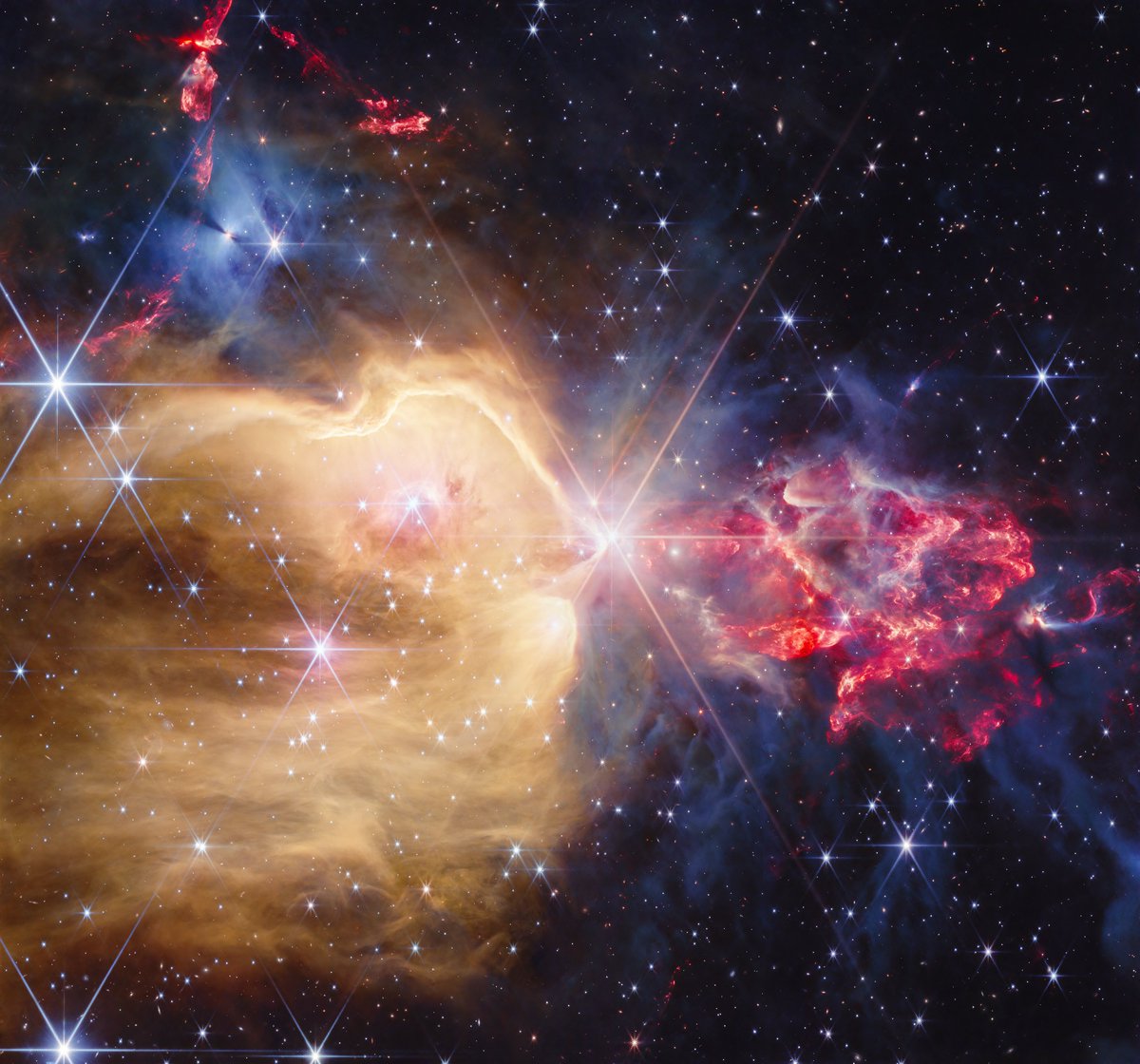
A young star cluster filled with many stars that display Webb’s unique eight-pronged diffraction pattern. At its center is a yellow star which sports the largest diffraction pattern. To the left of the star, there is a region filled with yellow dust and gas. This yellow region extends from the bottom, covering about two-thirds of the image. The yellow region has several blue stars of different sizes embedded within. The top third, which lies outside of the yellow region, holds a few bright protostars, within dense gray gas. Those stars illuminate the gas, making it appear blue. A few red outflows from other protostars are visible above this grayish-blue region. To the right of the central star, there is a clumpy, flame-like plume of red dust and gas with protostars that emit a soft white light within. The plume is surrounded by more dense gray gas and dust.

NASA's new Webb image turns one dusty stellar nursery into a snapshot of several stages of star formation. NGC 7129 lies about 3,300 light-years from Earth, and its clouds of gas and dust hide many young objects from telescopes that cannot see infrared light. Webb's infrared sensitivity cuts through much of that material, bringing stars and protostars into view together.

Featured Source

A nursery at several stages

The most prominent object near the center is LkHα 234, which NASA describes as the most massive and mature star in the scene. It is a pre-main-sequence star, meaning it has mostly finished gathering material but has not yet begun the stable hydrogen fusion that powers stars such as the sun. NASA estimates its mass at roughly five to eight times that of the sun.

To the star's left, a gold-colored cavity stretches about 3.5 light-years. Outflows from an earlier stage of LkHα 234's development helped carve into the surrounding molecular cloud, while the star's radiation energizes the gas. Some hydrogen has been pushed away, but some has also been compressed, creating conditions that can support more star formation.

The red, clumpy region to the right contains much younger protostars. These objects are still accumulating material, and they eject hot outflows that crash into the dense gas around them. Those shocks produce the textured red glow seen in the processed infrared image. In the upper-left portion of the scene, another protostar sits inside a disk whose shadow falls across a blue nebula.

What the colors reveal

The image's colors map different physical conditions rather than showing what human eyes would see. Hot atomic hydrogen appears gold. Cooler molecular hydrogen shocked by protostellar outflows is represented in red, while the coldest, densest gas, where stars have not yet formed, appears gray.

That contrast lets astronomers examine how young stars reshape the clouds that made them. Radiation, winds and outflows can disperse gas, compress nearby material and alter the chemistry at the boundary between warmer atomic hydrogen and colder molecular gas.

Webb also resolves finer filaments of gas and dust than NASA's retired Spitzer Space Telescope did in its view of the same region, while exposing many more background galaxies. NASA says researchers will use the Webb data to study how stars at different stages influence their surroundings and how the molecular cloud may erode over millions of years.

Sentiment

Positive——Negative

Summary

Not enough discussion yet.

No sentiment analysis available yet.

Useful links

HubbleWebbESA · YouTube

Zoom video: NGC 7129

Space Telescope Science Institute · YouTube

Webb: Transforming Our Understanding of Star Formation

Sentiment

Positive——Negative

Summary

Not enough discussion yet.

No sentiment analysis available yet.

Related Videos

  • Zoom video: NGC 7129HubbleWebbESA · YouTube
  • Webb: Transforming Our Understanding of Star FormationSpace Telescope Science Institute · YouTube

Related Videos

  • Zoom video: NGC 7129HubbleWebbESA · YouTube
  • Webb: Transforming Our Understanding of Star FormationSpace Telescope Science Institute · YouTube

Related

Webb identified the host galaxy of the most distant fast radio burst yet

NASA says the James Webb Space Telescope found an actively star-forming dwarf galaxy 1,000 times less massive than expected.

A field full of small galaxies of all shapes against the blackness of space. A few bright white stars show 8 prominent diffraction spikes. A small galaxy at lower right is highlighted with a white box. A shaded triangle extends upward to the corners of a larger box showing a zoom in of the region. Two fuzzy, light blue blobs are at center, with a larger and brighter one at top. Just above the top blob is a white crosshair showing the location where a fast radio burst was detected.
NASA Webb teases a new image in World Space Week post

NASA Webb said in an X post for World Space Week that people searching for space facts might come across the telescope’s newest image, but the post itself did not include details about the image.

A young star cluster filled with many stars that display Webb’s unique eight-pronged diffraction pattern. At its center is a yellow star which sports the largest diffraction pattern. To the left of the star, there is a region filled with yellow dust and gas that extends from the star to the left border of the image. This yellow region extends from the bottom, covering about two-thirds of the image. The yellow region has several blue stars of different sizes embedded within. The top third, which lies outside of the yellow region, holds a few bright protostars, within dense gray gas. Those stars illuminate the gas, making it appear blue. A few red outflows from other protostars are visible above this grayish-blue region. To the right of the central star, there is a clumpy, flame-like plume of red dust and gas with protostars that emit a soft white light within. The plume is surrounded by more dense gray gas and dust. 

Image credit: NASA, ESA, CSA, STScI, Processing: Alyssa Pagan.
Webb study of rare extreme debris disks points to two kinds of planet-shattering collisions

Webb and Spitzer observations of 21 rare extreme debris disks found silica-rich and silica-poor groups that may reflect different collision energies in young stellar systems.

Artist’s concept of a star and its debris disk against the black background of space. The star is in the background, right of center, and depicted as a small, luminous sphere. The debris disk is a large blue ring that encircles the star. The debris disk is angled toward the viewer, so that the portion nearest to the viewer extends beyond the bottom frame of the illustration. Many dark, rocky fragments are scattered throughout the debris disk. In the foreground, toward the left, is a small planetary embryo colliding into the left side of a larger spherical object. The impact site glows bright yellow and orange and has a mottled appearance, as though chunks of both colliding bodies are breaking up and being destroyed. Orange-yellow streams of vapor extend outward from the collision area. Behind the debris disk and its star are many small stars in the background. A label in the bottom right corner reads “Artist’s Concept.”

5 Sources

NASA ScienceNASA's Webb Captures Commotion From Nebula’s Stellar Jets - NASA Science3d
World and Science@WorldAndScienceMesmerizing! The “Jewel Bug” nebula, NGC 7027, quietly lost mass in a sphere for centuries, but just revealed a cloverleaf design. Credit: NASA, ESA, and J. Kastner (RIT)4h
NASA@NASABrewing up baby stars ⭐ @NASAWebb used infrared light to peer through the dust in this nebula, revealing many stars of different ages. This helps us study how stars change over time.1h
SV@TweetVolcano@NASA @NASAWebb baby stars hiding behind all that dust and Webb just shows up with infrared like we see you. love this1m
    • Home
    • Technology
    • Gaming
    • Entertainment
    • World & Business
    • Science
    • Sports
    • AI
    NASA Webb Telescope

    5 Sources

    NASA ScienceNASA's Webb Captures Commotion From Nebula’s Stellar Jets - NASA Science3d
    World and Science@WorldAndScienceMesmerizing! The “Jewel Bug” nebula, NGC 7027, quietly lost mass in a sphere for centuries, but just revealed a cloverleaf design. Credit: NASA, ESA, and J. Kastner (RIT)4h
    NASA@NASABrewing up baby stars ⭐ @NASAWebb used infrared light to peer through the dust in this nebula, revealing many stars of different ages. This helps us study how stars change over time.1h
    SV@TweetVolcano@NASA @NASAWebb baby stars hiding behind all that dust and Webb just shows up with infrared like we see you. love this1m
    Today's Rank

    #3

    Today's Rank

    #3