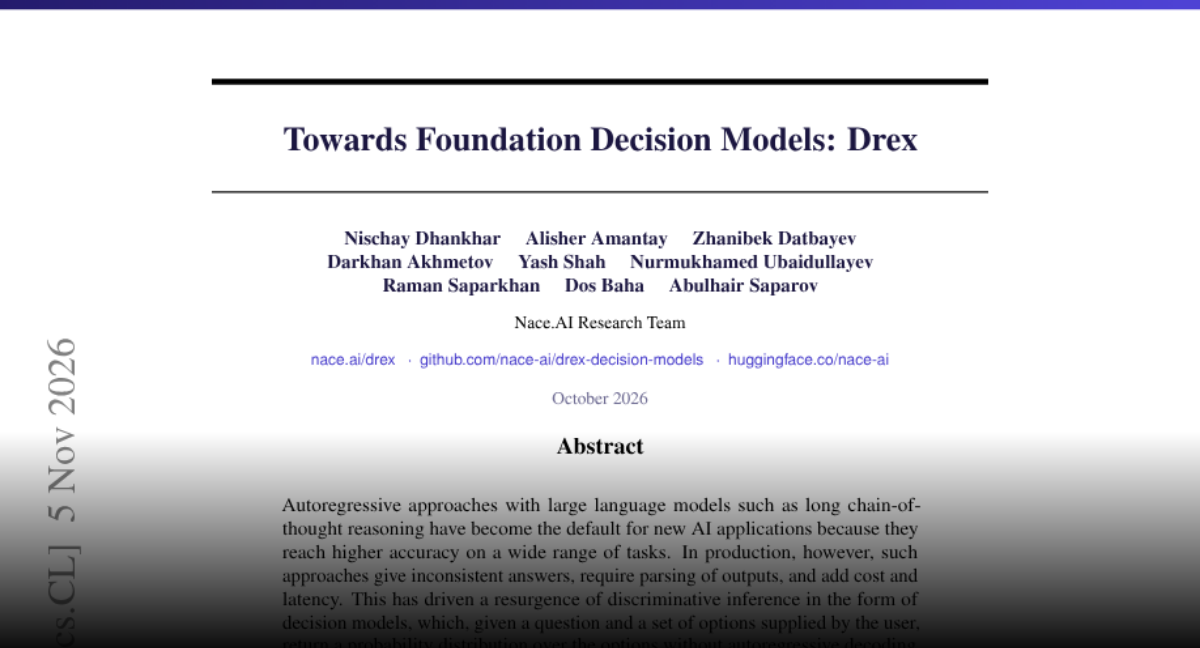
The approach, as @omarsar0 describes it, starts with a document, a record or an agent's context, plus questions with a fixed set of options. Rather than writing an answer, the model returns a probability for each option.
The same post lists four model sizes: 8 billion parameters, 9 billion, 35 billion with 3 billion active, and 27 billion. It identifies the 27-billion-parameter version as Max.
What the reported performance figures show
@omarsar0 puts Max within 1.6 points of Claude Opus 5.5 on Decision Bench v4, with answers in 183 milliseconds versus 3.5 seconds. The post gives no hardware, serving configuration or workload details for that latency comparison, so those figures do not establish a general speed advantage.
On the separate Decision Index 0.4.1 suite, @omarsar0 reports a score of 67.52 for Max, compared with 60.70 for Jev 1.14.0.
Both authors also report a tie with GPT-6 Sol on Decision Bench v4 and the highest accuracy among decision models on DecideBench. @omarsar0 calls the Decision Bench v4 tie statistical and also names d3-turbo; @arankomatsuzaki's post does not include those details. Neither post provides the underlying benchmark tables or evaluation methods.