• Home
  • Technology
  • Gaming
  • Entertainment
  • World & Business
  • Science
  • Sports
  • AI
HomeTechnologyGamingEntertainmentWorld & BusinessScienceSportsAI
World & Business
Report

China Passenger-Vehicle Retail Sales Fall 24% in September

CPCA's preliminary figures also show a 10% monthly rebound and new-energy vehicles reaching 67.1% of retail volume.

BloombergBL
Alexander Stahel 🌻AS
2 Sources, 4h ago, first seen 4h ago

TLDR

CPCA counted 1.702 million retail sales, down 24% from a year earlier but up 10% from August. New-energy vehicle retail sales fell 12% year over year to 1.141 million, rose 14% month over month, and made up 67.1% of the market. CPCA said an unusually high September 2025 base amplified the annual drop.

Combined views

80.3K

2 Sources, first seen 4h ago

455 likes3 comments164 saves76 reposts

Combined views

80.3K

2 Sources, first seen 4h ago

455 likes3 comments164 saves76 reposts

China's passenger-vehicle retail sales reached 1.702 million in September, down 24% from a year earlier, according to preliminary figures from the China Passenger Car Association.

Featured Source

The annual comparison was severe, but it was not the only direction in the data. Retail volume increased 10% from August. For the first nine months of 2026, sales totaled 13.418 million, 21% below the same period last year.

New-energy vehicles gained share

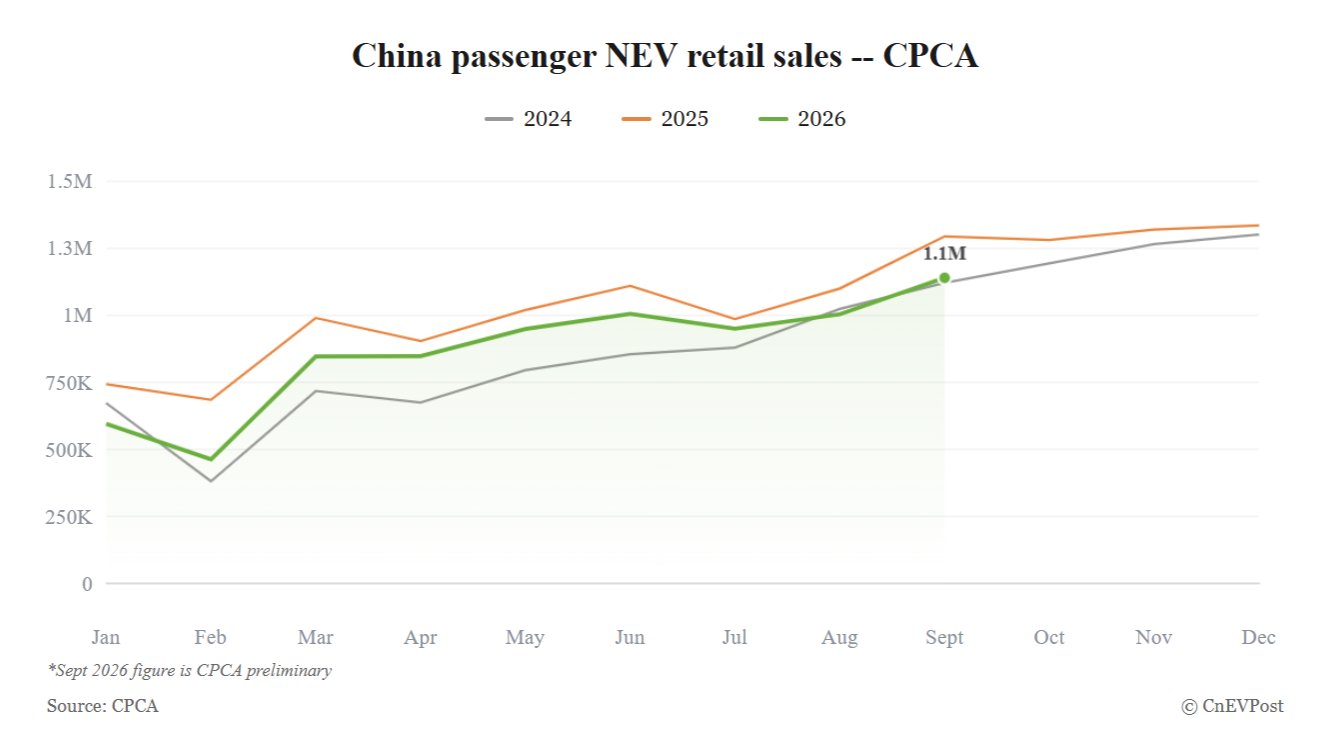
Retail sales of new-energy vehicles, a category that includes battery-electric cars and plug-in hybrids, totaled 1.141 million in September. That was down 12% year over year but up 14% from August.

New-energy vehicles accounted for 67.1% of passenger-vehicle retail sales during the month, the association said. January-through-September retail sales in the category reached 7.816 million, also down 12% from a year earlier.

The wholesale numbers were stronger than the retail comparison. Automakers wholesaled 2.528 million passenger vehicles in September, down 10% year over year and up 7% from August. New-energy vehicle wholesale volume rose 11% on both comparisons to 1.672 million.

Those figures separate factory shipments from sales to consumers. They also show why the 24% retail drop does not describe every part of the market in the same way.

A difficult comparison with last year

The association said September 2025 set an unusually high base because buyers in some regions rushed to make purchases before local subsidies stopped. It also pointed to holiday timing and the shorter final reporting week as factors affecting this year's comparison.

At the same time, CPCA said local consumption measures, manufacturer promotions, and newly launched models supported September demand. It described this year's market as a contest for existing buyers, with most incremental demand flowing to new-energy vehicles while gasoline-car demand remained weak.

Bloomberg's report on the data highlighted the same 24% annual retail decline and 12% drop in new-energy vehicle retail sales. The association's month-over-month and market-share figures add an important qualification: September improved from August even as it remained well below last year's unusually strong level.

Sentiment

Positive——Negative

Summary

Not enough discussion yet.

No sentiment analysis available yet.

Useful links

CnEVPost

China's September NEV retail sales fall 12% as month-end surge narrows decline, preliminary CPCA data shows

MarkLines Automotive Industry Portal

CPCA estimates September passenger car retail sales at 1.69 million units

Sentiment

Positive——Negative

Summary

Not enough discussion yet.

No sentiment analysis available yet.

Useful Links

CnEVPost

China's September NEV retail sales fall 12% as month-end surge narrows decline, preliminary CPCA data shows

MarkLines Automotive Industry Portal

CPCA estimates September passenger car retail sales at 1.69 million units

Useful Links

CnEVPost

China's September NEV retail sales fall 12% as month-end surge narrows decline, preliminary CPCA data shows

MarkLines Automotive Industry Portal

CPCA estimates September passenger car retail sales at 1.69 million units

3 Sources

mp.weixin.qq.comhttps://mp.weixin.qq.com/s/AlYQvlEp7ni_3D9zOm3vEw
Bloomberg@businessChina’s passenger vehicle retail sales fell 24% in September from a year earlier, while new-energy vehicle sales dropped 12%. https://www.bloomberg.com/news/articles/2026-10-10/china-passenger-vehicle-retail-sales-drop-24-in-september?taid=6aca17347195f10001afcd0a&utm_campaign=trueanthem&utm_content=business&utm_medium=social&utm_source=twitter4h
Alexander Stahel 🌻@BurggrabenHChina is experiencing a balance sheet recession on a scale the world has never seen before. Economist Richard Koo coined the term to explain Japan’s stagnation in the 1990s. At its core, it describes a collective shift in economic behaviour: households and companies prioritise repairing their balance sheets over spending, borrowing and investing, even at near-zero interest rates. The result is chronically weak aggregate demand, against which conventional monetary policy loses much of its effectiveness. It is not merely a financial problem. It is a profound shift in economic psychology. Deeply structural and profoundly scary. It is also the key reason I don’t buy the copper “supercycle” narrative. China accounts for roughly 50% of global copper consumption, much of it historically tied to construction and infrastructure. Nothing can compensate for a structural collapse in that demand. Not even close. Nor can the West afford the much-advertised “green transition” at the scale and speed promised. By now, much of it has become a face-saving exercise for bureaucrats in Brussels, increasingly divorced from economic and fiscal reality. It won’t survive the rebellion in government bond markets, already visible in French sovereign debt. In that sense, many European governments face their own balance sheet constraints, although these are not balance sheet recessions in Koo’s original sense. When the AI mania finally slows, copper, among others, will nosedive. For now, the scramble to front-run US tariffs and the speculative demand it generates keep the mirage alive. It won’t last forever.2h
    • Home
    • Technology
    • Gaming
    • Entertainment
    • World & Business
    • Science
    • Sports
    • AI
    China

    3 Sources

    mp.weixin.qq.comhttps://mp.weixin.qq.com/s/AlYQvlEp7ni_3D9zOm3vEw
    Bloomberg@businessChina’s passenger vehicle retail sales fell 24% in September from a year earlier, while new-energy vehicle sales dropped 12%. https://www.bloomberg.com/news/articles/2026-10-10/china-passenger-vehicle-retail-sales-drop-24-in-september?taid=6aca17347195f10001afcd0a&utm_campaign=trueanthem&utm_content=business&utm_medium=social&utm_source=twitter4h
    Alexander Stahel 🌻@BurggrabenHChina is experiencing a balance sheet recession on a scale the world has never seen before. Economist Richard Koo coined the term to explain Japan’s stagnation in the 1990s. At its core, it describes a collective shift in economic behaviour: households and companies prioritise repairing their balance sheets over spending, borrowing and investing, even at near-zero interest rates. The result is chronically weak aggregate demand, against which conventional monetary policy loses much of its effectiveness. It is not merely a financial problem. It is a profound shift in economic psychology. Deeply structural and profoundly scary. It is also the key reason I don’t buy the copper “supercycle” narrative. China accounts for roughly 50% of global copper consumption, much of it historically tied to construction and infrastructure. Nothing can compensate for a structural collapse in that demand. Not even close. Nor can the West afford the much-advertised “green transition” at the scale and speed promised. By now, much of it has become a face-saving exercise for bureaucrats in Brussels, increasingly divorced from economic and fiscal reality. It won’t survive the rebellion in government bond markets, already visible in French sovereign debt. In that sense, many European governments face their own balance sheet constraints, although these are not balance sheet recessions in Koo’s original sense. When the AI mania finally slows, copper, among others, will nosedive. For now, the scramble to front-run US tariffs and the speculative demand it generates keep the mirage alive. It won’t last forever.2h
    Today's Rank

    #3

    Today's Rank

    #3