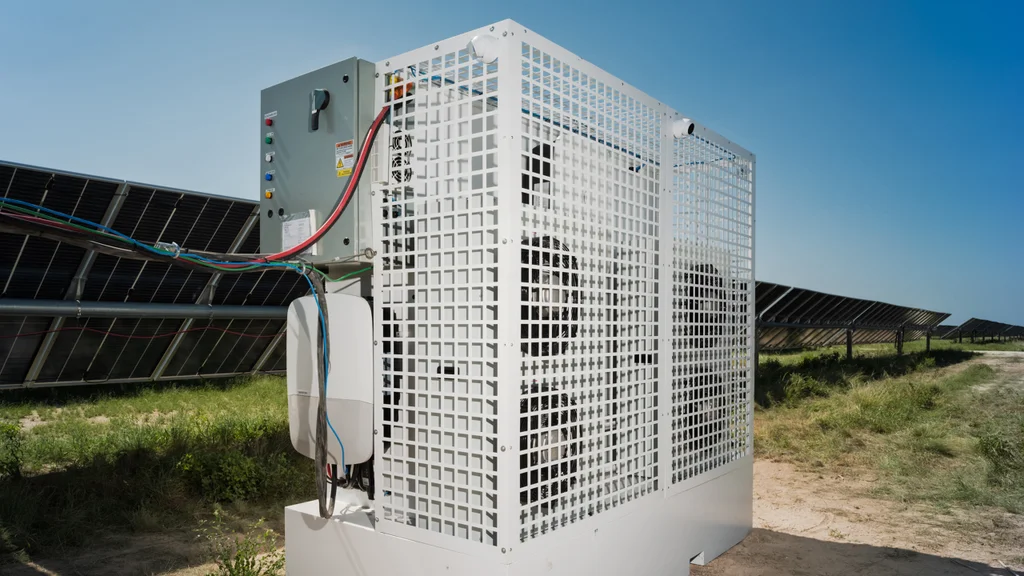
Rune has raised a $40 million Series A led by Spark Capital to expand a different kind of AI infrastructure: small, standardized data centers installed directly at solar farms.
The startup announced the financing on Sept. 16 alongside RELIC, short for Renewable Energy Linked Intelligent Compute. Union Square Ventures, Lowercarbon Capital, Activate Capital, Committed Capital, Timeless Partners and Logos Fund also joined the round, which Rune says brings its total funding to $53.5 million.
Rune’s pitch is to move computing to available power instead of waiting for new power infrastructure to reach a conventional data center. That approach arrives as Berkeley Lab researchers say surging demand from data centers and other large electricity users is contributing to grid-connection bottlenecks across the US.
Compute that sits beside the solar panels
Solar panels produce direct-current electricity. RELIC connects to that DC supply at the generation site, using custom power electronics to deliver the voltage its computers need. Rune says the design removes the need for a conventional grid connection and some of the equipment associated with one, including transformers.
Each 8-by-8-foot module contains servers, cooling equipment and power hardware, according to Fast Company. The company owns and operates the modules, partners with solar farms to use underutilized electricity, then sells the resulting computing capacity. Its initial focus is AI inference, the work a trained model performs when it generates text, images or other outputs.
Rune says RELIC can also absorb solar generation that would otherwise be curtailed, clipped or sold at very low prices. The architecture is a workaround for grid constraints, not an upgrade to the grid itself: the computing equipment is placed beside the power source and consumes electricity there.
A fast deployment claim meets a small installed base
The company says a RELIC unit can be placed with a forklift and installed in 60 minutes, with customer workloads energized in as little as six weeks after a contract is signed. It also claims the system reduces non-compute infrastructure costs by 85 percent compared with a traditional AI data center. Those speed and savings figures come from Rune and have not been independently benchmarked in the sources reviewed for this story.
Rune says its latest installation is operating at a 200 MW solar facility in Texas. That figure refers to the generating capacity of the host solar plant, not the amount of Rune computing equipment at the site. A correction appended to Fast Company’s report says Rune currently has 1 MW of total compute capacity spread across multiple locations in Texas and California.
The startup plans to deploy 100 MW of computing capacity at solar plants over the next year and eventually expand the model to wind farms. The new funding gives Rune room to test whether a manufacturing-style data center can turn underused renewable power into a reliable, repeatable computing business at that much larger scale.