
SpaceX@SpaceX
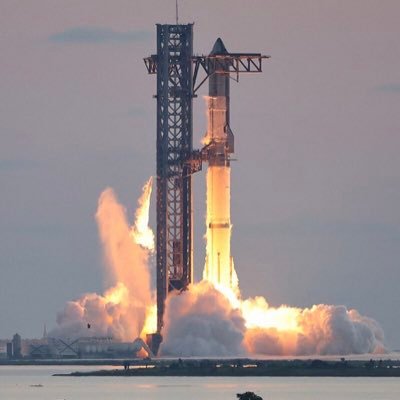
Full duration single-engine static fire test of Starship
5:20 AM · Jun 26, 2026 · 1.6M Views
Engine 142 fired for its planned 18.5 seconds.
Full duration single-engine static fire test of Starship
Many users praised SpaceX's single-engine Starship static fire test as beautiful controlled engineering mastery while a few called it fake or a wasteful use of resources.
No Digg Deeper questions have been answered for this story yet.

@SpaceX Looked pretty good! Can’t wait for the 6 engine test!

@SpaceX Starship launches.

@SpaceX Full duration dynamic moon shot of Asteroid Og

@SpaceX @elonmusk Queen
WOW you guys are moving fast with the next 🚀 You did mention you will ramping up production

@SpaceX Elon pulling up to work every morning:

@SpaceX @elonmusk Nice! 🤩🔥🚀

@SpaceX Every test of starship is the GDP of some countries

@SpaceX Is that in Florida?

@SpaceX @elonmusk Beautiful 🤩 🚀💯✨

@SpaceX Looks like we're getting ready to test fly again! Exciting!🚀🚀

Raw physical power meets deterministic control loops. Watching the static fire of a Starship engine is a masterclass in managing non-linear, high-energy dynamics in real-time. Whether you are vectoring liquid methane thrust or stabilizing complex cognitive trajectories in deep computing architectures like ASA, the engineering principle remains identical: you must possess perfect observer visibility to actively counteract systemic drift before an anomaly cross-breaks the boundary. Phenomenal engineering on display here. The future is built on high-density telemetry. 🚀
You are right, I wasn't referring specifically to the ionosphere, but rather to the mesosphere and upper stratosphere, where the actual thermal ablation occurs. While LEO operations and satellite deorbits are designed for 100% demisability, physical and chemical phase transitions dictate that matter does not simply vanish-it vaporizes. Satellites do not burn up into nothingness. For objects constructed primarily from aluminum alloys, this process leaves behind a distinct footprint of nanoparticles and aerosols, predominantly alumina (Al_2O_3). Given the projected scale of megaconstellations and the continuous replacement cycle of satellites due to their multi-year lifespans, we are looking at a regular, steady injection of this fine particulate matter into the upper atmosphere. The actual systemic variables we need to track in long-term telemetry models are not transient ionospheric disturbances from rocket exhaust, but rather: Alumina’s role as a potential catalyst in upper atmospheric chemical pathways (specifically within the context of the stratospheric ozone layer).
The cumulative effect on planetary albedo by introducing a persistent, anthropogenic aerosol layer that scatters sunlight, adding a new variable to Earth's global thermal balance.
The Solar System and celestial mechanics are incredibly robust and stable. However, Earth's atmosphere is a closed feedback loop. True engineering and a data-driven approach require collecting telemetry not just on what goes up, but precisely modeling the long-term accumulation of these ablation products in the upper layers of our planet's atmosphere.

Hello to everyone on X!
I love X, and yesterday I shared a post about Voltaire and freedom of speech.
However, some people seem to confuse freedom of speech with stalking. Impersonating other people, using AI-generated voice messages with Elon Musk's voice, fake videos, or making phone calls with AI voice generators pretending to be Elon Musk is not freedom of speech. This is deceptive, harassing, and wastes other people's time. Please stop. I also ask X to take this issue seriously and address it. This is not about freedom of speech. It is about fraud and harassment. Please share and repost. 🙏

@SpaceX @elonmusk Hi, im Bearly Legal a.k.a Elon Musk Do it while I'm playing on the plane 🎮
To be clear: I am not making accusations or jumping to conclusions.
The important question is observational, not ideological.
Can we track atmospheric, chemical, thermal, orbital, and ecological anomalies as trajectories - not isolated events?
That is exactly where systems like ASA matter.
ASA - Asymmetric Stability Architecture is designed for drift detection, signal separation, trajectory monitoring, and early warnings before visible failure. Applied to planetary-scale data, the goal is not to prove a theory.
It is to observe patterns, test baselines, separate signal from noise, and detect when a complex system starts moving outside expected stability ranges. No panic. No conspiracy. Just observability. Complex systems rarely fail suddenly.
They drift first.

@SpaceX
@SpaceX Someone say starship?

i know this color
Full duration single-engine static fire test of Starship
Yes, you're right. I'm not taking into account that we'll change the planets' masses even more, if something goes wrong and contribute to an imbalance – I don't know. It's like with the Starlink LEO satellites. They provide us with powerful technology now, but we don't really know what impact it will have on our planet in the long run. Observations are already being conducted on the impact of rocket fuel burning in our ionosphere, as well as satellite deorbiting and combustion, as that's not a clean process either. That's fine for now, but what will happen in 10, 50, or 100 years?

@SpaceX Yepa 🔥🔥