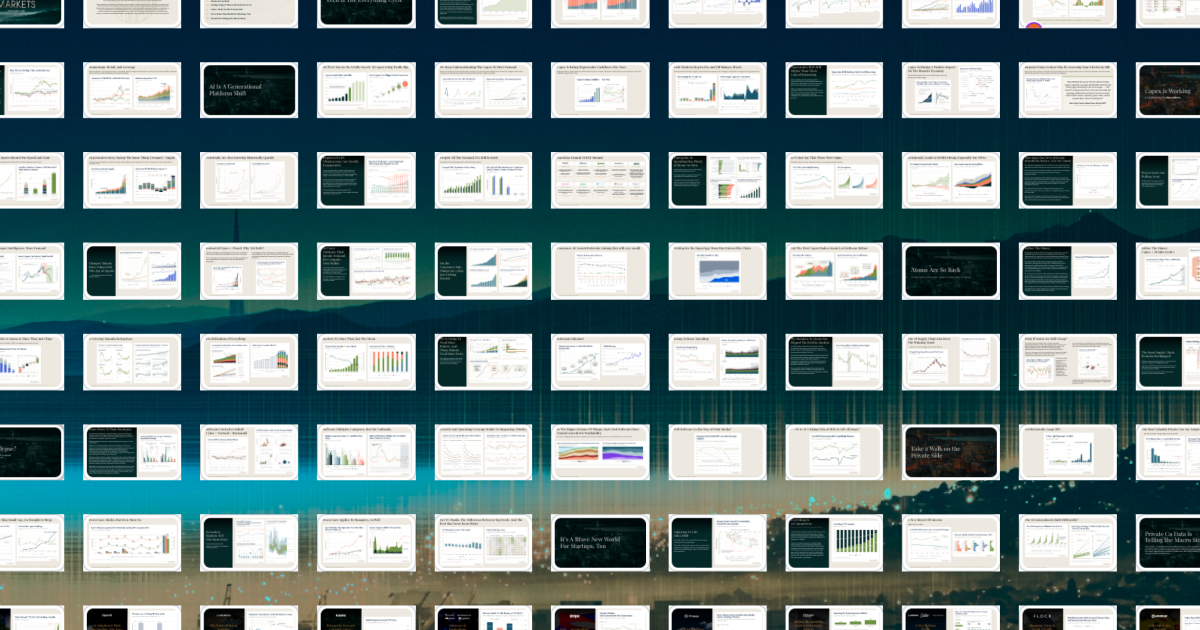
Andreessen Horowitz on Sept. 30 released the second edition of its State of Markets report and paired it with a companion video in which David George, Sarah Wang, Alex Immerman, and Santiago Rodriguez unpack 25 charts from the presentation.
The report’s central argument is that the current AI cycle is still being defined by buildout. In a16z’s telling, the biggest shift in markets is not just software demand but a rotation toward hardware and physical infrastructure, with capital moving into semiconductors, power, networking, robotics, manufacturing, and defense.
That theme shows up in one of the rollout’s most pointed lines: a16z summarized the trend as Big Tech’s profits becoming chipmakers’ profits. In the written report, the firm says historically large profits at the world’s biggest tech companies have funded the surge in demand for semiconductors and related infrastructure, with debt increasingly helping finance that spending as well.
The companion video description says hyperscaler CapEx is approaching $1 trillion annually. The written report also says demand for compute is still outpacing supply, arguing that AI infrastructure demand remains strong enough that older GPUs have continued to hold value rather than rapidly fading into obsolescence.
At the same time, a16z argues that adoption is still relatively shallow compared with the scale of the buildout. The report says nearly 30% of S&P 500 companies report some quantifiable AI impact, but only about 2% report any tracked metric. On the consumer side, it says that as of April, barely about 2% of U.S. households were paying for some AI service.
George emphasized that unevenness in posts tied to the release. He wrote that median AI vendor spending in the top 1% of companies is eight times that of the top 10%, and a16z said in a separate post that the top 1% of AI spenders are spending more than 600 times as much as the median company.
Taken together, the report and accompanying commentary make the case that the AI economy is still early in turning experimentation into broad, measurable use. a16z’s broader thesis is that demand could expand further as adoption matures across enterprise and consumer markets and extends into areas including robotics, biotech, health, autonomy, and what George described as enterprise diffusion.