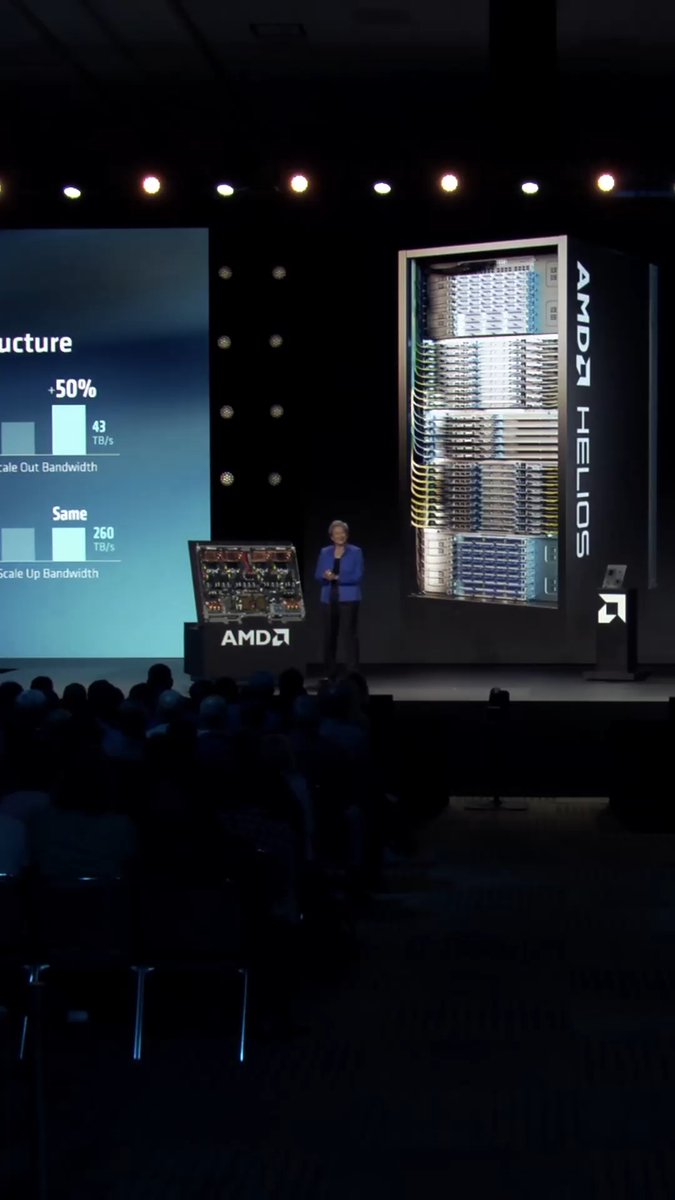
AMD is promoting Helios as a single-rack AI system that combines 72 Instinct MI455X accelerators, more than 18,000 CDNA 5 GPU compute units and 4,600 Zen 6 CPU cores.
The company also lists 31TB of HBM4 memory for the rack. Those figures describe the combined resources across the system, not 18,000 individual GPUs.
A shared 72-GPU compute domain
Each Instinct MI455X contains 432GB of HBM4 memory and offers up to 23.3TB/s of memory bandwidth, according to AMD. Helios connects 72 of those accelerators through an all-to-all UALoE fabric, allowing any GPU to communicate with another in a single hop.
That architecture is designed to keep large model weights, context windows and inference caches close to the accelerators while reducing the cost of moving data across the rack. AMD also uses a chiplet design that separates compute, cache, memory and I/O functions across specialized dies.
The scale claim still needs workload results
AMD positions Helios for training and serving large AI models, including agentic systems that need substantial memory and fast communication between accelerators. The company says its CDNA 5 architecture adds lower-precision data types and data-movement features intended to improve throughput and efficiency.
The published specifications establish the system's capacity and topology, but they do not by themselves show how Helios will perform on a customer's model, software stack or power budget. Those comparisons will depend on production systems and workload-level testing.