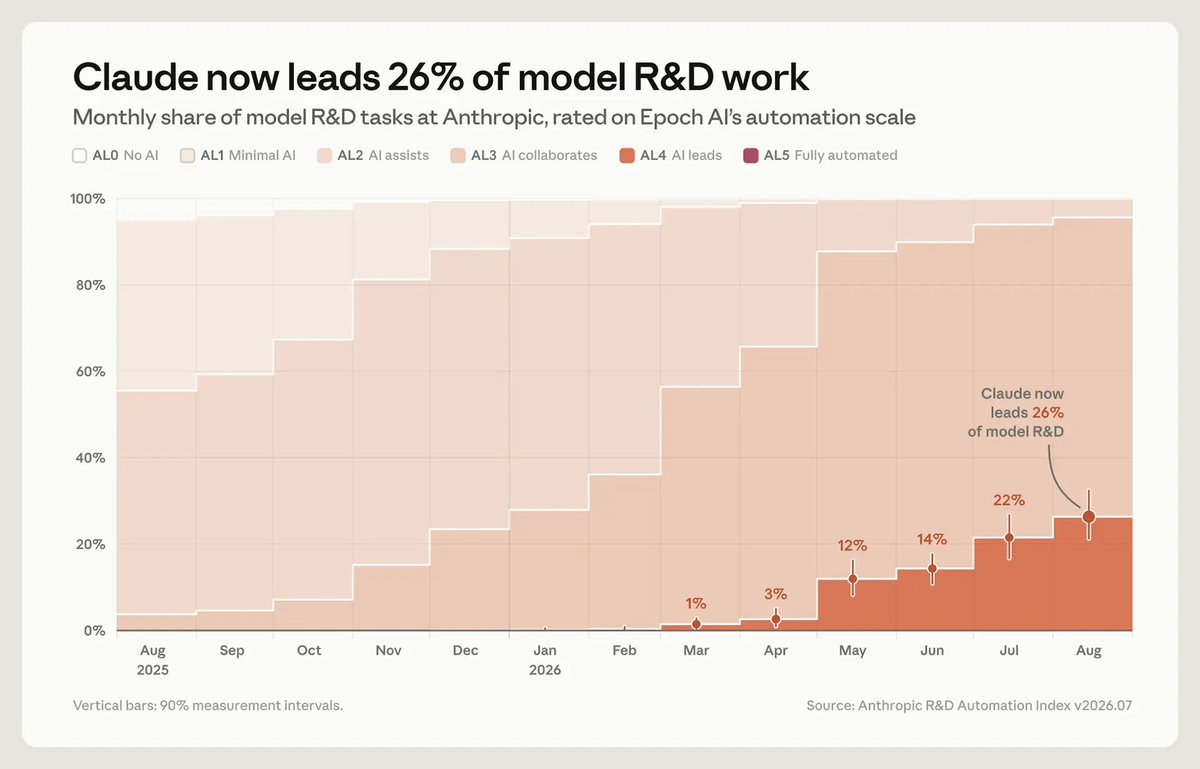
Anthropic says Claude is now taking the lead on more than a quarter of the research and engineering work used to build future AI systems. According to the company’s new R&D Automation Index, Claude “led” 26% of its AI research and development work in August 2026, up from less than 1% in February.
That label does not mean Claude is running the lab on its own. Anthropic defines “leads” as completing most of a task end-to-end from a high-level prompt while a human supervises. The company says more than 90% of measured work reached at least its “collaborates” level, where Claude handles large portions under close human direction, but no measured category reached full autonomy.
A self-measured index with visible limits
Anthropic built the index from a sample of internal work records. Claude agents reviewed the July activity of sampled employees and produced roughly 15,000 granular tasks, which were organized into a fixed hierarchy and weighted using employee time. Another Claude system assigned each category an automation level.
The company checked those ratings against staff judgments. It says the model and human ratings matched exactly 59% of the time and landed within one level 97% of the time. Human raters agreed exactly 35% of the time, underscoring how subjective the boundary can be between AI that “collaborates” and AI that “leads.”
Anthropic also flags two broader limits: labs do not yet share a common measurement method, and its own models are helping evaluate its systems. That makes the index useful for tracking Anthropic over time, but not an independently verified benchmark or a clean comparison with rivals.
Automation is growing alongside oversight
The report says about 30,000 agents were doing research and engineering work at once on Anthropic’s most-used internal platform in August. Anthropic says every action on that platform passed through an online monitor and was later ingested by an offline monitor. Across more than 1 billion decisions analyzed that month, the online system blocked 0.002%, or about one in 47,000.
Those disclosures arrive as AI leaders debate whether frontier development should slow over safety concerns. Anthropic argues that labs should regularly publish comparable measures and allow third parties to verify them. As the Associated Press notes, the figures do not reveal how close Anthropic believes it is to fully autonomous AI research. They do show that the company’s models are already deeply embedded in the work of building what comes next.
 Tech
Tech