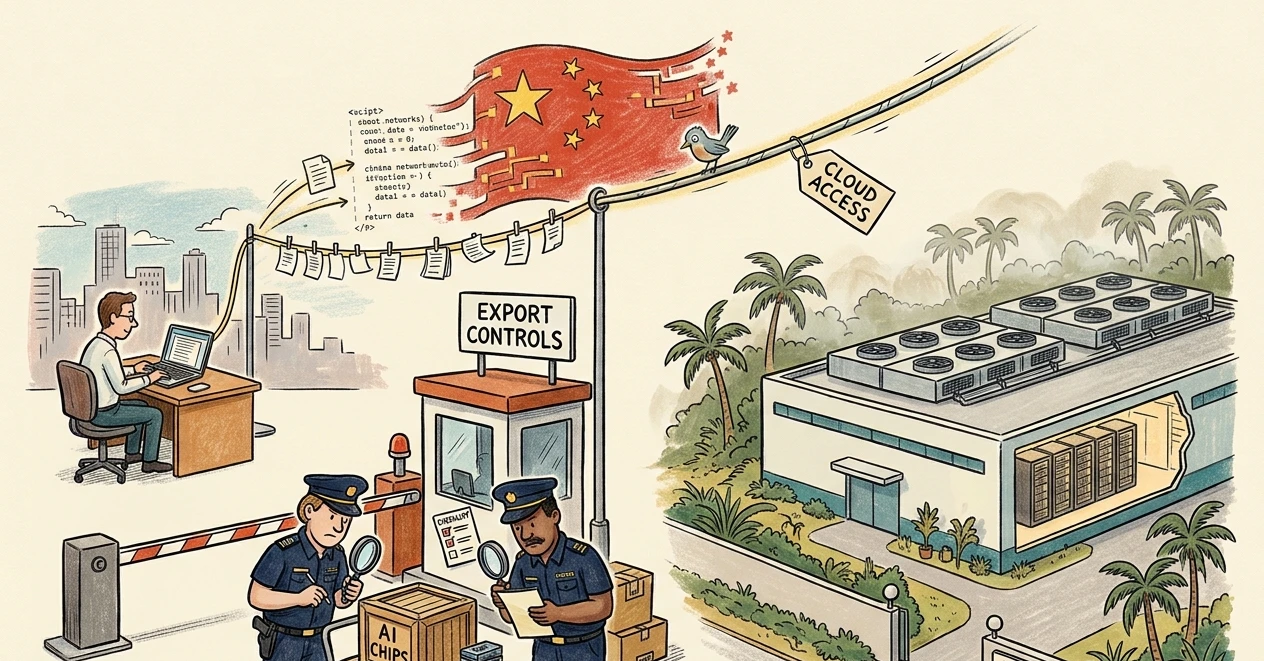
Asian data centers are looking for a customer Plan B. Bloomberg said on November 25 that providers across the region are seeking US buyers for excess computing capacity after the Trump administration tightened Chinese firms’ access to Nvidia’s most advanced chips. Source
In a November 19 post, Liquid Compute chief executive and co-founder Ronit Jain said AI cloud providers had approached his company to find new customers for long-term rentals of computing power from B300 AI chips. That capacity had originally been committed to Chinese-affiliated customers. The providers were targeting the US and Western Europe because of concerns about stricter rules on computing services for China, he wrote. Source Source
Jain called the number of providers “staggering,” but supplied no count in his post. Source
The rules reach beyond the shipping crate
The business under pressure involves remote access: Chinese companies renting computing resources on American chips housed in overseas data centers. The Financial Times reports that the practice did not explicitly breach previous US export rules. Renting computing power is not the same as physically shipping the chips to China. Source
Under the new rules described by the FT, data center operators in Singapore, Malaysia, Thailand, Indonesia and Brazil that supply significant processing power to Chinese customers must obtain special US government licences to buy advanced American chips. Operators have 90 days to obtain those licences, the newspaper reports. That is a licensing requirement, not a blanket prohibition on serving Chinese customers. Source
Lowy Institute research fellow Robert Walker told the FT: “The significant investment in data centres in the expectation that Chinese firms would be able to lease the capacity is now being challenged.” Source
Natixis adviser Abbas Rangwala warned the FT that projects could face delays “because people will spend a lot more time on due diligence, on understanding the licences”. Source
Jain also wrote that he expected B300 pricing to continue declining. That’s his forecast, not an advertised clearance price: his post supplies no pricing series. Neither his post nor Bloomberg’s public statement quantifies the capacity on offer or identifies completed US replacement contracts. Source Source




Comments