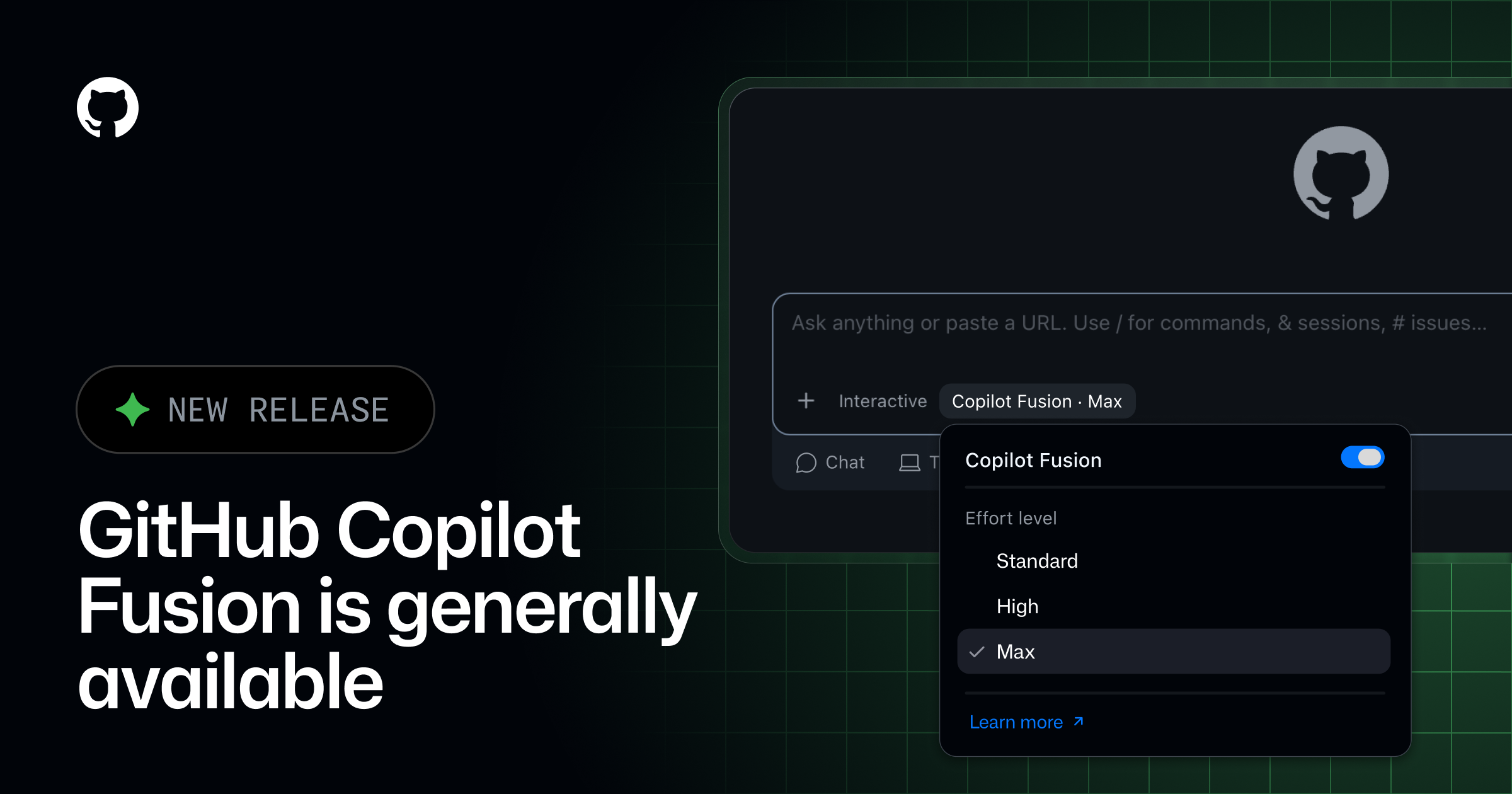
GitHub announced Copilot Fusion’s general availability at its Oct. 28, 2026, Universe event. Instead of picking a particular AI model for a coding task, developers choose an effort level. Fusion then determines which models to use for each prompt and how they work together.
The choices are Standard for everyday coding, High for challenging tasks that need deeper reasoning, and Max for the most demanding tasks. Fusion can use a single model to answer directly. When a task calls for more, GitHub describes two other patterns: Cascade starts with a response from an efficient model, then checks whether to accept it or escalate to a stronger one; in Critique, one model drafts an initial response, another reviews it, and the original model revises it. Multiple models are an option, not a requirement for every prompt.
Controls, availability and cost
GitHub says Fusion uses only models enabled by an enterprise’s or organization’s model policies. Enterprise administrators can disable a model specifically for Fusion without disabling it for everyone, and administrators can set Fusion as the default through Enterprise managed settings.
At launch, GitHub listed Fusion on all Copilot plans in Visual Studio Code, the GitHub Copilot app, GitHub Copilot CLI and JetBrains IDEs, with additional clients to follow. Users are billed at the standard rate for each model Fusion uses; GitHub announced a limited-time 30% discount on model costs for paid-plan users.
GitHub reports that Fusion Max scored 60 on the Artificial Analysis Coding Agent Index, within two points of Claude Code with Opus 5.5 Max. It says Fusion reached that score at about half the average API cost per task, with about half as many tokens and about 40% less time per task. Those are GitHub’s figures for that evaluation, not a claim that a subscriber’s bill will be cut in half.