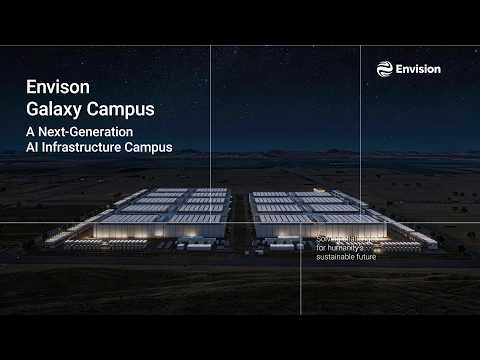
Envision’s Galaxy datacenter campus in Ulanqab, Inner Mongolia, delivered its first 120MW phase within a year, according to a SemiAnalysis site-visit report. The campus is planned for up to 800MW of IT capacity: power for computing equipment, rather than the facility’s total electricity demand. The project combines company-built wind farms, battery storage and a live high-voltage DC power pilot. Bring-your-own-power is getting fairly literal. Source
SemiAnalysis reports that the initial phase was delivered in August 2026, with the full campus expected to be completed by the end of 2027. Delivery alone doesn’t establish how fully that capacity is being used. Source
According to the report, Envision builds its own wind farms and a dedicated power line, designed and integrated campus electrical systems, and co-designed a prefabricated substation. Affiliate AESC supplies battery systems. SemiAnalysis’s reporters found Envision’s turbine-blade factory across the road. Even the neighborhood is vertically integrated. Source
Fewer power stages, no central chiller
During their September visit, SemiAnalysis’s reporters say they saw a live 5MW pilot using solid-state transformers to convert 10kV alternating current, or AC, directly into 800V direct current, or DC, for server racks. The report says this removes intermediate low-voltage transformer, uninterruptible power supply and rectifier stages. The 800V system is a 5MW pilot, not a campus-wide rollout. Source
Galaxy’s cooling design also skips a central chiller plant. SemiAnalysis says its liquid- and air-cooled servers share one water loop. That’s still a cooling system, not a thermodynamics loophole. Source
Wind targets and the business case
Envision aims to supply more than 60% of the first two phases’ electricity use from its own wind farms, according to SemiAnalysis. That’s a supply target, not a measurement of actual wind use. Source
The reported design pairs 420MW of installed wind capacity with 240MW of datacenter load across the first two phases, supported by four-hour battery storage. Wind capacity is not constant output, though. The report notes that storage can shift surplus generation into later hours but cannot do much when calm conditions last for days. The batteries are a buffer, not a weather override. Source
SemiAnalysis also reports that the first phase was delivered at a fifth of US costs. Verifying that comparison would require the specific US benchmark and a breakdown of included costs. Source
SemiAnalysis says it’s too early to tell whether vertical integration will become a meaningful competitive advantage. For now, large cloud operators still choose datacenter vendors mainly on available resources and track record, according to the report. Source