• Home
  • Technology
  • Gaming
  • Entertainment
  • World & Business
  • Science
  • Sports
  • AI
HomeTechnologyGamingEntertainmentWorld & BusinessScienceSportsAI
Technology

Physicist David Deutsch Fixes Dishwasher with ChatGPT, Questions GDP Limits

Physicist David Deutsch fixed his dishwasher with ChatGPT instead of buying a replacement.

DD
PS
DM
14 Sources, 21d ago, first seen 21d ago

TLDR

David Deutsch posted that he repaired his broken dishwasher using ChatGPT. He had planned to order a new unit but completed the repair as a trivial task instead. Deutsch stated the software raised the country's real wealth while lowering measured GDP. He added that GDP fails to register self-reliant improvements that make people better off. Replies noted GDP tracks cooperation rather than self-reliance, discussed potential understatement in official figures, and referenced an AEA paper on GDP-B accounting for new and free goods.

Combined views

1.9M

14 Sources, first seen 21d ago

12.4K likes1.2K comments2.3K saves1.2K reposts

Combined views

1.9M

14 Sources, first seen 21d ago

12.4K likes1.2K comments2.3K saves1.2K reposts
Physicist David Deutsch Fixes Dishwasher with ChatGPT, Questions GDP Limits

Sentiment

Positive74.6%25.4%Negative

Based on 74 sentiment-bearing replies from 71 accounts across 3 conversations.

Featured Source

Sentiment

Positive74.6%25.4%Negative

Based on 74 sentiment-bearing replies from 71 accounts across 3 conversations.

Related

OpenAI expands ‘Sign in with ChatGPT’ to bring Plus and Pro plan usage to third-party tools

The New Stack reports that eligible usage in participating apps counts against subscribers’ existing ChatGPT limits. OpenAI named 16 launch partners, including Devin, Amp, OpenClaw and Vercel; Lovable was listed as coming soon.

OpenAI expands ChatGPT plugins with app-like interfaces and automations

TechCrunch reports that plugins are getting dedicated sidebar homes, interactive panels and file viewers.

ChatGPT is coming to Slack and Microsoft Teams

Engadget says ChatGPT is headed to both workplace messaging platforms.

14 Sources

@DavidDeutschOxfI just fixed my dishwasher with the help of ChatGPT. A trivial task. I had been about to order a new one. So this software has increased the country's real wealth yet decreased the measured GDP. The main economic indicator is structurally incapable of registering the thing that actually makes people better off, namely the growth of knowledge21d
@Truthcoin@DavidDeutschOxf This is partly because GDP measures *cooperation*, not self reliance Anything you do for yourself isn't counted!21d
@misraetel@DavidDeutschOxf @connoraxiotes Yep. The 3rd Industrial Revolution already did lots of that. I think we need a very well thought through quality of life measure to index progress to instead of GDP.21d
@PatrickHeizerUnless you put that cash under your mattress, it's going to contribute to GDP when it's spent on consumption or investment. The dishwasher manufacturer is worse off, but the overall macro economy isn't.21d
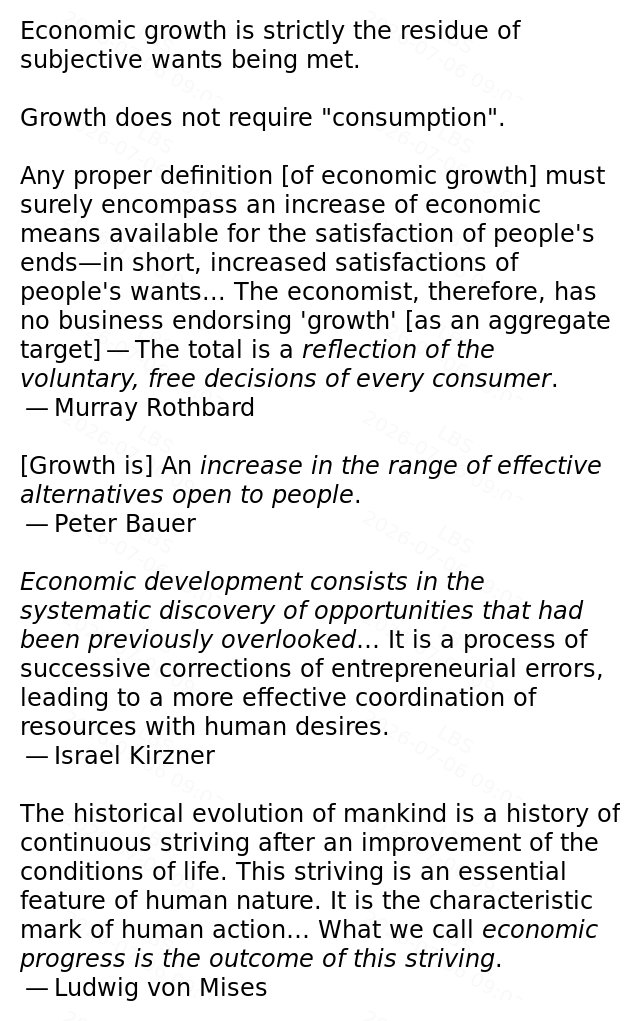
@MaxUtilitarianAnother case of confusing growth with consumption. A new dishwasher would have shown up in GDP. Going from “broken machine / uneasiness” to “working machine / less uneasiness” is growth in the Misesian sense. The money not spent *might* lower measured GDP, or it might not — if you spend or invest it elsewhere. Either way, your personal wealth rose. As others have said, GDP just isn’t built to register Misean growth.21d
@ElonBachmanNot to rag on David (who's worlds smarter than I am), but it's instructive to see that even brilliant physicists struggle to understand the "creative destruction" by which both prosperity *and* measured GDP are increased21d
@jmhorpEconomists such as @erikbryn have tried to quantify how much GDP is understated for those kinds of reasons: https://www.aeaweb.org/articles?id=10.1257%2Fmac.2021031921d
@JesusFerna7026David Deutsch (@DavidDeutschOxf) has a nice post today explaining how he fixed his dishwasher with the help of ChatGPT. We have all been there over the last couple of years. In my case, from fixing a light fixture in my kitchen to repairing a leak in my irrigation system. Deutsch and many readers point out something that has been a staple of my talks for a decade. GDP was designed to measure an economy that produced coal and steel, easily measurable quantities. And GDP did its job quite well for decades. IT, first, and later the internet and AI, changed the landscape. My favorite example is books. Even as late as 2010 or so, getting the most recent books in Spanish on, let’s say, Spanish economic history was hard in the U.S.: expensive and time-consuming. Every time I went to Madrid, I carried two bags, one of them empty because it would come back filled with books. Then Kindle arrived, and now I can buy nearly every single Spanish book I want in seconds and at a lower price than the physical copy. This was an enormous increase in my welfare that never got reflected in GDP. The literature is divided on how big this effect is. I tend to side with those who think it is a big deal. Therefore, many of the gains in GDP growth announced by the strongest defenders of AI might not materialize: they will go instead into higher welfare. But the issue goes beyond getting GDP wrong. What Deutsch perhaps did not notice is that he did not pay VAT on the service of the repair person he did not hire, and that such a repair person did not pay income taxes on the service he did not render. Taxing AI-based economies might thus become much harder, from a purely technical perspective. One solution would be to tax the profits of OpenAI (or Deutsch’s subscription), but I am among those who think those profits are not going to be nearly as large as anticipated. Competition among labs will drive the subscription prices of models down (unless labs can cartelize, for example, by appealing to “AI security”). Over 95%, and perhaps as much as 99%, of the gains from AI will pass to the final user, whether another business or an individual. Now, we could tax the final user, for instance, at a fixed rate per token used. But that implies we are taxing the high-return activity (how to fix the dishwasher) at the same rate as the low-return activity (Claude: “tell me a joke about my cat jumping”). And taxing per token might hurt those final users who use more tokens because they are more productive, something we might not want to do (yes, there is something called the uniform commodity taxation theorem, but it often breaks down). Let me give you an extreme example: imagine that tomorrow the new OpenAI model cures all cancers, forever. Just a vaccine, $10, once in your life, and you never get cancer again. The increase in human welfare from such an invention would be staggering. But how do you measure it in GDP? Yes, people will live longer, perhaps work longer. A second-order effect on GDP. And more importantly: how do you tax the vaccine? Do you even want to tax the vaccine? I would argue we want to subsidize it, and generously. When I was still an undergrad, my first RA job was helping to construct GDP and other national aggregate statistics in Spain. It was a most valuable experience, because it made me aware of what GDP means, its strengths (and it has many more than its critics concede), and its limitations. But it also taught me that what you can tax out of GDP is far more limited than you would think at first sight. There are real upper bounds on taxation, and I am afraid the bound is tighter now than it used to be.21d
@AravSrinivasQuite an important take. Economists and their theories are outdated to measure the benefits of AI. AI is already saving people a lot of time and money that doesn’t get measured.21d
@DeryaTR_On the bright side, this is one of the most important points about the age of AI you’ll read. All that pace-unpace gloom-and-doom talk & posturing have less value than this dishwasher. Millions, soon billions, experience this incredible uplifting, and that’s what really matters.21d
  • HomeTechnologyGamingEntertainmentWorld & BusinessScienceSportsAI
    • Home
    • Technology
    • Gaming
    • Entertainment
    • World & Business
    • Science
    • Sports
    • AI
    David DeutschChatGPT

    14 Sources

    @DavidDeutschOxfI just fixed my dishwasher with the help of ChatGPT. A trivial task. I had been about to order a new one. So this software has increased the country's real wealth yet decreased the measured GDP. The main economic indicator is structurally incapable of registering the thing that actually makes people better off, namely the growth of knowledge21d
    @Truthcoin@DavidDeutschOxf This is partly because GDP measures *cooperation*, not self reliance Anything you do for yourself isn't counted!21d
    @misraetel@DavidDeutschOxf @connoraxiotes Yep. The 3rd Industrial Revolution already did lots of that. I think we need a very well thought through quality of life measure to index progress to instead of GDP.21d
    @PatrickHeizerUnless you put that cash under your mattress, it's going to contribute to GDP when it's spent on consumption or investment. The dishwasher manufacturer is worse off, but the overall macro economy isn't.21d
    @MaxUtilitarianAnother case of confusing growth with consumption. A new dishwasher would have shown up in GDP. Going from “broken machine / uneasiness” to “working machine / less uneasiness” is growth in the Misesian sense. The money not spent *might* lower measured GDP, or it might not — if you spend or invest it elsewhere. Either way, your personal wealth rose. As others have said, GDP just isn’t built to register Misean growth.21d
    @ElonBachmanNot to rag on David (who's worlds smarter than I am), but it's instructive to see that even brilliant physicists struggle to understand the "creative destruction" by which both prosperity *and* measured GDP are increased21d
    @jmhorpEconomists such as @erikbryn have tried to quantify how much GDP is understated for those kinds of reasons: https://www.aeaweb.org/articles?id=10.1257%2Fmac.2021031921d
    @JesusFerna7026David Deutsch (@DavidDeutschOxf) has a nice post today explaining how he fixed his dishwasher with the help of ChatGPT. We have all been there over the last couple of years. In my case, from fixing a light fixture in my kitchen to repairing a leak in my irrigation system. Deutsch and many readers point out something that has been a staple of my talks for a decade. GDP was designed to measure an economy that produced coal and steel, easily measurable quantities. And GDP did its job quite well for decades. IT, first, and later the internet and AI, changed the landscape. My favorite example is books. Even as late as 2010 or so, getting the most recent books in Spanish on, let’s say, Spanish economic history was hard in the U.S.: expensive and time-consuming. Every time I went to Madrid, I carried two bags, one of them empty because it would come back filled with books. Then Kindle arrived, and now I can buy nearly every single Spanish book I want in seconds and at a lower price than the physical copy. This was an enormous increase in my welfare that never got reflected in GDP. The literature is divided on how big this effect is. I tend to side with those who think it is a big deal. Therefore, many of the gains in GDP growth announced by the strongest defenders of AI might not materialize: they will go instead into higher welfare. But the issue goes beyond getting GDP wrong. What Deutsch perhaps did not notice is that he did not pay VAT on the service of the repair person he did not hire, and that such a repair person did not pay income taxes on the service he did not render. Taxing AI-based economies might thus become much harder, from a purely technical perspective. One solution would be to tax the profits of OpenAI (or Deutsch’s subscription), but I am among those who think those profits are not going to be nearly as large as anticipated. Competition among labs will drive the subscription prices of models down (unless labs can cartelize, for example, by appealing to “AI security”). Over 95%, and perhaps as much as 99%, of the gains from AI will pass to the final user, whether another business or an individual. Now, we could tax the final user, for instance, at a fixed rate per token used. But that implies we are taxing the high-return activity (how to fix the dishwasher) at the same rate as the low-return activity (Claude: “tell me a joke about my cat jumping”). And taxing per token might hurt those final users who use more tokens because they are more productive, something we might not want to do (yes, there is something called the uniform commodity taxation theorem, but it often breaks down). Let me give you an extreme example: imagine that tomorrow the new OpenAI model cures all cancers, forever. Just a vaccine, $10, once in your life, and you never get cancer again. The increase in human welfare from such an invention would be staggering. But how do you measure it in GDP? Yes, people will live longer, perhaps work longer. A second-order effect on GDP. And more importantly: how do you tax the vaccine? Do you even want to tax the vaccine? I would argue we want to subsidize it, and generously. When I was still an undergrad, my first RA job was helping to construct GDP and other national aggregate statistics in Spain. It was a most valuable experience, because it made me aware of what GDP means, its strengths (and it has many more than its critics concede), and its limitations. But it also taught me that what you can tax out of GDP is far more limited than you would think at first sight. There are real upper bounds on taxation, and I am afraid the bound is tighter now than it used to be.21d
    @AravSrinivasQuite an important take. Economists and their theories are outdated to measure the benefits of AI. AI is already saving people a lot of time and money that doesn’t get measured.21d
    @DeryaTR_On the bright side, this is one of the most important points about the age of AI you’ll read. All that pace-unpace gloom-and-doom talk & posturing have less value than this dishwasher. Millions, soon billions, experience this incredible uplifting, and that’s what really matters.21d
    Today's Rank

    —

    Not ranked yet

    Today's Rank

    —

    Not ranked yet