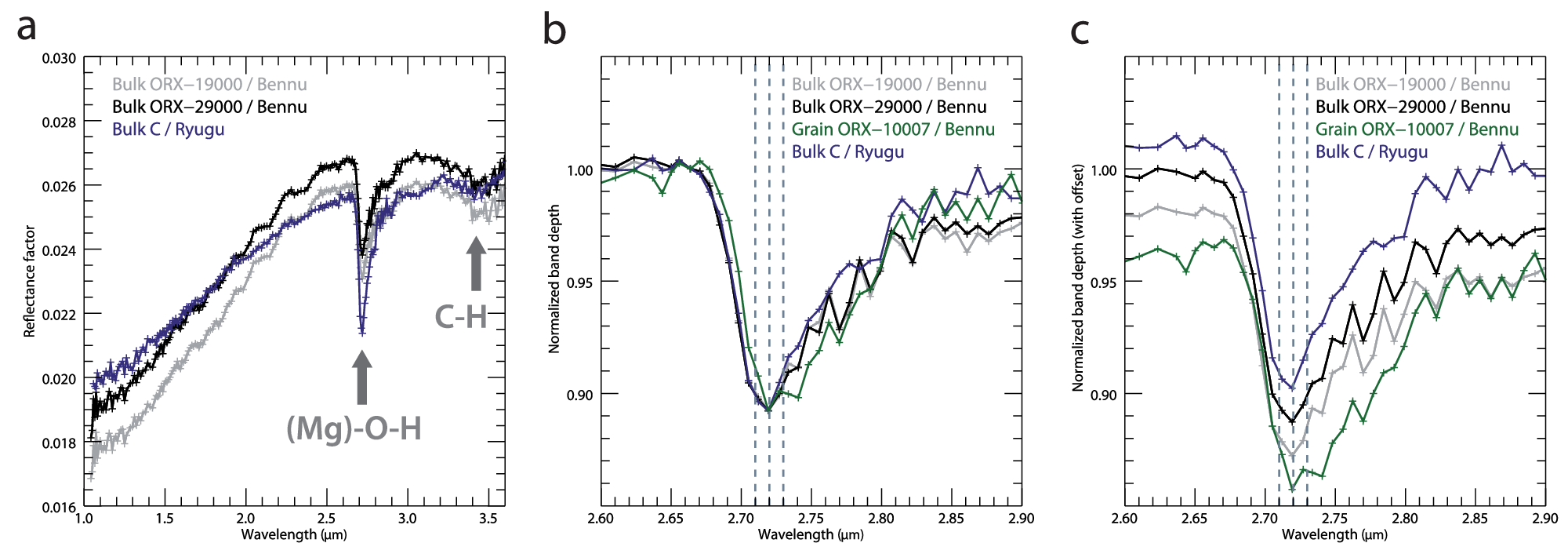
In an analysis now published in Science Advances, an ETH Zurich team studying samples from NASA’s asteroid Bennu found an isotopic resemblance to the asteroid Ryugu and rare CI meteorites, according to ETH Zurich material published by ScienceDaily. The researchers interpret the similarities as a sign that the objects’ original material came from the same reservoir of ancient dust.
NASA’s OSIRIS-REx mission delivered Bennu material to Earth in 2023. A capsule carrying about 120 grams landed in Utah on Sept. 23, 2023, and ETH Zurich professor Maria Schönbächler’s laboratory received half a gram. Her team examined isotopes of iron, titanium and chromium. Isotopes are forms of an element with different numbers of neutrons; their relative amounts provide clues about the material’s origins.
A proposed meeting place for ancient dust
The researchers propose that material that became Bennu, Ryugu and CI meteorites accumulated near the water-ice line in the disk around the young Sun. At that boundary, temperatures were low enough for water vapor to freeze. In the team’s account, dust from the inner and outer Solar System mixed there. Schönbächler called Bennu “a hybrid,” saying its material does not clearly match either region.
The team also suggests a possible role for Jupiter: As the planet grew, it could have prevented most larger particles from crossing its orbital region while finer dust moved around it and mixed near the water-ice line. That is a proposed explanation for the mixing, not a direct measurement of Jupiter’s role.
Schönbächler said Bennu “may offer our best glimpse of the original mix of chemical elements from which the terrestrial planets were ultimately built.” The researchers still want to determine more precisely how Jupiter influenced dust’s movement and whether its gravity favored the accumulation of particularly fine particles.