Simulations suggest a hypothetical planet twice Earth’s mass could help explain unusual orbits beyond Neptune, Phys.org reported on November 27, 2026. The proposed world, dubbed “Planet X2,” hadn’t been detected. Source
Small bodies in the favored simulations followed orbits similar to those of each of the 11 extreme distant objects the team examined, Sedna included. The models also retained the main orbital structures nearer Neptune. Source
When the researchers compared their simulated populations with what the Dark Energy Survey would have detected, every model predicted too few detections of objects on larger orbits. Models with and without Planet X2 also matched some of the same observations. Those overlapping successes can’t establish that the extra planet exists. Source
What the extra gravity would do
Patryk Sofia Lykawka of Kindai University in Japan and colleagues simulated 4.5 billion years of evolution, tracking the four giant planets and a disk of smaller bodies. They compared systems without extra planets with scenarios containing temporary additional planets or a lasting outer companion. Phys.org reported that the study had been accepted for publication in the Monthly Notices of the Royal Astronomical Society. Source
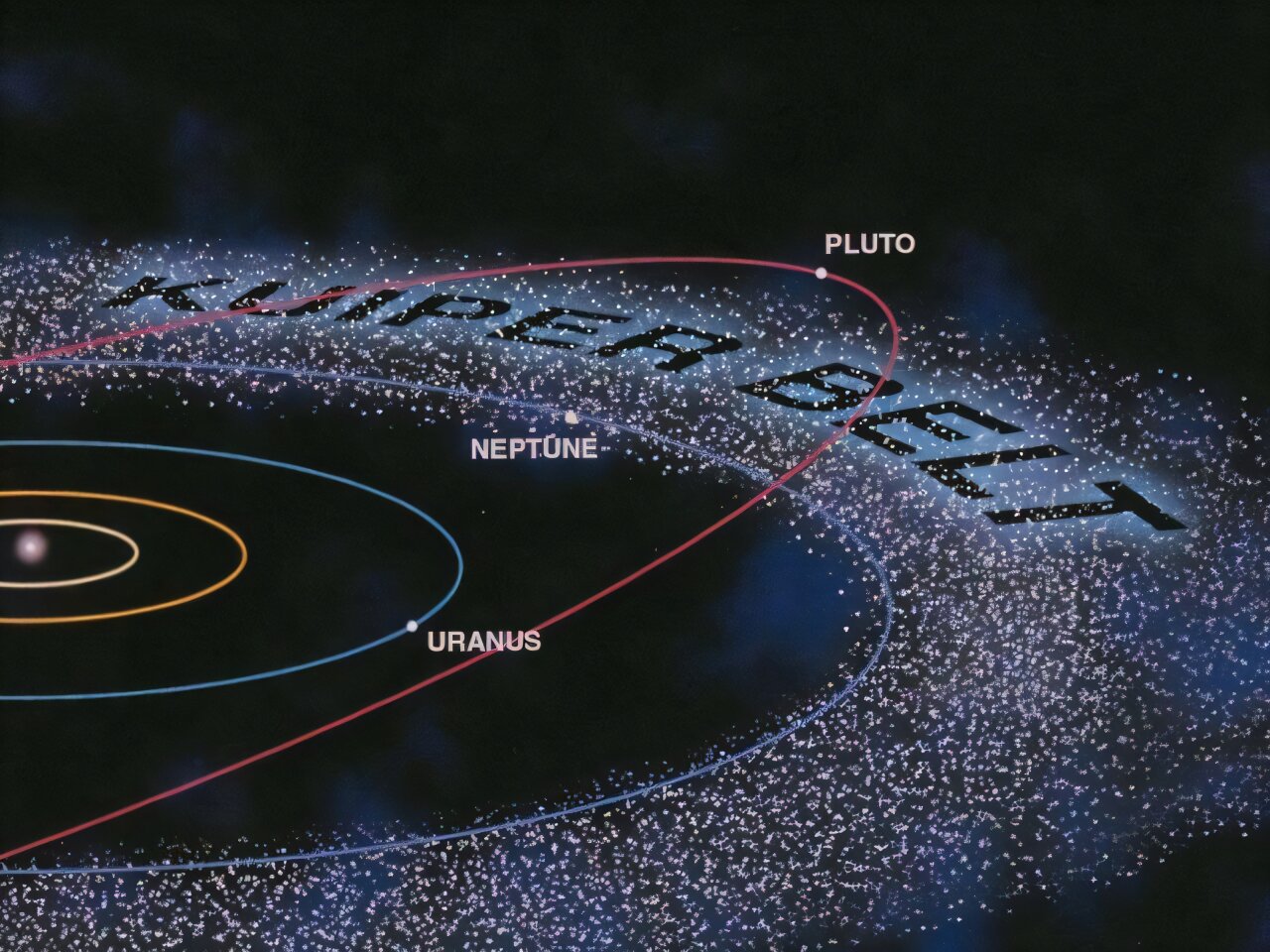
The puzzle involves icy bodies beyond Neptune with very different orbital habits. Some follow steeply tilted paths; others never come particularly close to the giant planets. Sedna, for instance, stays at least about 76 Earth–sun distances from the sun. Explaining how it acquired that remote orbit remains difficult. Sedna is not making this convenient. Source
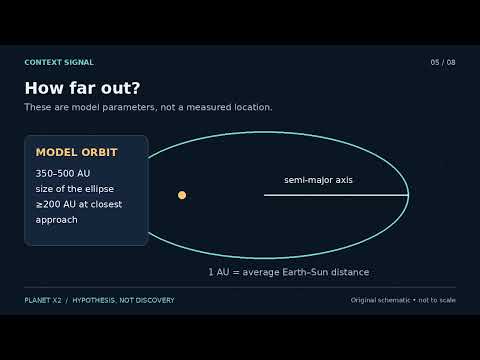
The strongest overall simulation results favored a lasting planet twice Earth’s mass on an elongated orbit, with only a modest tilt relative to Earth’s orbital plane. It would come no closer to the sun than about 200 times the Earth–sun distance and travel much farther out. Source
In those models, the planet’s gravity gradually altered smaller bodies’ paths. Some ended up with even their closest solar approaches well beyond Neptune; others acquired steep orbital tilts. The simulations also produced distant objects on relatively flat orbits, part of the observed mixture. Source
Why a sizable planet could be hard to spot
Twice Earth’s mass sounds conspicuous. Hundreds of Earth–sun distances away, the lighting is less cooperative: a planet would receive little sunlight, and only a small fraction of what it reflected would reach Earth. Source
Phys.org identifies the Vera C. Rubin Observatory’s Legacy Survey of Space and Time as a way to test the idea: it could search for the planet itself and discover more distant objects whose orbits would probe its proposed influence. Source




Comments