• Home
  • Technology
  • Gaming
  • Entertainment
  • World & Business
  • Science
  • Sports
  • AI
HomeTechnologyGamingEntertainmentWorld & BusinessScienceSportsAI
Science
Report

Nuclear clocks based on thorium-229 demonstrate stable operation

A post says scientists in China and Austria independently demonstrated thorium-229 clocks; prototypes haven't beaten the best optical atomic clocks.

China ScienceCS
SSCSS
2 Sources, 4h ago, first seen 4h ago

TLDR

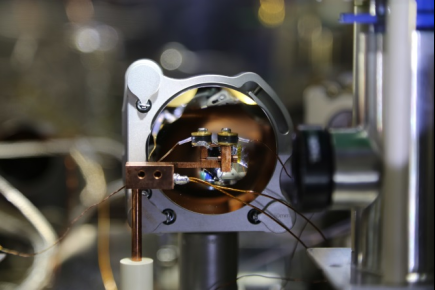
ChinaScience, citing a Nature article, reports that Chinese scientists achieved stable operation of a nuclear clock using thorium-229 transitions and a 148-nanometer laser. Another post says scientists in Austria and China independently demonstrated nuclear clocks, which use transitions in atomic nuclei rather than electrons. The post says the prototypes have not beaten the best optical atomic clocks, but the approach could eventually improve navigation and tests of fundamental physics, including dark matter searches.

Combined views

3K

2 Sources, first seen 4h ago

28 likes1 comments4 saves2 reposts
Combined views

3K

2 Sources, first seen 4h ago

28 likes1 comments4 saves2 reposts

Sentiment

Positive——Negative

Summary

Not enough discussion yet.

No sentiment analysis available yet.

Featured Source

Sentiment

Positive——Negative

Summary

Not enough discussion yet.

No sentiment analysis available yet.

2 Sources

China Science@ChinaScienceChinese scientists have developed a nuclear clock and achieved stable operation, shifting ultra-precise time measurement from electron transitions inside atoms to transitions within atomic nuclei, according to a research article published in the journal Nature. The nuclear clock uses lasers to drive precise energy-level transitions within the atomic nucleus of thorium-229, a special radioactive isotope, and uses the frequency of these nuclear transitions as its time reference. Researchers built the device with a self-developed 148-nanometer continuous-wave vacuum ultraviolet laser and a thorium-229-doped calcium fluoride crystal. The new clock is expected to set a next-generation time and frequency standard, and marks an important breakthrough in the field of quantum precision measurement.4h
SSC@ssc_globa1What if the future of timekeeping lies inside an atomic nucleus? ⏱️🔬 Scientists in Austria and China have independently demonstrated operating nuclear clocks — a major step in precision timekeeping. Unlike traditional atomic clocks, which track changes in electrons, these devices use transitions inside the nucleus of thorium-229. Why does that matter? Atomic nuclei are far less sensitive to some environmental disturbances than electrons, potentially making nuclear clocks exceptionally stable. The technology is still in its early stages. Today’s prototypes haven’t beaten the world’s best optical atomic clocks. But the possibilities are exciting. More precise clocks could improve navigation, strengthen scientific measurements, and help researchers test fundamental theories of physics — even search for subtle clues about dark matter. We’ve spent centuries learning to measure time more accurately. Now, scientists are exploring a whole new place to find its rhythm. #Science #Physics #Technology #QuantumScience #Innovation1h
    • Home
    • Technology
    • Gaming
    • Entertainment
    • World & Business
    • Science
    • Sports
    • AI

    2 Sources

    China Science@ChinaScienceChinese scientists have developed a nuclear clock and achieved stable operation, shifting ultra-precise time measurement from electron transitions inside atoms to transitions within atomic nuclei, according to a research article published in the journal Nature. The nuclear clock uses lasers to drive precise energy-level transitions within the atomic nucleus of thorium-229, a special radioactive isotope, and uses the frequency of these nuclear transitions as its time reference. Researchers built the device with a self-developed 148-nanometer continuous-wave vacuum ultraviolet laser and a thorium-229-doped calcium fluoride crystal. The new clock is expected to set a next-generation time and frequency standard, and marks an important breakthrough in the field of quantum precision measurement.4h
    SSC@ssc_globa1What if the future of timekeeping lies inside an atomic nucleus? ⏱️🔬 Scientists in Austria and China have independently demonstrated operating nuclear clocks — a major step in precision timekeeping. Unlike traditional atomic clocks, which track changes in electrons, these devices use transitions inside the nucleus of thorium-229. Why does that matter? Atomic nuclei are far less sensitive to some environmental disturbances than electrons, potentially making nuclear clocks exceptionally stable. The technology is still in its early stages. Today’s prototypes haven’t beaten the world’s best optical atomic clocks. But the possibilities are exciting. More precise clocks could improve navigation, strengthen scientific measurements, and help researchers test fundamental theories of physics — even search for subtle clues about dark matter. We’ve spent centuries learning to measure time more accurately. Now, scientists are exploring a whole new place to find its rhythm. #Science #Physics #Technology #QuantumScience #Innovation1h
    Today's Rank

    —

    Not ranked yet

    Today's Rank

    —

    Not ranked yet