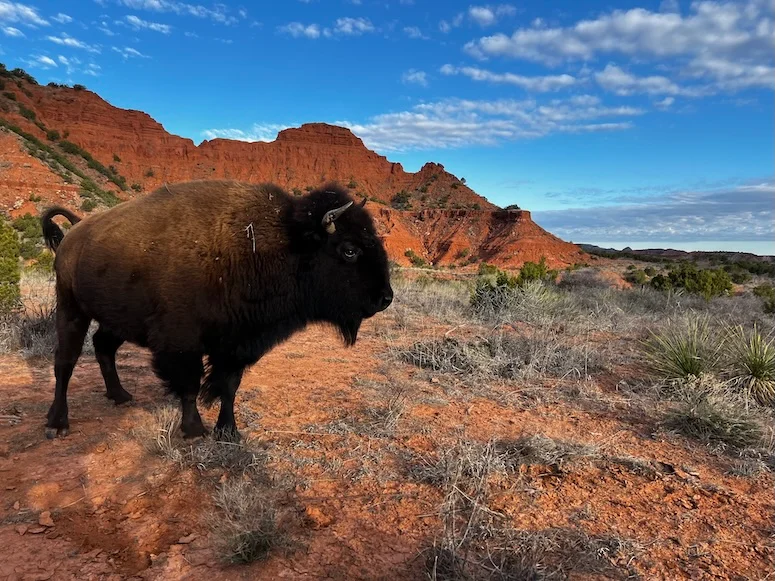
Indigenous hunters repeatedly used a Texas Panhandle cliff for bison hunts spanning roughly 3,000 years, according to a Rice University account published by Phys.org. Radiocarbon dating of bison bones points to at least seven separate hunts at Nighthawk, in Caprock Canyons State Park. The animals likely could see the drop ahead. Source
The research was led by August “Gus” Costa, an adjunct lecturer of anthropology at Rice, and appeared in American Antiquity, according to the university’s account. Rice identifies Nighthawk as Texas’s second scientifically verified bison jump, after Bonfire Shelter. Source
Bison jumping involved maneuvering herds toward cliffs, where the animals would fall to their deaths or become incapacitated. These were coordinated, large-scale hunts requiring extensive planning and cooperation. At many northern Plains jumps, the terrain may have concealed the edge. Nighthawk’s projecting cliff presents a different problem. Source
“We don't know exactly how they managed herding the bison, but the setting is different from the typical northern Plains jump,” Costa said in Rice’s account. Source
The bones provide a timeline, not a herding manual.
Researchers initially inferred at least two hunts from stone spear and arrow points found at the site. Radiocarbon dating expanded that record to at least seven hunts. The site’s long history spanned the transition from stone-tipped spears to bows and arrows, the introduction of pottery and changes in the surrounding landscape. Source
Even the cliff edge didn’t stay put. Rice reports that erosion shifted the jump-off point by approximately the length of a football field over time. Generations of hunters nevertheless kept returning to the location. Source
Rice’s account says the scarcity of documented jumps had led some archaeologists to question whether Southern Plains communities used cliffs for large-scale bison hunting, despite the technique being well documented farther north. Nighthawk offers a bone-based rebuttal. Source
According to Rice, steep slopes beneath cliffs can be overlooked because archaeologists have traditionally concentrated on places suitable for living and camping. Erosion and limited access to private property have complicated the search, too. Source
Costa and his colleagues have identified eight additional potential bison jump sites in and around Caprock Canyons. Source
“Bison jumping is a complicated community effort, and getting that incorporated into the story of Southern Plains people is important,” Costa said. Source



Comments