Researchers report cooling a Bose-Einstein condensate aboard China’s Tiangong space station to an effective temperature of 9.7 picokelvins—less than 10 trillionths of a kelvin above absolute zero. The research was published November 5, 2026, in Science, whose news coverage described it as a new temperature record. Source
This is not Tiangong’s thermostat setting. The figure describes the atoms’ motion: physicists can infer an effective temperature from how slowly an ultracold cloud spreads when released. A Bose-Einstein condensate forms when atoms occupy the same quantum state, behaving collectively as one quantum system. Source
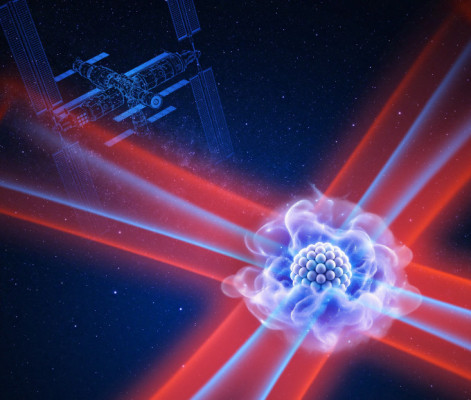
Inside Tiangong’s Cold Atom Physics Rack, researchers used two nested laser traps. They started with about 2 million rubidium atoms, then reduced the laser power, letting the more energetic atoms make their exit. The remaining roughly 20,000 atoms cooled to 3 nanokelvins, or 3 billionths of a kelvin. Next, those atoms expanded into the wider trap, reducing their interaction energy and cooling them further, according to Science’s reporting. Source
On Earth, gravity makes trapped atom clouds sag, hampering cooling. Aboard the station, the atoms experience microgravity—the apparent weightlessness of free fall, not an absence of Earth’s gravity. Unlike a drop-tower experiment, an orbiting experiment doesn’t have a short fall imposing a countdown. Source
For comparison, Science News reports earlier effective temperatures as low as 52 picokelvins aboard the International Space Station and 38 picokelvins in an Earth-based drop-tower experiment. Tiangong’s reported result comes in below both. SourceSource
Researchers could track the released cloud’s expansion for seven seconds, according to Science. Source
“The 7 seconds is an even more important figure of merit than the 10 picokelvin,” UC Berkeley atomic physicist Holger Mueller told Science. Source
Such long observation times could support future interference experiments testing whether gravity pulls equally on different types of atoms. Source




Comments