Researchers report tracking a male rufous hummingbird from Alabama to Alaska over 38 days, documenting a track totaling 6,526 kilometers—about 4,055 miles. They call it the longest recorded hummingbird track. Its solar-powered Bluetooth transmitter weighed about 0.06 grams. Strict luggage allowance, enormous itinerary. Source Source
The findings appeared November 16, 2026, in Ecology and Evolution, but the journey happened in spring 2025. The bird was released in Lillian, Alabama, on March 27 and last detected in Juneau, Alaska, on May 3. Its track crossed northern Mexico before heading north along the Pacific coast. The researchers presumed it was breeding in Juneau; they didn’t confirm that. Source
Researchers calculated the 6,526-kilometer track by adding the distances between consecutive detections. The endpoints were 4,730 kilometers apart in a straight line. This was a reconstructed track, not an exact, continuously observed flight path—and the 38-day tracking period doesn’t mean nonstop flying. Source
The paper describes a previous record: a female rufous hummingbird banded in Florida and recaptured 5,632 kilometers away in Alaska. That distance between endpoints exceeds the new bird’s 4,730 kilometers, but is shorter than its reconstructed track. The authors’ record claim compares two different kinds of distance. Source
A tiny tag borrows a much bigger network
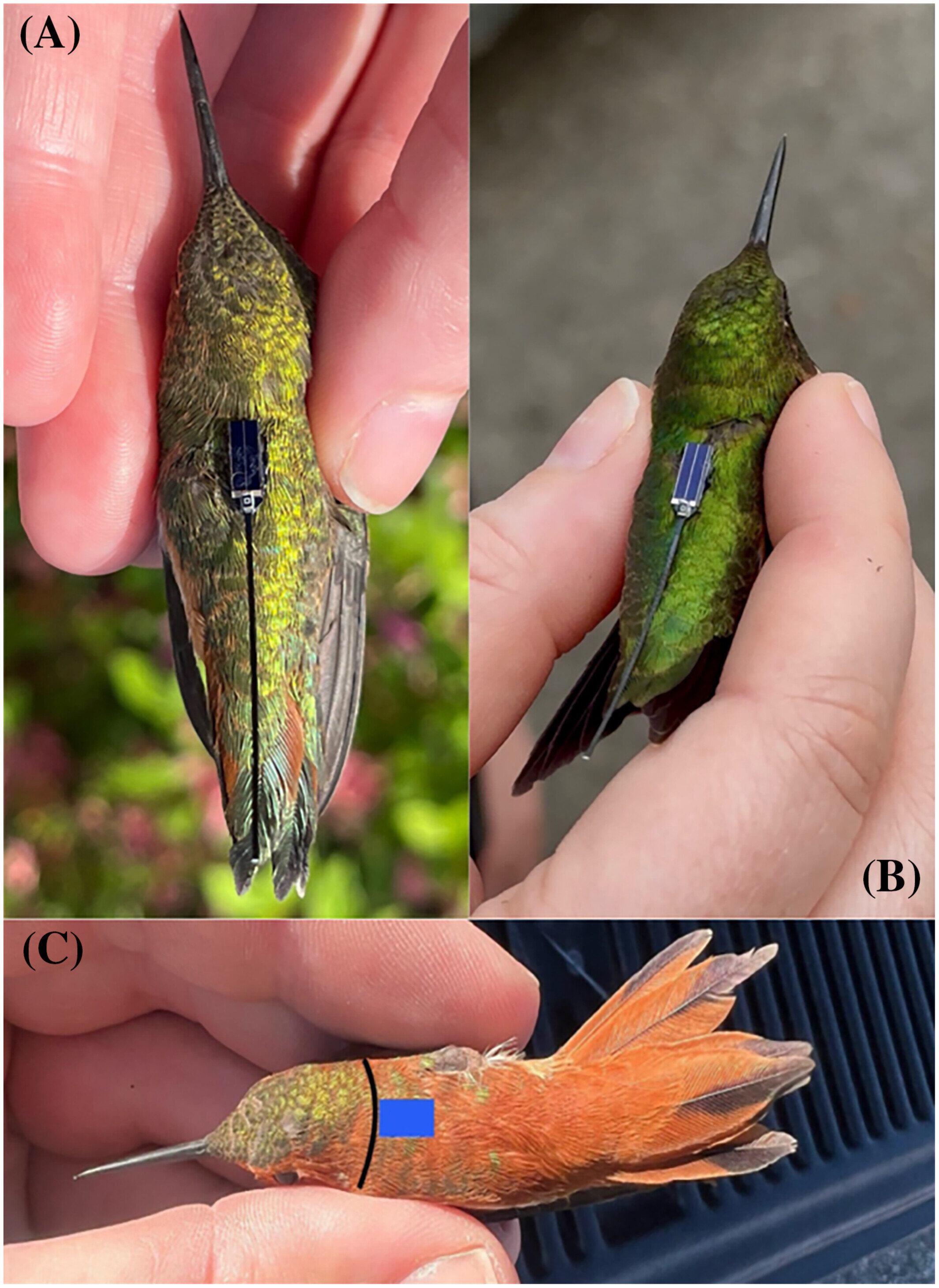
Led by Emma M. Rhodes of the University of Memphis, the team tested BlūMorpho transmitters on four rufous and seven ruby-throated hummingbirds in coastal Alabama and the Florida Panhandle during March and April 2025. Tags were glued to trimmed feathers between the shoulders, with all attachments kept at no more than 3% of each bird’s body mass. Source
The transmitter carries no battery and stores no onboard data. When there’s enough light, it broadcasts a unique signal every three seconds. Phones, tablets and computers on a compatible location network can detect it from up to about 200 meters away. Bluetooth and location services must be switched on. These devices relay detections with their own GPS coordinates. The bird brings the signal; nearby electronics handle the location reporting. Source
Researchers can access the detections remotely without recapturing the bird or retrieving its tag. Across all 11 birds, the paper reports 23,784 data points spanning 23 U.S. states, northern Mexico and parts of Canada. Source
Several coauthors were affiliated with tag maker Cellular Tracking Technologies, which supported the research alongside the Banding Coalition of the Americas. The paper declares no conflicts of interest. Source
Small hardware, real limitations
Leaving out the battery saves weight; it doesn’t deliver round-the-clock coverage. Transmissions require sufficient light, and detections require a compatible receiver within range. Coverage therefore favors more populated places. Receiver GPS errors and the distance between receiver and bird also introduce positional uncertainty that needs further study. Source
Keeping tags attached is another obstacle. The authors identify retention on the bird, rather than the transmitter’s operating lifespan, as the current constraint on longer tracking. Source
“This study was not designed to quantify potential behavioral, physiological, or survival effects of transmitters and attachment,” the authors write. Immediate post-release observations couldn’t establish longer-term effects. The 3% attachment limit is a protocol, not a safety verdict. Source
The authors hope future tracking will connect wintering and breeding areas and identify important migration stopovers, helping direct conservation work for declining hummingbirds. Source Source




Comments