People with two copies of a DNA variant inherited from Neanderthals were about 10% less likely to have been diagnosed with schizophrenia, according to Science’s account of a new study. The variant was also associated with a slightly smaller brain region involved in visual processing. Source
The research, by Hugo Zeberg of the Karolinska Institute and Svante Pääbo of the Max Planck Institute for Evolutionary Anthropology, was published November 16 in Proceedings of the National Academy of Sciences, Science reports. About 20% of people of European descent carry at least one copy of this particular variant—not necessarily the two copies associated with that roughly 10% diagnosis difference. Source
The roughly 10% diagnosis difference describes a statistical association, not a 10-percentage-point reduction in someone’s individual risk or proof that the variant prevents schizophrenia. Evolutionary neuroscientist Cedric Boeckx cautioned against overinterpreting the result, telling Science that “genes and environment both contribute in complex, nonlinear ways.” Source
For the brain-anatomy analysis, the researchers examined UK Biobank data. Scientific American reports that each copy of the variant was associated with about 0.85 cubic centimeters less volume in the occipital lobe, which helps process visual information. Two copies corresponded to about 1.7 cubic centimeters less volume. These are differences in size, not evidence of brains shrinking over time. Source
The inherited DNA segment sits near DAAM1, a gene involved in early brain development, Zeberg told Scientific American. That gives researchers a genetic address to investigate, though exactly how the segment interacts with DAAM1 remains unclear. Source
“But the honest answer is we don’t understand the exact mechanics at this point,” Zeberg told Science. The findings also don’t establish that the smaller occipital-lobe volume explains the association with fewer schizophrenia diagnoses. Source
The study detected no association with intelligence, depression, bipolar disorder or ADHD, Scientific American reports. Source
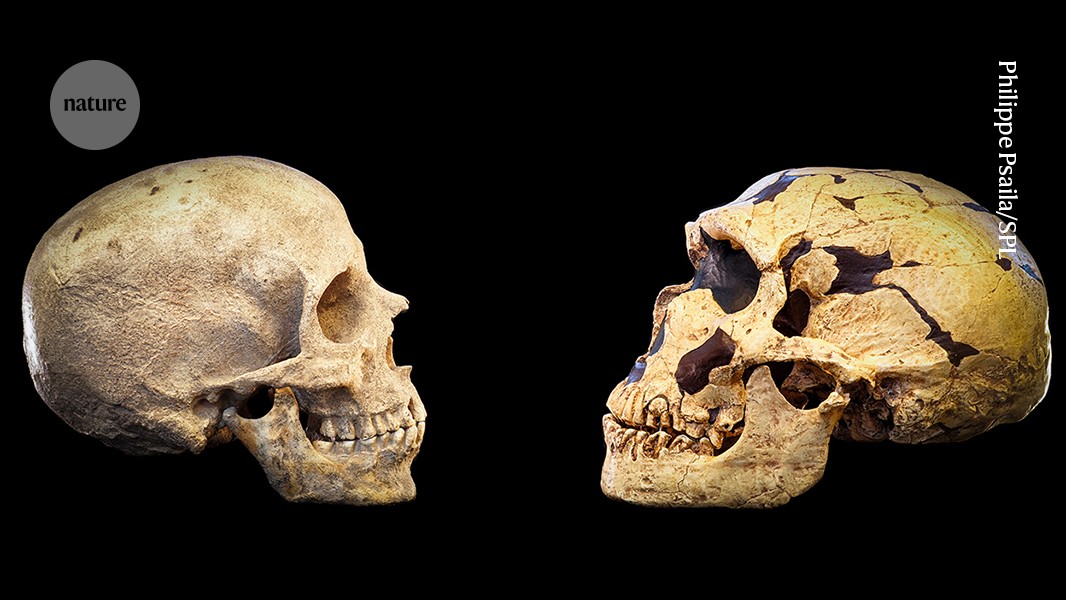
There’s an evolutionary plot twist, too: fossil evidence suggests Neanderthals themselves had relatively large occipital lobes. Anthropologist Thomas Schoenemann told Science that interactions with other modern human genes might shape the variant’s effects today. An inherited fragment is not a complete set of instructions for an ancient brain. Source





Comments