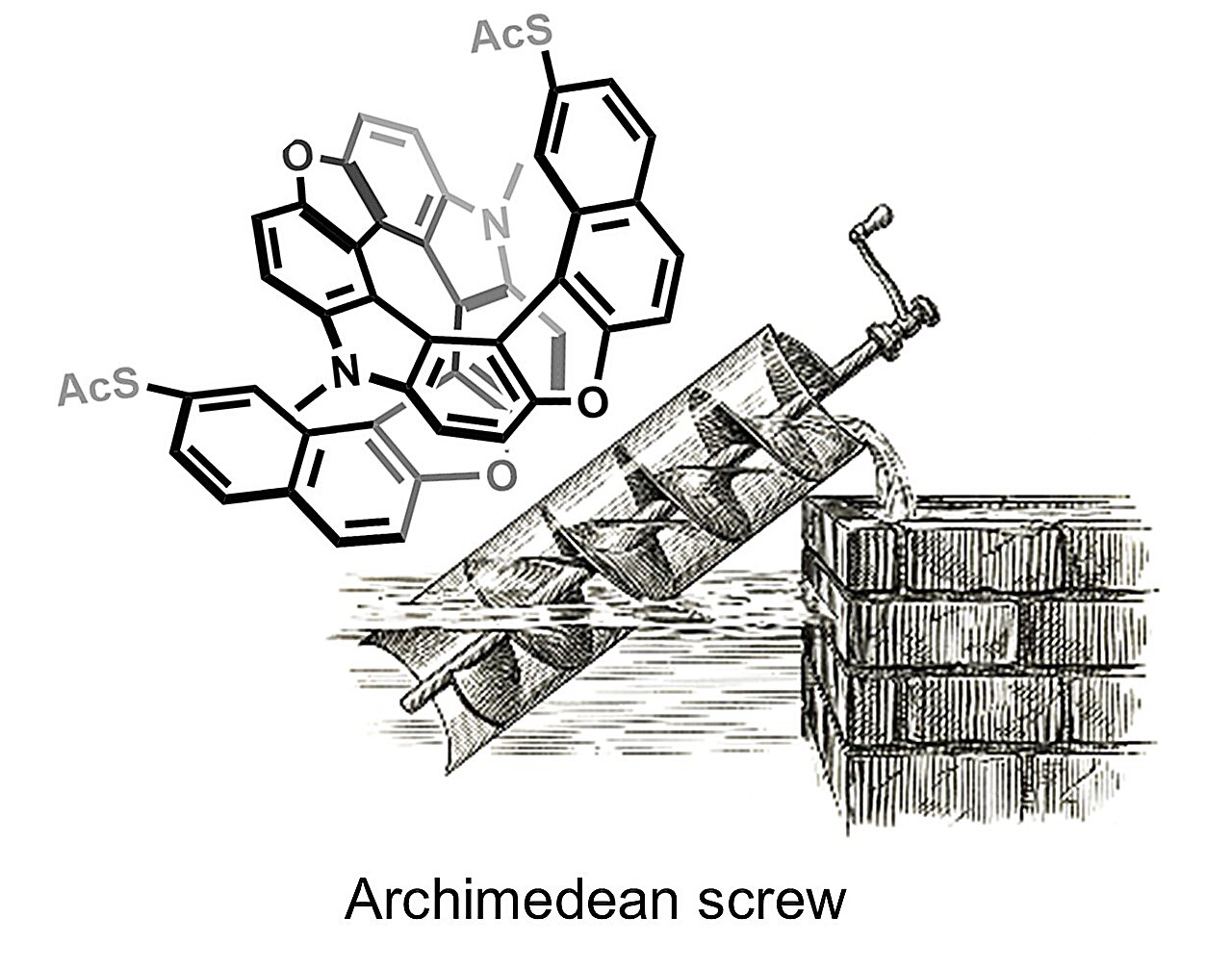
An international research team reports a single-molecule motor that changes its direction of rotation when voltage polarity is reversed. The molecule is held between two gold electrodes and driven by electric current, according to an account credited to the University of Augsburg and published by Phys.org.
Michael Pittelkow’s team at the University of Copenhagen made the helical molecule, which can attach to gold through sulfur atoms. At Israel’s Weizmann Institute of Science, Oren Tal and Anil Kumar Singh’s team stretched individual molecules between two fine gold tips. Adjusting the gap let them stretch or compress the molecule. The researchers drew inspiration from the Archimedes screw, which lifts water: in their proposed mechanism, electrons passing through the helical molecule transfer angular momentum to it.
The account says measurements showed rotation when voltage was applied and a reversal of direction when its polarity changed. But the molecule was not watched turning. “In the experiment, you only see the current,” Augsburg researcher Yuta Ito says. “Our calculations allow us to glimpse what is happening inside the nanocontact.” Simulations by Augsburg researchers also indicate that the molecule’s conductivity depends on its rotational angle and can increase by up to two orders of magnitude during rotation.
The Augsburg account calls this the first current-driven molecular motor with a controllable direction of rotation firmly attached to two metal electrodes. It notes that earlier current-driven molecular motors operated on a surface under the tip of a scanning tunneling microscope. Potential uses include molecular electronics, spintronics and microfluidics, but Interesting Engineering describes the device as a laboratory prototype whose performance in practical devices has not been established.