Northwestern physicists say they have trapped a single positron—the electron’s antimatter counterpart—for months and demonstrated precise control over its quantum energy states. They plan to measure its magnetic properties and compare them with an electron’s, looking for an unexpected difference. Source
Northwestern announced the work on October 21, 2026, and said the study was published in Physical Review Letters. ScienceDaily’s November 25 account credits university-provided material; it is later coverage of the same work. Source Source
A strict no-touch policy
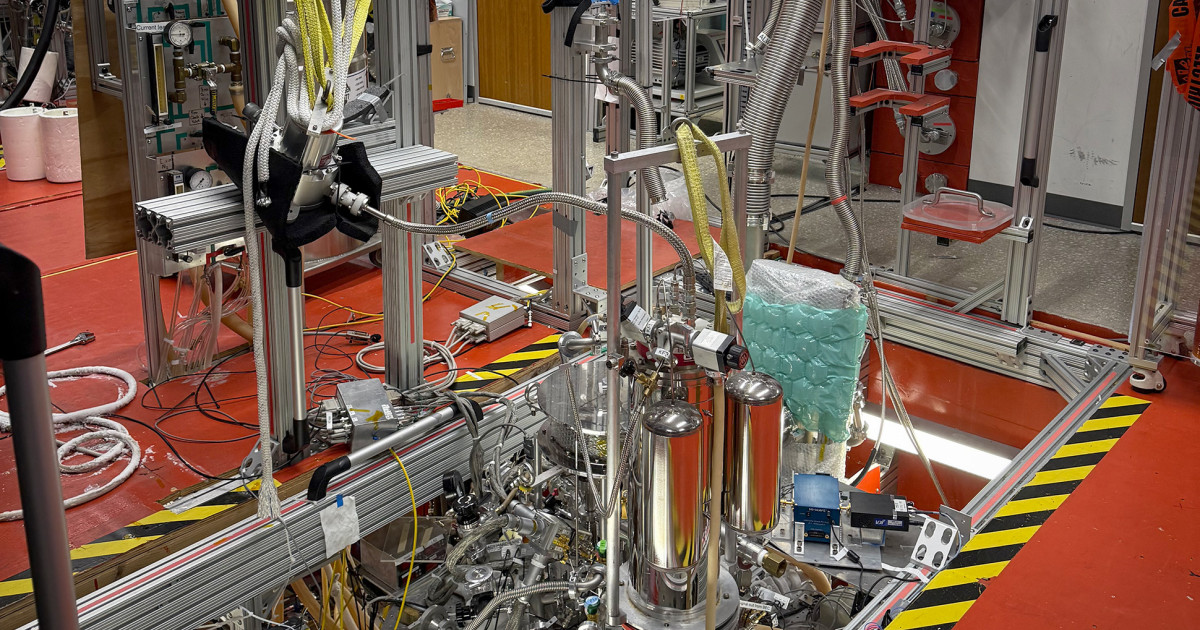
A positron can annihilate when it encounters an electron, making an ordinary storage jar a very short-lived solution. Northwestern’s trap instead uses electric and magnetic fields to suspend the particle away from material surfaces. The apparatus still has walls; the positron doesn’t get to meet them. Source
According to the university, the team slowed a positron produced through the radioactive decay of sodium-22 and guided it into a near-perfect vacuum. The trap’s interior was cooled to about 300 millikelvins, or 0.3 kelvin above absolute zero. Source
Study leader Gerald Gabrielse said the cooling puts the positron in its quantum ground state, the lowest quantum energy state it can occupy. “We actually coaxed this very fast positron to sit there and behave for months at a time,” he said in Northwestern’s announcement. Source Source
This wasn’t just long-term parking. The researchers used carefully tuned microwaves to change the positron’s individual quantum energy states and detected the resulting transitions. They call the system a “one-positron quantum cyclotron.” Source
The big comparison is still ahead
In earlier work, Gabrielse’s team measured the electron’s magnetic moment—a measure of its magnetism—to about one part in 10 trillion. The researchers plan to make a corresponding measurement with the positron and compare the two. Source
Northwestern says an unexpected mismatch could expose a weakness in the Standard Model, the theory describing fundamental particles and three of the four fundamental forces. The university connects that search to a larger unresolved question: why the observable universe contains overwhelmingly more matter than antimatter. Source
“Current theories suggest that there will be no difference in the two measurements,” Gabrielse said. Source




Comments