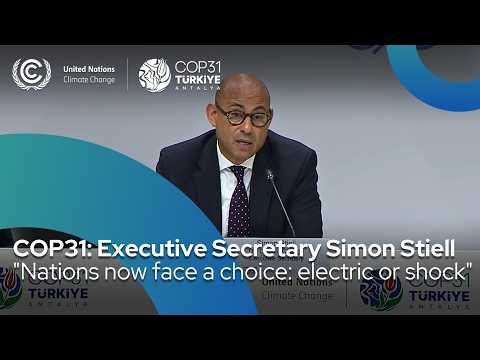
Turkey’s proposal to raise electricity’s share of global final energy consumption to 35% by 2035 has backing from more than 75 countries and a place in COP31’s draft statement, Nature reported on November 20. Source
Carbon Brief’s November 19 analysis said the summit’s second draft “cover decision” retained the electricity target but removed any mention of fossil fuels. COP31 president Murat Kurum stressed: “This is not the final text”. Source
What ‘35 by 35’ would require
New Scientist describes “35 by 35” as a voluntary global target covering final energy: the energy delivered to consumers. Electricity supplies an estimated 23.4% of that total, according to its report. The goal is about electricity’s share of energy use, not the percentage of electricity generated from renewables. Source
Electricity’s share has risen by only 6.7 percentage points since 2000. Reaching the proposed target would require the pace of electrification to quadruple compared with 2000–2025, or triple compared with 2020–2025, New Scientist calculates. There’s a lot of rewiring hiding inside that tidy slogan. Source
Judit Hecke of the New Climate Institute told New Scientist that acceleration is possible, but “the challenge is getting policies, investment and infrastructure moving at the same pace”. Source
Oxford’s Jan Rosenow considers the target achievable because electric vehicles, heat pumps and electric industrial heating are often the cheapest options, New Scientist reports. He also argues that electric technologies’ greater efficiency can cut fossil-fuel use even on today’s grids. Source
The fuel behind the socket still matters
As Hecke points out in New Scientist, electricity qualifies regardless of how it is generated. A country could help advance the global target while still relying heavily on coal and gas for power. A plug is not a clean-energy certificate. Source
According to Carbon Brief, the draft’s electrification language explicitly describes the target as complementary to efforts to triple global renewable capacity and double the global average annual rate of energy-efficiency improvements by 2030. It also names storage, system flexibility, modern and resilient grids, and improved energy access. Source
IRENA told New Scientist that reaching 35% electrification by 2035 would not meet global temperature goals on its own. Hecke urged governments to advance electrification, renewables and efficiency together, and explain how they would deliver the target nationally. Source


Comments