OpenAI model disproves a longstanding mathematical conjecture on unit circle grid-point intersections
The proof builds on assumptions established by Paul Erdős.
If you read last week's OpenAI post about their (quite impressive) math breakthrough, you probably got to this diagram and had no idea what you were looking at. I know I didn't. Now you can read @chi_t_williams's article explaining it and the rest of the result.
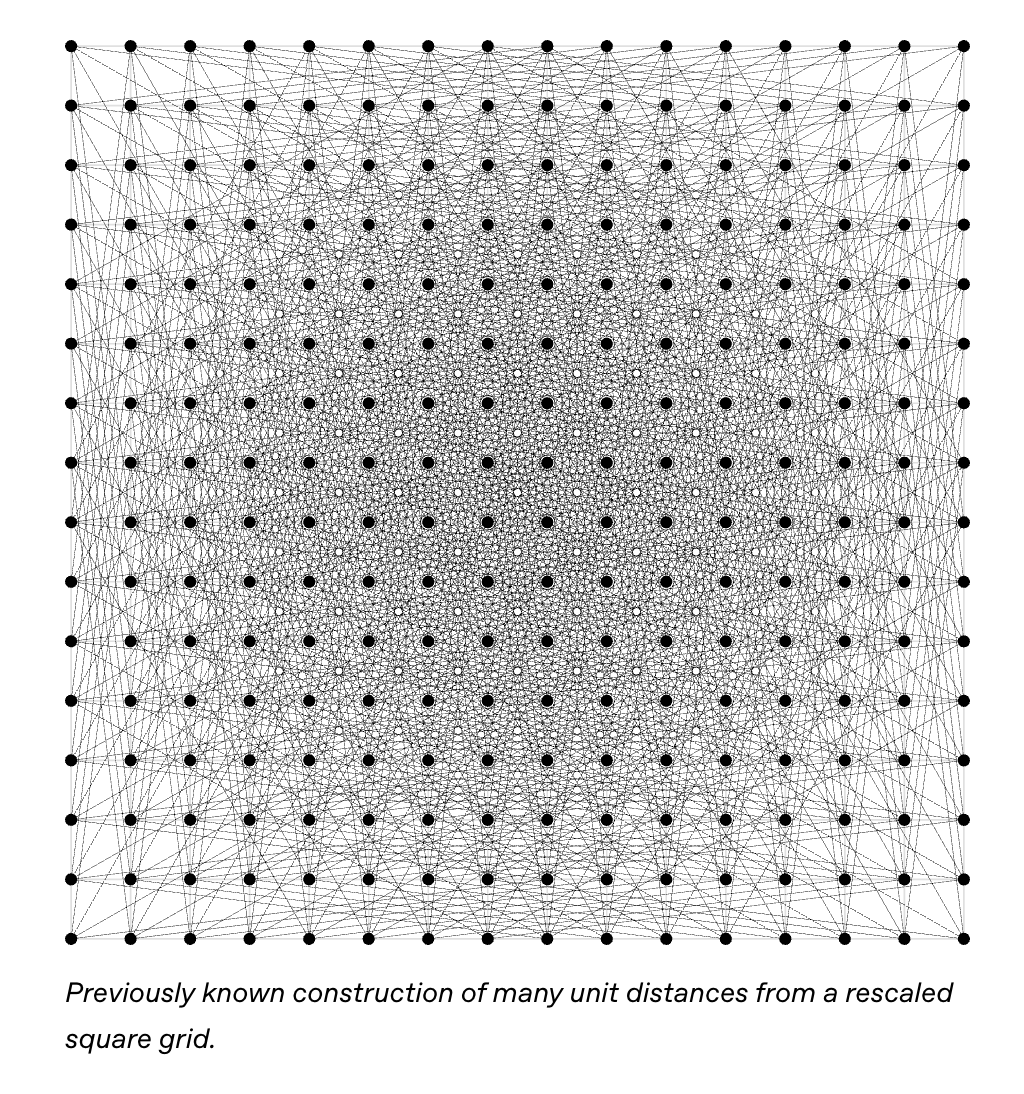
The unit distance problem tries to calculate how many points in a plan can be exactly one unit apart. Erdos tried to do this by placing points on a grid. He realized that if you pick exactly the right grid size, you can have a bunch of one-away diagonals. Like this:

 Timothy B. Lee@binarybits
If you read last week's OpenAI post about their (quite impressive) math breakthrough, you probably got to this diagram and had no idea what you were looking at. I know I didn't. Now you can read @chi_t_williams's article explaining it and the rest of the result.
OpenAI's diagram showed a scenario with grid points 1/√65 apart. This should have led to points in the middle being 1 away from 16 neighbors, though (ironically) this meant the unit circle is larger than the grid and so no point is actually 1 away from 16 others.
 Timothy B. Lee@binarybits
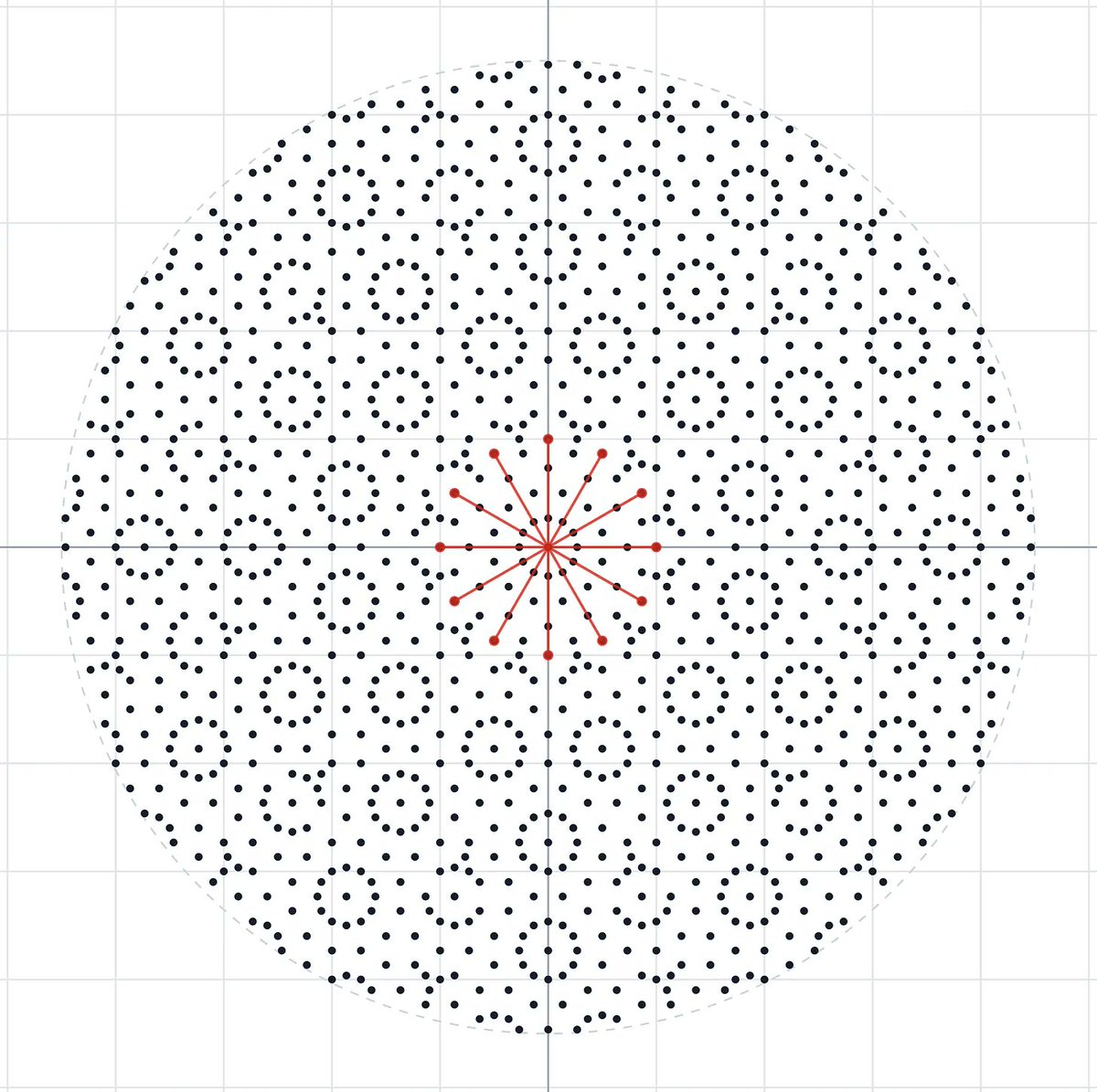
For example, if the grid points are 1/5 apart, then each point will be 1 unit away from 12 points, as illustrated here:
Anyway, Erdos's conjecture was that this grid construction would produce (close to) the maximum number of unit-distance pairs. But it turns out this is wrong! OpenAI's Ai came up with another arrangement of points works better when the number of points is large.
Timothy B. Lee@binarybitsOpenAI's diagram showed a scenario with grid points 1/√65 apart. This should have led to points in the middle being 1 away from 16 neighbors, though (ironically) this meant the unit circle is larger than the grid and so no point is actually 1 away from 16 others.
It's hard to draw this alternative pattern because it only produces more unit-distance pairs when you have many points. But @chi_t_williams generated a similar pattern with hundreds of points here. It's pretty.
 Timothy B. Lee@binarybits
Anyway, Erdos's conjecture was that this grid construction would produce (close to) the maximum number of unit-distance pairs. But it turns out this is wrong! OpenAI's Ai came up with another arrangement of points works better when the number of points is large.
@chi_t_williams Read a full explanation of the OpenAI result, and its implications for math, in Kai's post. https://www.understandingai.org/p/openais-milestone-math-breakthrough
Timothy B. Lee@binarybitsIt's hard to draw this alternative pattern because it only produces more unit-distance pairs when you have many points. But @chi_t_williams generated a similar pattern with hundreds of points here. It's pretty.
Other news outlets hand-waved past the substance of OpenAI's big math breakthrough last week. But I realized I had a math major on my team and I could get him to actually explain the result.

@chi_t_williams went to a math conference in January, so he was well placed to assess the announcement's larger significance.
 Timothy B. Lee@binarybits
Other news outlets hand-waved past the substance of OpenAI's big math breakthrough last week. But I realized I had a math major on my team and I could get him to actually explain the result.
@chi_t_williams https://www.understandingai.org/p/openais-milestone-math-breakthrough
Timothy B. Lee@binarybits@chi_t_williams went to a math conference in January, so he was well placed to assess the announcement's larger significance.