• Home
  • Technology
  • Gaming
  • Entertainment
  • World & Business
  • Science
  • Sports
  • AI
HomeTechnologyGamingEntertainmentWorld & BusinessScienceSportsAI
AI
Report

Past experiment records reportedly improve an LLM's predictions of research outcomes

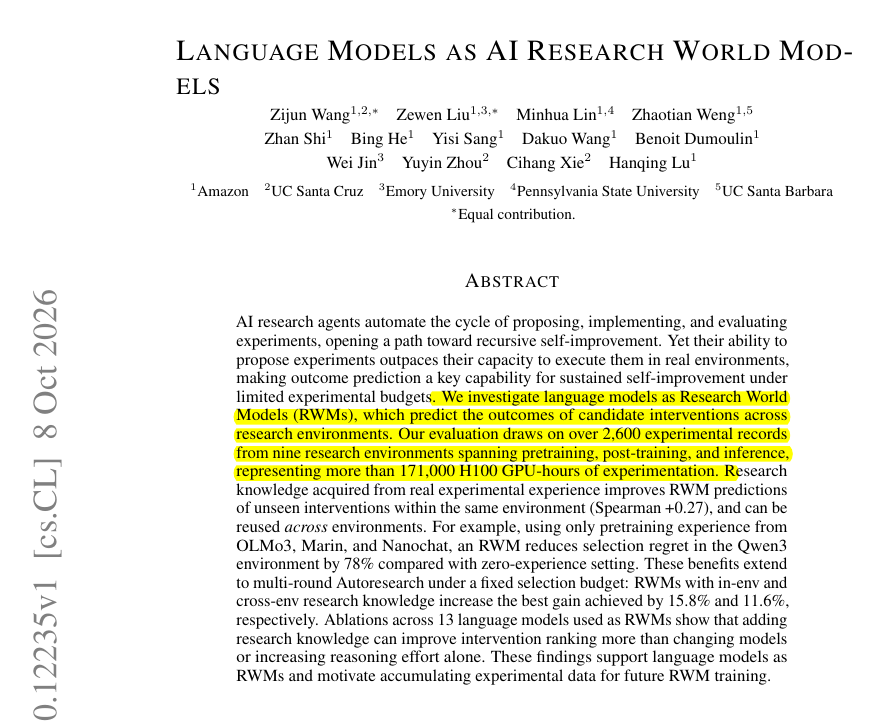
A post on an Amazon paper says same-setup records raised average ranking correlation from 0.506 to 0.774 across five setups.

1 Source, 1h ago, first seen 1h ago

TLDR

A post describing an Amazon paper says an LLM was tested on 2,653 experiment records across nine setups, from pretraining to inference. Past records from the same setup reportedly raised average ranking correlation with actual results from 0.506 to 0.774 across five setups. On OLMo3-100M, adding records at low reasoning effort scored 0.892, versus 0.648 at maximum effort without records. The author recommends logging failures, too, to help choose future experiments.

Combined views

—

1 Source, first seen 1h ago

— likes— comments— saves— reposts

Combined views

—

1 Source, first seen 1h ago

— likes— comments— saves— reposts

Sentiment

Positive——Negative

Summary

Not enough discussion yet.

No sentiment analysis available yet.

Featured Source

Sentiment

Positive——Negative

Summary

Not enough discussion yet.

No sentiment analysis available yet.

1 Source

Rohan Paul@rohanpaul_aiNew Amazon paper shows that an LLM can act as a research world model, predicting whether a training change will help before anyone spends GPU time on it. AI research agents can propose experiments far faster than teams can afford to run them. Choosing what gets GPU time means guessing outcomes in advance. They used an LLM as a research world model that predicts an experiment's gain before it runs. They tested it on 2,653 real experiment records from 9 setups, from pretraining to inference. Past records from the same setup raised average ranking correlation with actual results from 0.506 to 0.774 across 5 setups. On the OLMo3-100M setup, adding records at low reasoning effort scored 0.892, while max effort without records reached 0.648. If you run research agents, log every experiment, including failures, and feed those records to whatever model picks the next run.1h
    • Home
    • Technology
    • Gaming
    • Entertainment
    • World & Business
    • Science
    • Sports
    • AI

    1 Source

    Rohan Paul@rohanpaul_aiNew Amazon paper shows that an LLM can act as a research world model, predicting whether a training change will help before anyone spends GPU time on it. AI research agents can propose experiments far faster than teams can afford to run them. Choosing what gets GPU time means guessing outcomes in advance. They used an LLM as a research world model that predicts an experiment's gain before it runs. They tested it on 2,653 real experiment records from 9 setups, from pretraining to inference. Past records from the same setup raised average ranking correlation with actual results from 0.506 to 0.774 across 5 setups. On the OLMo3-100M setup, adding records at low reasoning effort scored 0.892, while max effort without records reached 0.648. If you run research agents, log every experiment, including failures, and feed those records to whatever model picks the next run.1h
    Today's Rank

    #9

    Today's Rank

    #9