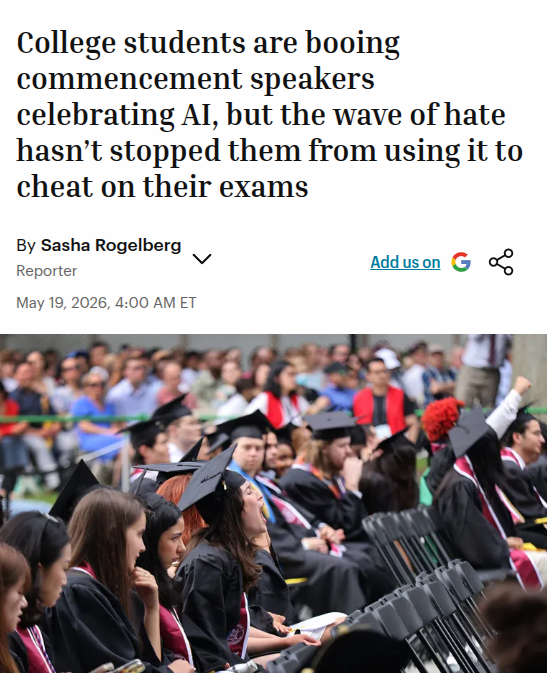
Eric Schmidt draws boos from Arizona State University graduates for every reference to artificial intelligence in his commencement address
Similar reactions hit other recent U.S. graduation speeches amid job loss fears.

 #153Gary Marcus@GARYMARCUS
So, should the AI industry go “all in” on its own Vietnam war?!
 @jason@Jason
AI is Gen Z’s Vietnam: they want nothing to do with it and they are vocally opposing it — small to no chance they stop it, but a trend worth monitoring.
#153Gary Marcus@GARYMARCUS@Jason Maybe the analogy goes much further than you think: given the economics, LLMs could easily turn out to be the tech industry’s Viet Nam, arrogant and ultimately a huge, arrogant waste of resources.
#153Gary Marcus@GARYMARCUS‼️ Could large language models turn out to be the tech industry’s Vietnam?
All In’s @jason notes below that today’s students are speaking out against AI, just as students in the 60s and 70s spoke out against the Vietnam war.
But I think the analogy might run deeper. In the Vietnam war, the US invested massively in a huge, disastrous campaign that drained resources and achieved nothing, fueled by arrogance; the war moved forward for years despite evidence that it wasn’t working as planned.
Could the multitrillion dollar investment in AI, burning money at unprecedented rates, and still struggling with hallucinations, unreliability and misalignment – even after massive investments, turn out to be another epic arrogance-fueled mistake?
@jason@JasonAI is Gen Z’s Vietnam: they want nothing to do with it and they are vocally opposing it — small to no chance they stop it, but a trend worth monitoring.
#153Gary Marcus@GARYMARCUS👇@jason’s Vietnam vs AI backlash comparison below is fascinating. But maybe it goes in a really different direction than the one he suggests.
@jason’s point is that today’s students are speaking out against AI, just as students in the 60s and 70s spoke out against the Vietnam war.
But there’s another analogy, too, to one of the world’s great powers investing in a huge, disastrous campaign that drained resources and achieved nothing, fueled by arrogance; it moved forward for years despite evidence that the war wasn’t working as planned.
Could the multitrillion dollar investment in AI, burning money at unprecedented rates, turn out to be similar, another epic mistake of bad forecasting and arrogance, decried by youth and ultimately futile?
@jason@JasonAI is Gen Z’s Vietnam: they want nothing to do with it and they are vocally opposing it — small to no chance they stop it, but a trend worth monitoring.
 #1032Rohan Paul@ROHANPAUL_AI
College students are booing AI praise at graduation while using the same tools to finish work, cheat on exams, and survive a job market they think AI is already reshaping.
The split is not hypocrisy so much as pressure meeting resentment.
---
fortune .com/2026/05/19/college-students-booing-commencement-speakers-ai-cheating-cognitive-dissonance/
 Rohan Paul@rohanpaul_ai
College Students are booing graduation speakers for celebrating AI. But I dont get what exactly are they booing? They’re in the best position to use AI natively this early in their careers.
College Students are booing graduation speakers for celebrating AI. But I dont get what exactly are they booing? They’re in the best position to use AI natively this early in their careers.
 #1032Rohan Paul@ROHANPAUL_AIRohan Paul@rohanpaul_ai
College students are booing AI praise at graduation while using the same tools to finish work, cheat on exams, and survive a job market they think AI is already reshaping. The split is not hypocrisy so much as pressure meeting resentment. --- fortune .com/2026/05/19/college-students-booing-commencement-speakers-ai-cheating-cognitive-dissonance/
#1061@jason@JASONAI is Gen Z’s Vietnam: they want nothing to do with it and they are vocally opposing it — small to no chance they stop it, but a trend worth monitoring.
 #1498Sharon Goldman@SHARONGOLDMAN
A perfect example of a leader like Eric Schmidt touting some real long-term opportunities of AI (science, health) while speaking to students whose total interaction with AI has been four years of chatbots, image generators, and hearing AI leaders warn about white collar job loss. And if the kids take a moment to Google (or ask ChatGPT/Claude about) Schmidt, they can read about his proposal for Mutual AI Malfunction (a hypothetical AI doomsday scenario). Truly tone-deaf.
@jason@JasonHere’s the longer version of Eric Schmidt’s commencement speech from Arizona State & an AI transcript. Every mention of AI, instantly booed. ─── Every profession, every classroom, every hospital, every laboratory, every person, and every relationship you have. I know what many of you are feeling about that. I can hear you. There is a fear. There is a fear in your generation. And that the future has already been written, that the machines are coming, that the jobs are evaporating, that the climate is breaking, that politics is fractured, and that you are inheriting a mess that you did not create. And I understand that fear. It's rational. And it's amplified every day by social media platforms, with algorithms that have learned with great precision, that fear earns clicks, and that anxiety drives engagement. But I want to say something to you this evening as clearly as I can. To speak of the future, as though it has already been decided, is to surrender the one thing that actually matters. You are surrendering your agency. The future does not simply arrive. It gets built in laboratories, in dormitories, in startups, in classrooms, in legislators, and the people building it will be you and people like you. The question is not whether AI will shape the world — it will. The question is whether you will help shape artificial intelligence. We do not know the precise contours of what this transformation will look like. But what we do know is it will require each of us to adapt in ways that we cannot yet anticipate. My hope is that you will choose to engage, that you choose to be in the room where these decisions take place, and to have a voice in how they're made. When you are in that room, bring something with you — bring the values that make us human in the first place. The technology on its own is just a tool. It will optimize for what we tell it to optimize for. But somebody has to decide, and in your lifetime, that somebody is going to be you. So choose freedom. Choose open debates, and the slow, often messy, but beautiful project of learning to live alongside people with whom you disagree. Choose equality. Choose a diversity of perspectives, including the perspective of the immigrant, who has so often been the person who came to this country and made it better. America is at its best when we are the country that ambitious people want to come to. Let us not lose that. But above all, choose respect for one another, and for the basic unfashionable idea that the person on the other side of the argument is still a person. If we build artificial intelligence to reflect those values, the world will be unimaginably better for it. So let me tell you how hopeful I am about that, because on balance, I am deeply optimistic, and I believe that you should be as well. So consider science. So much of human progress is the story of science and medicine, and artificial intelligence is already accelerating research at a rate that we could not have imagined even five years ago. We have only seen maybe one percent of what is to come. AI is now designing new molecules, running simulations, identifying patterns in genomic data that no team of humans could uncover in a lifetime. AI has solved the 50-year-old protein folding problem in a matter of months. The next generation of antibiotics will come from this work. The next generation of cancer treatments will come from this work. The materials that will allow us to scale clean energy will come from this work. Or look at astronomy, a field in which this university excels. The team at the Steward Observatory are building a telescope more powerful than Hubble. That work, which is changing the understanding of the universe, is happening right here in Tucson right now.
 #1988Daniel Jeffries@DAN_JEFFRIES1
Eric Schmidt should’ve stopped mid-speech and said:
“Fine. Boo AI.
But make your next Preply class Chinese, because the civilization cheering this stuff is not waiting for you to finish your campus struggle session.”
China’s grandmas are lining up to install AI tools. Chinese developers are shipping open-source models like their hair is on fire. Their public is overwhelmingly positive about AI (83% feel positive about the future while in the west we are circling the drain around 30%). Their companies are moving fast, copying fast, improving fast, innovating fast, deploying fast.
And in America?
Our most educated children boo the mere mention of the most important technology since electricity.
Why?
Because our AI leadership class has spent three years doing the dumbest possible PR campaign in the history of technology.
One half of them tells everyone AI will kill them.
The other half tells everyone AI will take every white-collar job in 18 months.
Then the closed-model cartel runs to DC whispering that ordinary people cannot be trusted with powerful open-source AI, that the future must be locked behind a handful of corporate APIs, safety boards, export controls, permission slips, and East India Company monopolies.
And everyone acts shocked when the kids hate it.
You told them AI means unemployment.
You told them AI means extinction.
You told them AI means no future.
Then you walk onto a graduation stage and say “AI” and wonder why they boo.
This is what strategic suicide looks like.
The country that taught the world to love computers, the internet, open source, startups, hackers, builders, weirdos, tinkerers, and permissionless innovation is now teaching its children to fear the next platform shift.
Meanwhile China looked at AI and said: deploy it, open it, copy it, improve it, integrate it, normalize it.
We looked at AI and said: regulate it, monopolize it, catastrophize it, litigate it, protest the datacenters, ban the open models, blame every layoff on it, then act mystified when the public thinks it’s a demon machine.
NIMYBs are moving from blocking housing to blocking datacenters. The same folks that stopped nuclear, the cleanest energy we have, are now joining hands with the NIMYBs. The hard right nationalists in Bannon and the hard left socialists in Bernie are joining hands in a new American party with mad Max Tegmark spending billions to terrify children about AI. Wonder what they'll call themselves? Maybe the National Socialists?
The West does not have an AI capability problem.
It has an AI civilizational-confidence problem.
And if we keep telling our kids that the future is something to boo, don’t be surprised when the future answers back in Mandarin.