6h ago

Naturalistic Computational Cognitive Science Preprint Updated With Expanded RL And Neuroscience Examples

0
Original post

We've updated the preprint of our Naturalistic Computational Cognitive Science paper — we've clarified and streamlined the arguments, and expanded examples where we see increasing naturalism already yielding new theoretical insights, from RL to perceptual neuroscience. 1/4

Two examples of naturalistic computational cognitive science. Given a computational theory, researchers generate initial predictions to test their theory in a simplified setting. Theories are validated by their ability to predict human behavior in increasingly naturalistic conditions, and refined where they fail to predict correctly. (Top) Progression of theories of sequential task generalization. (Bottom) Examples of progression in understanding PRC involvement in difficult visual judgments..
7:12 AM · May 26, 2026 View on X

We've also clarified why we think shared, dynamic benchmarks that the community builds (and builds on) can be a valuable focal point for cumulative, generalizable science. 2/4
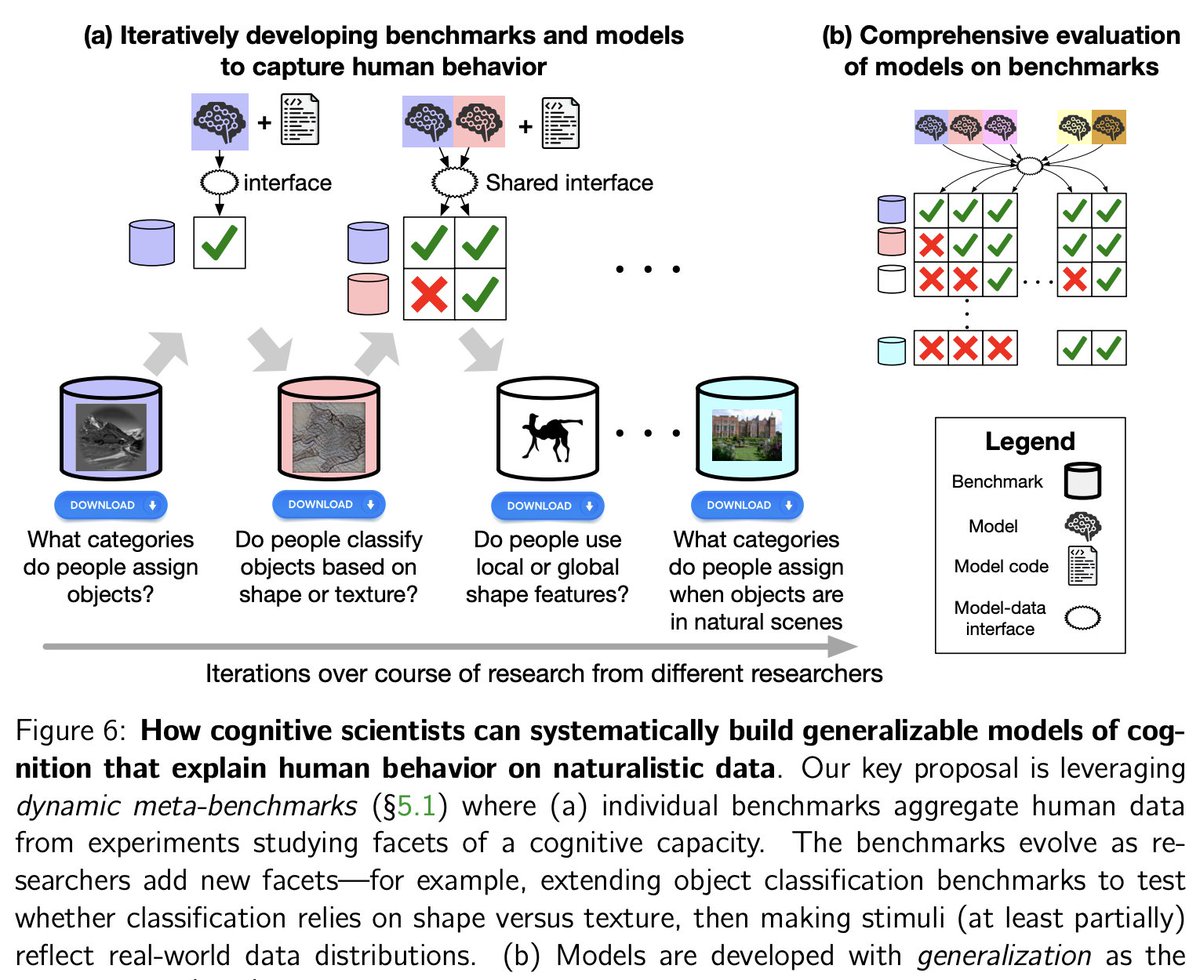

How cognitive scientists can systematically build generalizable models of cognition that explain human behavior on naturalistic data. Our key proposal is leveraging dynamic meta-benchmarks (§5.1) where (a) individual benchmarks aggregate human data from experiments studying facets of a cognitive capacity. The benchmarks evolve as researchers add new facets—for example, extending object classification benchmarks to test whether classification relies on shape versus texture, then making stimuli (at least partially) reflect real-world data distributions. (b) Models are developed with generalization as the
primary goal (§5.2): the same model should predict human behavior across all benchmark facets. (c) To facilitate frictionless reproducibility (§5.3), models are evaluated through a standardized interface. (d) This makes it easy for researchers to comprehensively evaluate their hypothesis (i.e. model) against a large swath of human behavioral data capturing different facets of a cognitive
Andrew LampinenAndrew Lampinen@AndrewLampinen

We've updated the preprint of our Naturalistic Computational Cognitive Science paper — we've clarified and streamlined the arguments, and expanded examples where we see increasing naturalism already yielding new theoretical insights, from RL to perceptual neuroscience. 1/4

2:12 PM · May 26, 2026 · 3.5K Views
2:12 PM · May 26, 2026 · 558 Views

And we've elaborated how theoretical progress is possible even when experimental paradigms and models get more complex — using parametric manipulation to maintain experimental control, and coupling models to reductions like other simpler models, or rational analysis. 3/4

Building from naturalistic experiments to cognitive theories:

An overview of how we can develop theories with potentially opaque models and unnatural manipulations of natural data: building task-performing models that can reproduce behavior across naturalistic and unnatural stimuli, while tightly coupling them to reductive explanations.
Andrew LampinenAndrew Lampinen@AndrewLampinen

We've also clarified why we think shared, dynamic benchmarks that the community builds (and builds on) can be a valuable focal point for cumulative, generalizable science. 2/4

2:12 PM · May 26, 2026 · 558 Views
2:12 PM · May 26, 2026 · 626 Views