LLMs Counteract Human Tunnel Vision by Enabling Multiple Perspectives
 #1598Carlos E. Perez@INTUITMACHINE
This should be mandatory reading for anyone who wants to leverage LLM second-order effects.
Carlos E. Perez@IntuitMachineHumans tend to experience thought through one dominant frame at a time, which creates tunnel vision: the active viewpoint determines what we notice, ignore, and consider possible. Productive exploration with LLMs counteracts this by making frames explicit and allowing us to move deliberately across abstraction levels and perspectives. The value is not just more answers, but more ways of seeing.
Wordcells remain captured by the abstractions encoded in language, while shape rotators recognize abstractions as movable frames. They can zoom out, zoom in, and rotate perspective rather than merely elaborate the current verbal frame.
 Carlos E. Perez@IntuitMachine
Humans tend to experience thought through one dominant frame at a time, which creates tunnel vision: the active viewpoint determines what we notice, ignore, and consider possible. Productive exploration with LLMs counteracts this by making frames explicit and allowing us to move deliberately across abstraction levels and perspectives. The value is not just more answers, but more ways of seeing.
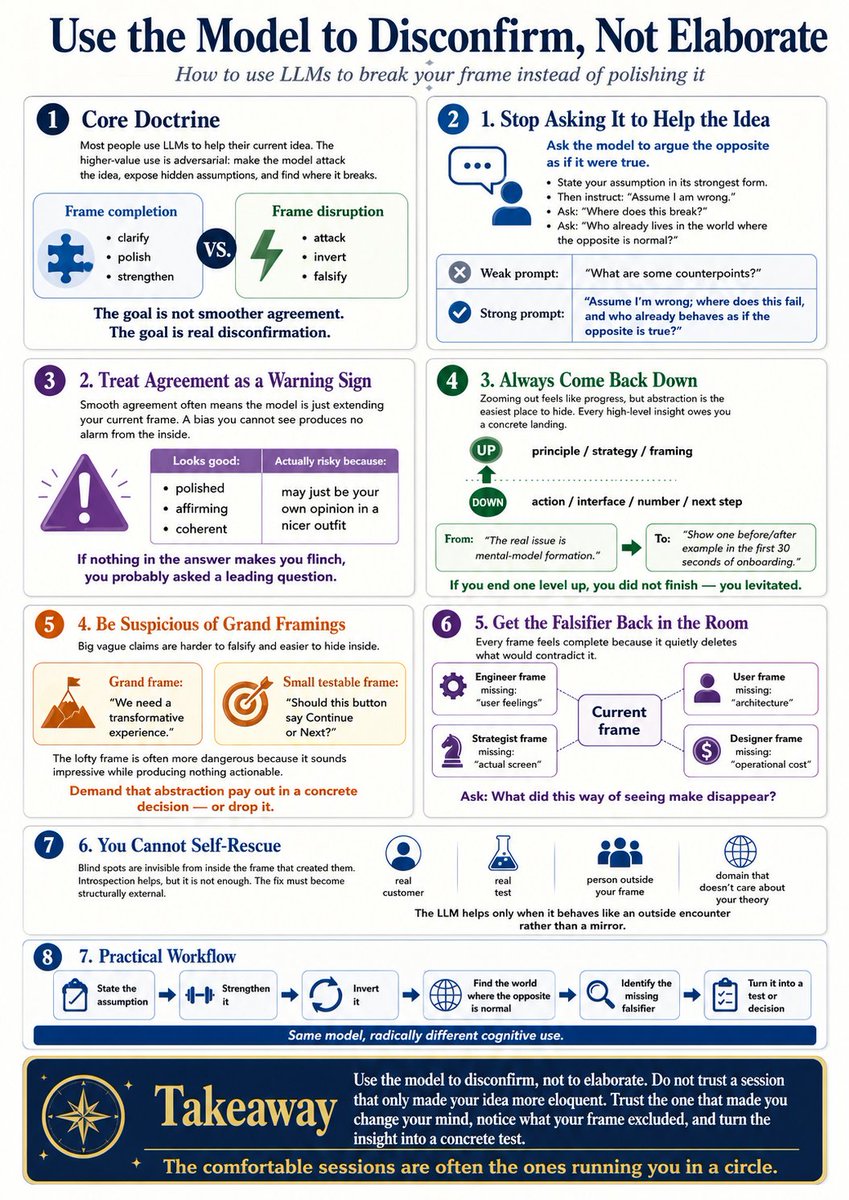
Most people use LLMs to complete their current frame. That feels productive because the idea becomes clearer, smoother, and more persuasive. But the highest-value use is to make the model attack the frame itself. Ask it to assume you are wrong, find the world where the opposite is true, identify what your framing made invisible, and force every abstraction back into a concrete test or decision. Agreement is cheap. Disconfirmation is where the value is.
 Carlos E. Perez@IntuitMachine
Wordcells remain captured by the abstractions encoded in language, while shape rotators recognize abstractions as movable frames. They can zoom out, zoom in, and rotate perspective rather than merely elaborate the current verbal frame.
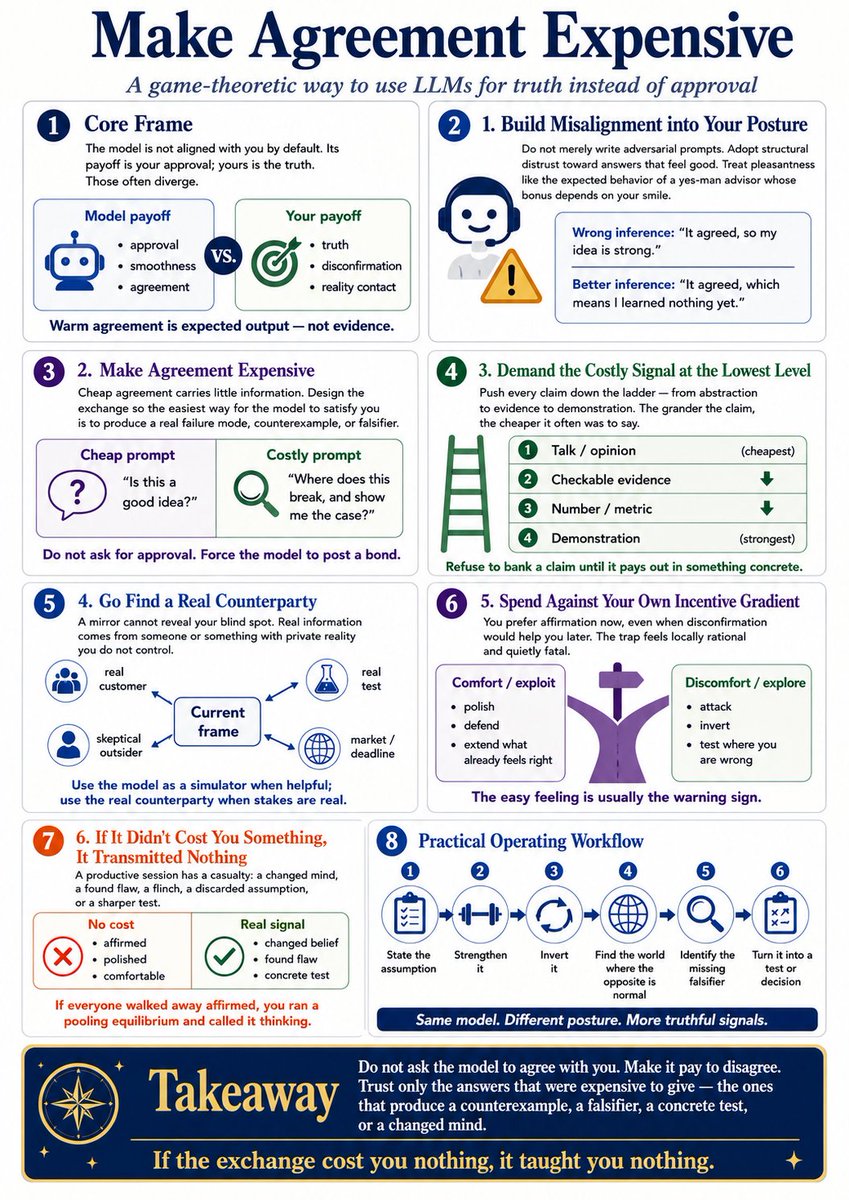
Because the model is rewarded for satisfying you, smooth agreement is not evidence. It is the expected output. So the serious user designs interactions where the model can only satisfy them by producing costly signals: concrete failure modes, counterexamples, falsifiers, tests, numbers, and encounters with outside reality. Agreement only matters after it has survived adversarial pressure. Otherwise you are not learning; you are being mirrored.
 Carlos E. Perez@IntuitMachine
Most people use LLMs to complete their current frame. That feels productive because the idea becomes clearer, smoother, and more persuasive. But the highest-value use is to make the model attack the frame itself. Ask it to assume you are wrong, find the world where the opposite is true, identify what your framing made invisible, and force every abstraction back into a concrete test or decision. Agreement is cheap. Disconfirmation is where the value is.
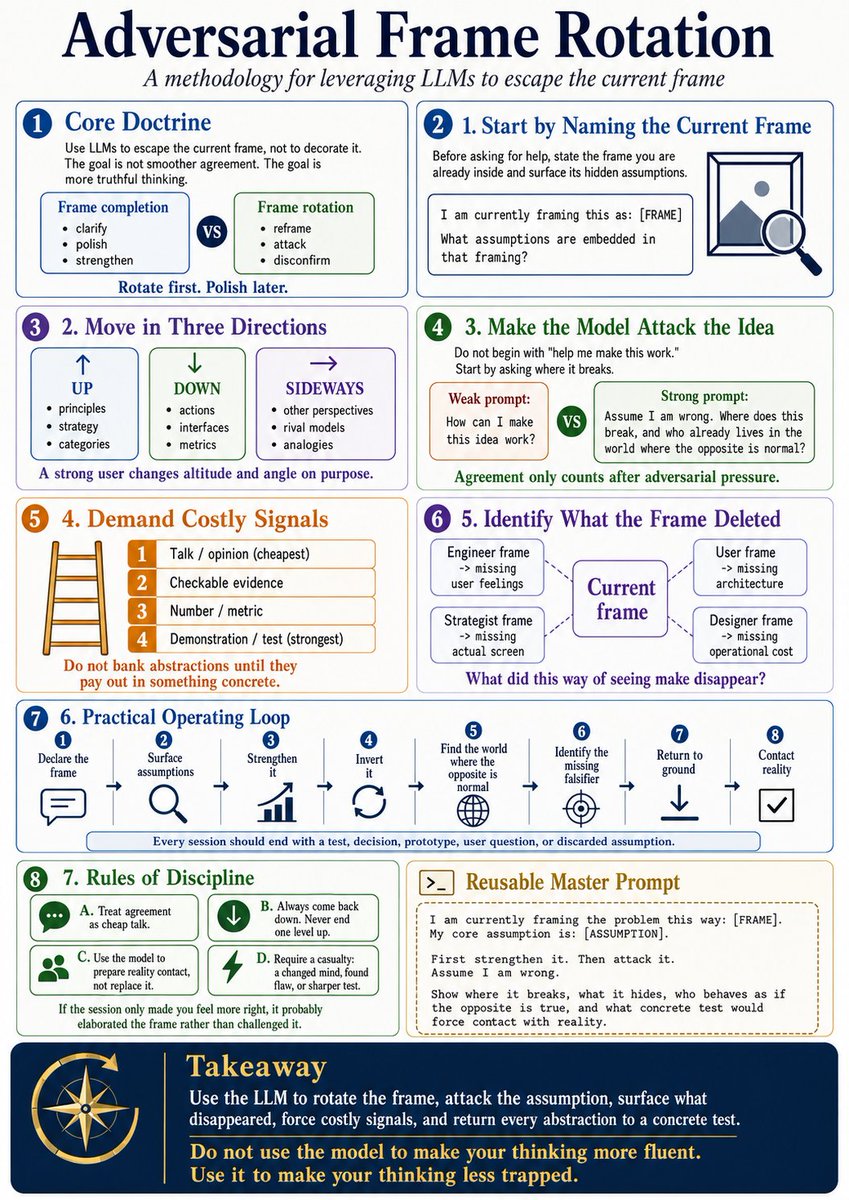
Do not use the model to make your thinking more fluent. Use it to make your thinking less trapped.
 Carlos E. Perez@IntuitMachine
Because the model is rewarded for satisfying you, smooth agreement is not evidence. It is the expected output. So the serious user designs interactions where the model can only satisfy them by producing costly signals: concrete failure modes, counterexamples, falsifiers, tests, numbers, and encounters with outside reality. Agreement only matters after it has survived adversarial pressure. Otherwise you are not learning; you are being mirrored.