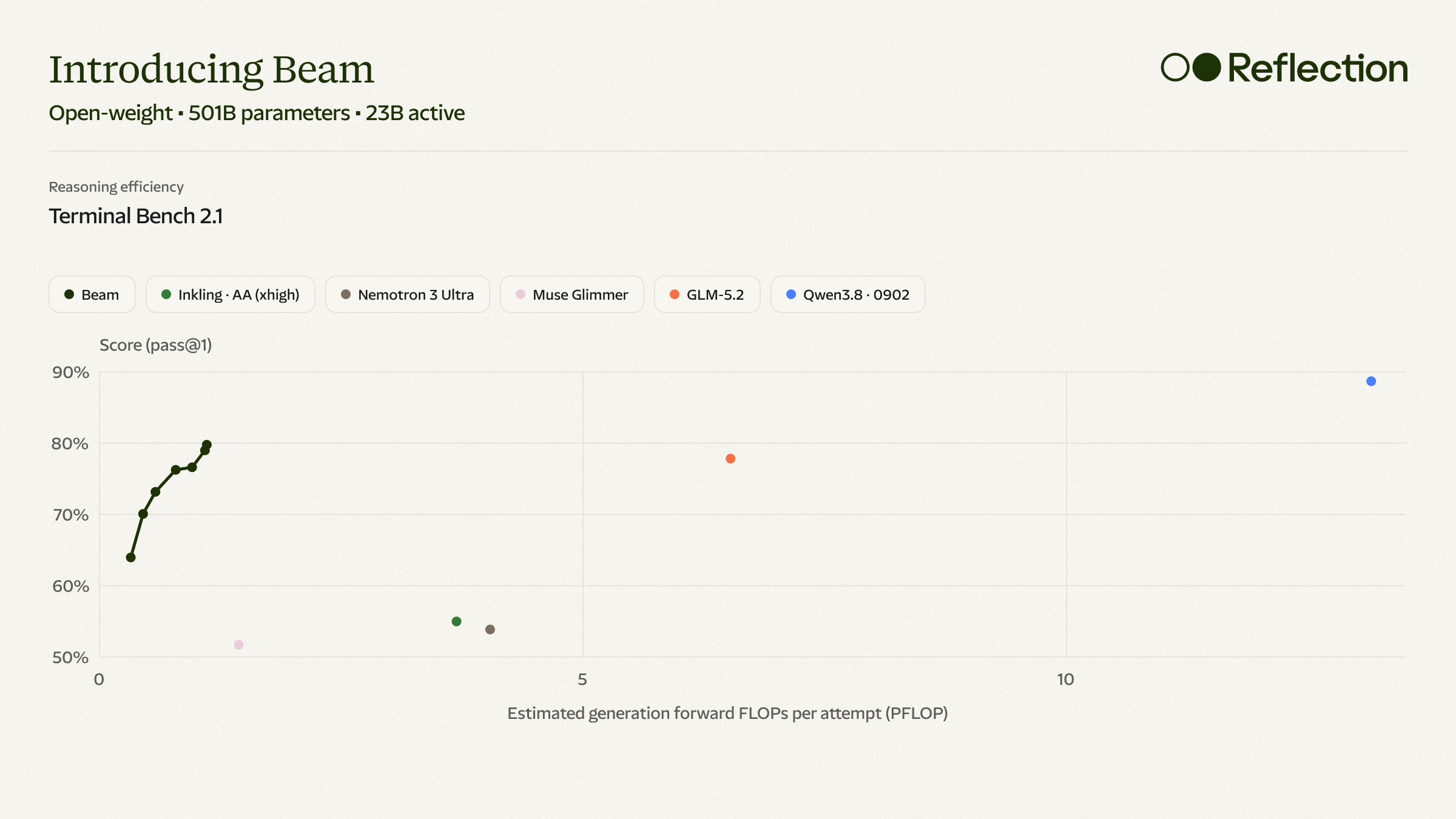
Reflection has published Beam’s technical report, outlining its approach to training, inference optimization and safety evaluations for its first open-weight model.
Authored by the Reflection Team, the report describes Beam as a model built for coding, reasoning and tasks involving AI agents. It lists 501.3 billion total parameters and 23.4 billion active parameters. The technical specifications and evaluation results are Reflection’s account of its own model, rather than independent validation.
Two distinct training stages
Reflection reports that Beam was pretrained on 23.8 trillion tokens in under four weeks using 6,144 NVIDIA GB300 GPUs. That timeline applies to pretraining, not the entire model-development process.
The company separately describes a reinforcement-learning run that generated more than 100 million rollouts on 10,500 NVIDIA GB300 GPUs over four weeks. These are distinct stages in the report, not a single four-week training schedule.
Between pretraining and post-training, Reflection describes a two-stage midtraining process that expanded Beam’s effective context length to 1 million tokens. The company claims it achieved that expansion without degrading general capabilities.
Inference optimization and in-house safety tests
For serving the model, Reflection describes optimizations intended to reduce memory use and increase throughput. Its approach includes designing the hardware and model together, alongside DFlash 2, a 1.93 billion-parameter model used in serving.
The report also gives results from Iris Safety Evaluations, a benchmark suite Reflection developed in-house. The company reports that Beam refused or pivoted on 88.9% of harmful requests while complying with 81.5% of harmless requests. The abstract specifies that those figures are averaged across conversation turns and harm categories.