Former Wired editor Chris Anderson argues intelligence has infinite demand, drawing pushback from writer Noah Smith
Smith questions why highly intelligent academics remain relatively low-paid.

@Noahpinion Just creating conditions for proper open-ended research (the kind OpenAI has just started to emulate) and selecting for people willing to do that.
 Noah Smith 🐇🇺🇸🇺🇦🇹🇼@Noahpinion
I've wondered about this. If demand for intelligence were so infinite, why do we have so.many of our smartest people sitting around doing esoteric fun stuff for smallish salaries in academia?

@Noahpinion Perhaps it is because real worth is built through manufacturing rather than gaming the system.
Noah Smith 🐇🇺🇸🇺🇦🇹🇼@NoahpinionI've wondered about this. If demand for intelligence were so infinite, why do we have so.many of our smartest people sitting around doing esoteric fun stuff for smallish salaries in academia?
@Noahpinion It's all a question of where smart people focus their attention. They focus it on what they are passionate about and its not always the accumulation of wealth.
Noah Smith 🐇🇺🇸🇺🇦🇹🇼@NoahpinionI've wondered about this. If demand for intelligence were so infinite, why do we have so.many of our smartest people sitting around doing esoteric fun stuff for smallish salaries in academia?

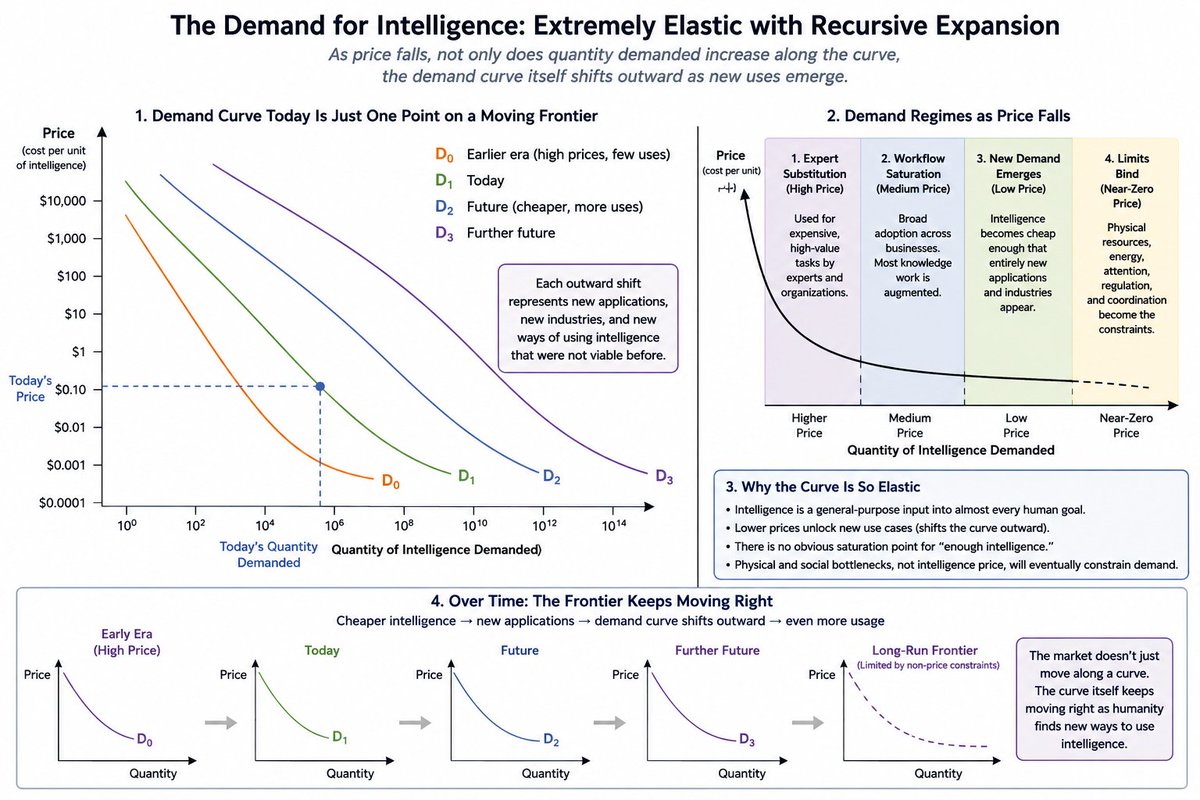
In all of human history, has there ever been a commodity with infinite demand, as there appears to be for intelligence? I can't think of one. Even compute, energy or just silicon/sand are just downstream of intelligence, which is the main demand driver.
In economics, rather than modeling the usual price/demand curve to reach an equilibrium, perhaps you'd have to model price/*rate of demand growth* (ie, the derivative of demand, or some other indicator of velocity)
Interestingly, ChatGPT (below) prefers the framework of "recursive expansion of demand" as increasing intelligence opens new applications/markets.
But the end result is the same -- the demand curve keeps moving to the right, maybe forever.
Which I think is unprecedented.