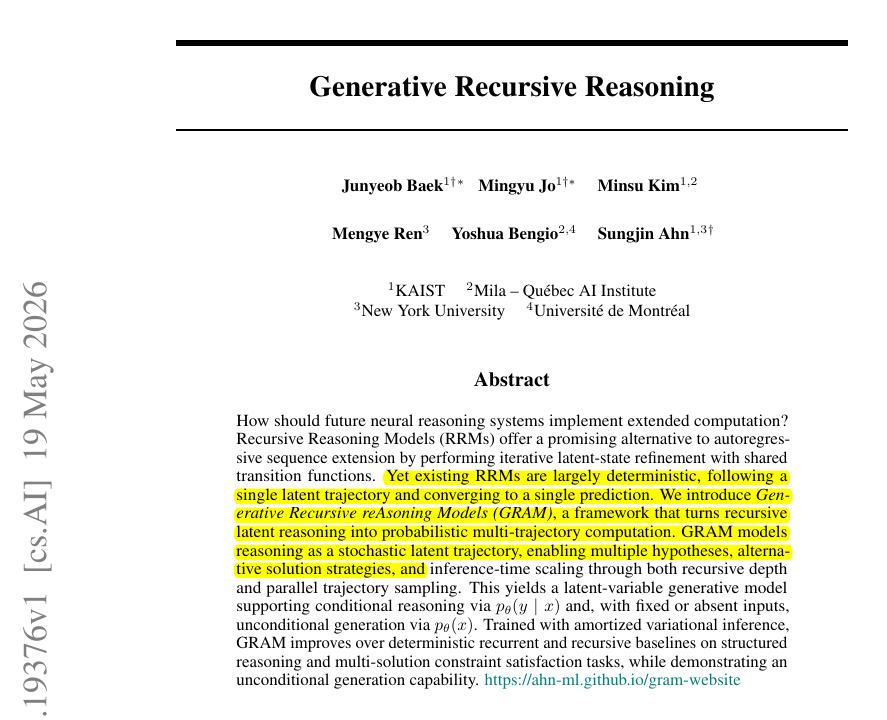
Junyeob Baek and colleagues introduce Generative Recursive reAsoning Models (GRAM) that convert deterministic recursive reasoning into stochastic latent trajectories and report 97.0% accuracy on Sudoku-Extreme with 10 million parameters
The model also scores 52.0% on ARC-AGI-1 and 44.6% on ARC-AGI-2.

 #840billy bubba@WGRATHWOHL
You know shits gonna be fire when fig1 is MNIST
 Sungjin Ahn@SungjinAhn_
🧠We introduce "Generative Recursive Reasoning"! Recursive Reasoning Models like HRM, TRM, and Looped Transformers are deterministic — same input, same reasoning, every time. They collapse the entire space of plausible reasoning paths into a single attractor. Our model GRAM (Generative Recursive reAsoning Models) turns recursion itself into a stochastic latent trajectory. Multiple hypotheses, alternative solution strategies, and inference-time scaling not just by depth, but by width — parallel trajectory sampling. And here's the kicker: the same formulation that gives us conditional reasoning p(y|x) also makes GRAM a general generative model p(x). With only 10M params: • Sudoku-Extreme: 97.0% (TRM 87.4%) • ARC-AGI-1: 52.0% • ARC-AGI-2: 11.1% • N-Queens coverage: 90%+ 📄 Paper: https://arxiv.org/abs/2605.19376 🌐 Project page: https://ahn-ml.github.io/gram-website w/ Junyeob Baek @JunyeobB (KAIST), Mingyu Jo @pyross0000 (KAIST), Minsu Kim @minsuuukim (KAIST & Mila), Mengye Ren @mengyer (NYU), Yoshua Bengio @Yoshua_Bengio (Mila), Sungjin Ahn @SungjinAhn_ (KAIST)

A 10 million parameter model just outperformed deterministic rivals 3 times its size by doing something regular recursive AI dont do: exploring multiple reasoning paths at the same time.
Most AI reasoning models are trapped on a single train of thought, and GRAM ("Generative Recursive Reasoning") is the first to break that by letting the model think in parallel universes simultaneously.
The problem is that all existing recursive models are fully deterministic, meaning given the same input they always follow the exact same reasoning path and can never escape a wrong trajectory or discover more than 1 valid answer.
GRAM fixes this by injecting learned randomness at each refinement step, so the model samples a slightly different direction each time rather than snapping to 1 fixed next state, which produces a spread of diverse reasoning trajectories.
At test time the model runs many of these paths in parallel and selects the best one using a small reward predictor trained alongside the main model, adding a "width" scaling axis on top of the usual "depth" axis of running more recursion steps.
On hard Sudoku puzzles, GRAM with 10M parameters hits 97% accuracy versus 87.4% for the best prior recursive model, and with only 20 parallel samples it outperforms every deterministic baseline even at 320 recursion steps.
On tasks with many valid answers like N-Queens, deterministic recursive models collapse as the number of solutions grows, while GRAM maintains near-perfect accuracy throughout.
The same stochastic framework also acts as a generator: given a blank board, GRAM produces valid Sudoku puzzles 99% of the time using 16 steps, versus 1,000 steps and 55M parameters for the best diffusion baseline at just 91%.
---
Paper Link – arxiv. org/abs/2605.19376v1
 #1776Super Dario@INDUCTIONHEADS
Whoa
Sungjin Ahn@SungjinAhn_🧠We introduce "Generative Recursive Reasoning"! Recursive Reasoning Models like HRM, TRM, and Looped Transformers are deterministic — same input, same reasoning, every time. They collapse the entire space of plausible reasoning paths into a single attractor. Our model GRAM (Generative Recursive reAsoning Models) turns recursion itself into a stochastic latent trajectory. Multiple hypotheses, alternative solution strategies, and inference-time scaling not just by depth, but by width — parallel trajectory sampling. And here's the kicker: the same formulation that gives us conditional reasoning p(y|x) also makes GRAM a general generative model p(x). With only 10M params: • Sudoku-Extreme: 97.0% (TRM 87.4%) • ARC-AGI-1: 52.0% • ARC-AGI-2: 11.1% • N-Queens coverage: 90%+ 📄 Paper: https://arxiv.org/abs/2605.19376 🌐 Project page: https://ahn-ml.github.io/gram-website w/ Junyeob Baek @JunyeobB (KAIST), Mingyu Jo @pyross0000 (KAIST), Minsu Kim @minsuuukim (KAIST & Mila), Mengye Ren @mengyer (NYU), Yoshua Bengio @Yoshua_Bengio (Mila), Sungjin Ahn @SungjinAhn_ (KAIST)