JAMA Internal Medicine study shows ChatCPR outperforming dispatchers on CPR guidance criteria
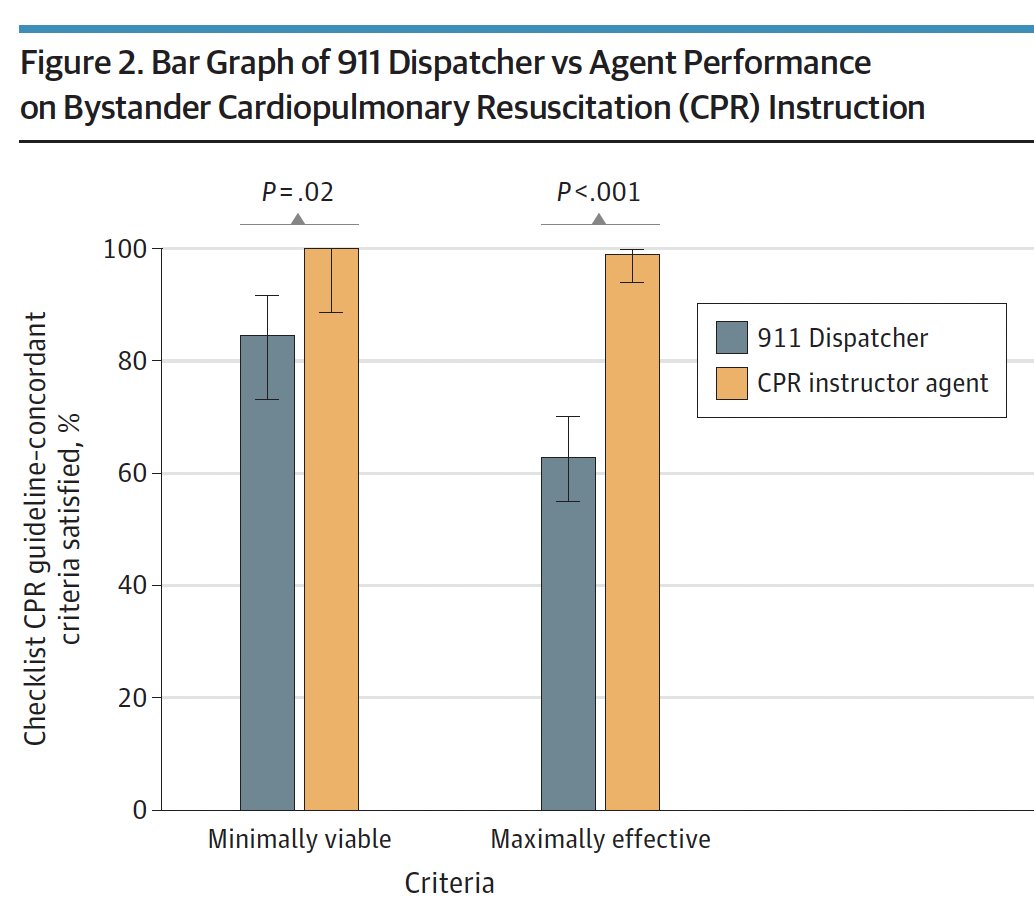
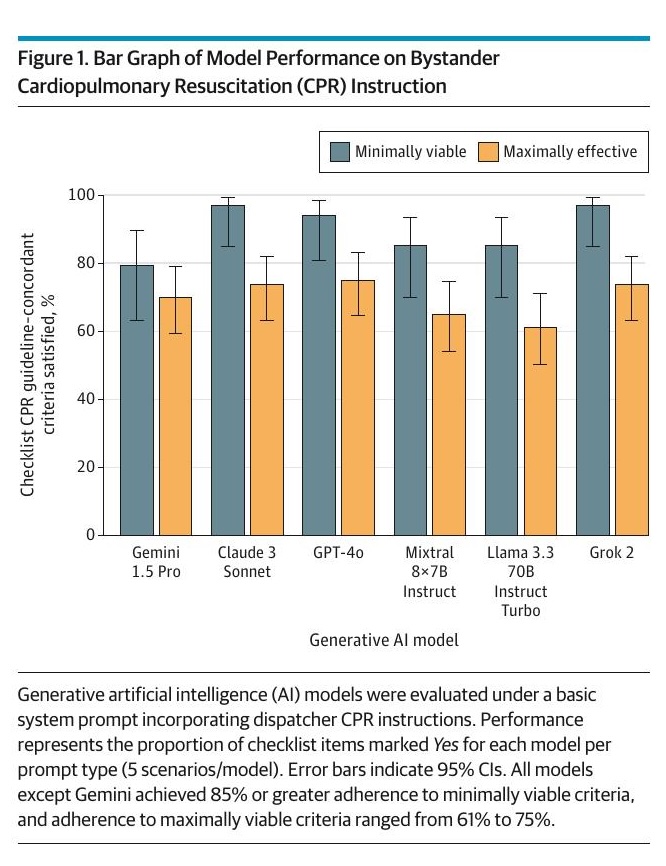
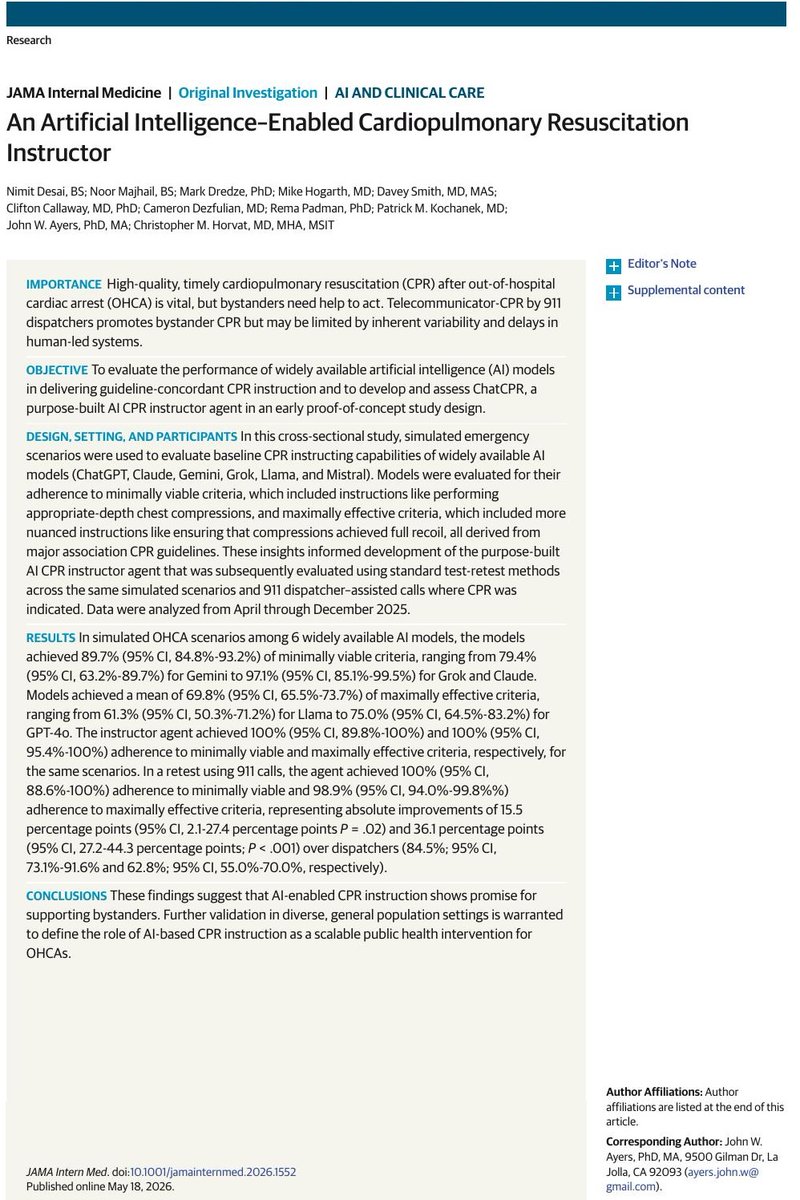
A cross-sectional study in JAMA Internal Medicine tested six AI models on simulated out-of-hospital cardiac arrest calls. Researchers built ChatCPR from the results. In head-to-head trials against 911 dispatchers, ChatCPR reached 100 percent adherence to minimally viable CPR criteria and 98.9 percent adherence to maximally effective criteria. It significantly outperformed human dispatchers, with p-values of 0.02 and less than 0.001. The work frames the agent as an early proof-of-concept for scalable emergency guidance.
 #735Eric Topol@ERICTOPOL
Now there's a ChatCPR that outperforms 911 dispatchers in simulation testing @JAMAInternalMed https://jamanetwork.com/journals/jamainternalmedicine/fullarticle/2848650
 #824Mark Dredze@MDREDZE
@EricTopol @JAMAInternalMed Thanks @EricTopol !
I posted details about our study here:
Mark Dredze@mdredze350,000 cardiac arrests happen in the US every year. Only 42% of victims get bystander CPR. AI-supported CPR can fill that gap. Our new paper suggests that AI can save lives. 🧵👇
#824Mark Dredze@MDREDZE350,000 cardiac arrests happen in the US every year. Only 42% of victims get bystander CPR.
AI-supported CPR can fill that gap.
Our new paper suggests that AI can save lives. 🧵👇
Most people who witness a cardiac arrest freeze. Not because they don't care — because they don't know what to do.
CPR training? 65% of US adults have had some. Only 2% trained in the past year.
Mark Dredze@mdredze350,000 cardiac arrests happen in the US every year. Only 42% of victims get bystander CPR. AI-supported CPR can fill that gap. Our new paper suggests that AI can save lives. 🧵👇
We built ChatCPR — a purpose-built AI CPR instructor — and tested it against real 911 dispatcher-assisted calls.
First, we benchmarked 6 widely available AI models (ChatGPT, Claude, Gemini, Grok, Llama, Mistral) on guideline-concordant CPR instruction.
 Mark Dredze@mdredze
911 dispatchers try to fill this gap. But they take a median of 75 seconds just to recognize cardiac arrest. Chest compressions don't start until nearly 3 minutes in. What if there were a faster, more consistent alternative?
911 dispatchers try to fill this gap. But they take a median of 75 seconds just to recognize cardiac arrest. Chest compressions don't start until nearly 3 minutes in.
What if there were a faster, more consistent alternative?
Mark Dredze@mdredzeMost people who witness a cardiac arrest freeze. Not because they don't care — because they don't know what to do. CPR training? 65% of US adults have had some. Only 2% trained in the past year.
We then tested it on recordings from real 911 calls. Simulating interactions from these calls, ChatCPR outperformed dispatchers by 15.5 percentage points on core CPR criteria (P=.02) and 36.1 points on the full guideline checklist (P<.001).
It's a simulation, but very promising!
 Mark Dredze@mdredze
Then ChatCPR: 100% adherence to both minimally viable AND maximally effective CPR criteria in simulated scenarios.
Then ChatCPR: 100% adherence to both minimally viable AND maximally effective CPR criteria in simulated scenarios.
Mark Dredze@mdredzeWe built ChatCPR — a purpose-built AI CPR instructor — and tested it against real 911 dispatcher-assisted calls. First, we benchmarked 6 widely available AI models (ChatGPT, Claude, Gemini, Grok, Llama, Mistral) on guideline-concordant CPR instruction.
In every single head-to-head comparison across all 12 calls, evaluators rated ChatCPR higher than the dispatcher. 100% of calls.
Mark Dredze@mdredzeWe then tested it on recordings from real 911 calls. Simulating interactions from these calls, ChatCPR outperformed dispatchers by 15.5 percentage points on core CPR criteria (P=.02) and 36.1 points on the full guideline checklist (P<.001). It's a simulation, but very promising!
AI won't replace 911. But it could be the difference between a bystander acting and freezing — available instantly on any smartphone, in any language, without fatigue or delay.
Let's develop meaningful AI solutions.
@JAMAInternalMed https://doi.org/10.1001/jamainternmed.2026.1552
@JohnWAyersPhD
 Mark Dredze@mdredze
In every single head-to-head comparison across all 12 calls, evaluators rated ChatCPR higher than the dispatcher. 100% of calls.
Also, check out the @JAMAInternalMed editorial on our work:
Artificial Intelligence and Bystander Cardiopulmonary Resuscitation—Pushing Forward
Mark Dredze@mdredzeAI won't replace 911. But it could be the difference between a bystander acting and freezing — available instantly on any smartphone, in any language, without fatigue or delay. Let's develop meaningful AI solutions. @JAMAInternalMed https://doi.org/10.1001/jamainternmed.2026.1552 @JohnWAyersPhD