Pope Leo XIV's AI encyclical 'Magnifica Humanitas' denies machines can genuinely think, drawing criticism from tech analysts
The document frames artificial intelligence as mere data handling.
 #1409Aran Nayebi@ARAN_NAYEBI
@deanwball Yup, it's the pre-Copernican view of our times (almost by definition):
Aran Nayebi@aran_nayebiIndeed, Anthropocentrism is (quite literally!) the new pre-Copernican view of our times⛪️ I wonder what model will eventually take on the role of Copernicus in this era? 🤖 It'll certainly disrupt society in many ways, not entirely unlike discovering an alien lifeform would.
#1409Aran Nayebi@ARAN_NAYEBI@tyler_tone @HumanHarlan @deanwball No, the Church is definitely downplaying AI as thinking too:
@deanwball Very whig, very Founder/Framer vibes
 Dean W. Ball@deanwball
Reading the encyclical, I am reminded that the Vatican is fundamentally a city-state on the continent of Europe, and that its elites, which of course include the Pope himself, cannot resist the myopic preoccupations of the Eurocrat. This document would be much improved if it were less enamored of the traditional academia/civil society talking points on AI (“The apparent objectivity of the responses and suggestions these systems provide can lead us to overlook the fact that they reflect the cultural assumptions of those who designed and trained them” woah! really???) and more engaged with where AI is headed. But instead of doing that, the encyclical dodges in the deepest sense, denying that AI “really thinks” or “really learns” and all that typical strain of cope that amounts to magical thinking: “when a computer does it, it is ‘data processing,’ beep boop, but when a human does it, it is ‘actual learning’” It is probably actively bad for global understanding of AI that the Pope endorsed this viewpoint as late as 2026. In the end, this encyclical reads to me as though ghost written by the blob of Western civil society, the same people whose feckless and incoherent preaching we have heard blanketing our media for decades now. And, in a very important sense, it was written by them; after all, who forms the peer group for the elites of a European city-state? Like that blob, the encyclical is intellectually flaccid at its core, no matter how well intentioned it may be. This document is a missed opportunity to advance global understanding of AI, and yet another blow to the legitimacy and sanctity of storied Western institutions. As if you needed one more.
@deanwball Well, of course, the Roman Catholic church would project a Western European perspective. Why would we be surprised?
Dean W. Ball@deanwballReading the encyclical, I am reminded that the Vatican is fundamentally a city-state on the continent of Europe, and that its elites, which of course include the Pope himself, cannot resist the myopic preoccupations of the Eurocrat. This document would be much improved if it were less enamored of the traditional academia/civil society talking points on AI (“The apparent objectivity of the responses and suggestions these systems provide can lead us to overlook the fact that they reflect the cultural assumptions of those who designed and trained them” woah! really???) and more engaged with where AI is headed. But instead of doing that, the encyclical dodges in the deepest sense, denying that AI “really thinks” or “really learns” and all that typical strain of cope that amounts to magical thinking: “when a computer does it, it is ‘data processing,’ beep boop, but when a human does it, it is ‘actual learning’” It is probably actively bad for global understanding of AI that the Pope endorsed this viewpoint as late as 2026. In the end, this encyclical reads to me as though ghost written by the blob of Western civil society, the same people whose feckless and incoherent preaching we have heard blanketing our media for decades now. And, in a very important sense, it was written by them; after all, who forms the peer group for the elites of a European city-state? Like that blob, the encyclical is intellectually flaccid at its core, no matter how well intentioned it may be. This document is a missed opportunity to advance global understanding of AI, and yet another blow to the legitimacy and sanctity of storied Western institutions. As if you needed one more.
@deanwball Video summary here: https://youtu.be/YhlQFXFz6BU
Dean W. Ball@deanwballReading the encyclical, I am reminded that the Vatican is fundamentally a city-state on the continent of Europe, and that its elites, which of course include the Pope himself, cannot resist the myopic preoccupations of the Eurocrat. This document would be much improved if it were less enamored of the traditional academia/civil society talking points on AI (“The apparent objectivity of the responses and suggestions these systems provide can lead us to overlook the fact that they reflect the cultural assumptions of those who designed and trained them” woah! really???) and more engaged with where AI is headed. But instead of doing that, the encyclical dodges in the deepest sense, denying that AI “really thinks” or “really learns” and all that typical strain of cope that amounts to magical thinking: “when a computer does it, it is ‘data processing,’ beep boop, but when a human does it, it is ‘actual learning’” It is probably actively bad for global understanding of AI that the Pope endorsed this viewpoint as late as 2026. In the end, this encyclical reads to me as though ghost written by the blob of Western civil society, the same people whose feckless and incoherent preaching we have heard blanketing our media for decades now. And, in a very important sense, it was written by them; after all, who forms the peer group for the elites of a European city-state? Like that blob, the encyclical is intellectually flaccid at its core, no matter how well intentioned it may be. This document is a missed opportunity to advance global understanding of AI, and yet another blow to the legitimacy and sanctity of storied Western institutions. As if you needed one more.
 #1753𝚟𝚒𝚎 ⟢@VIEMCCOY
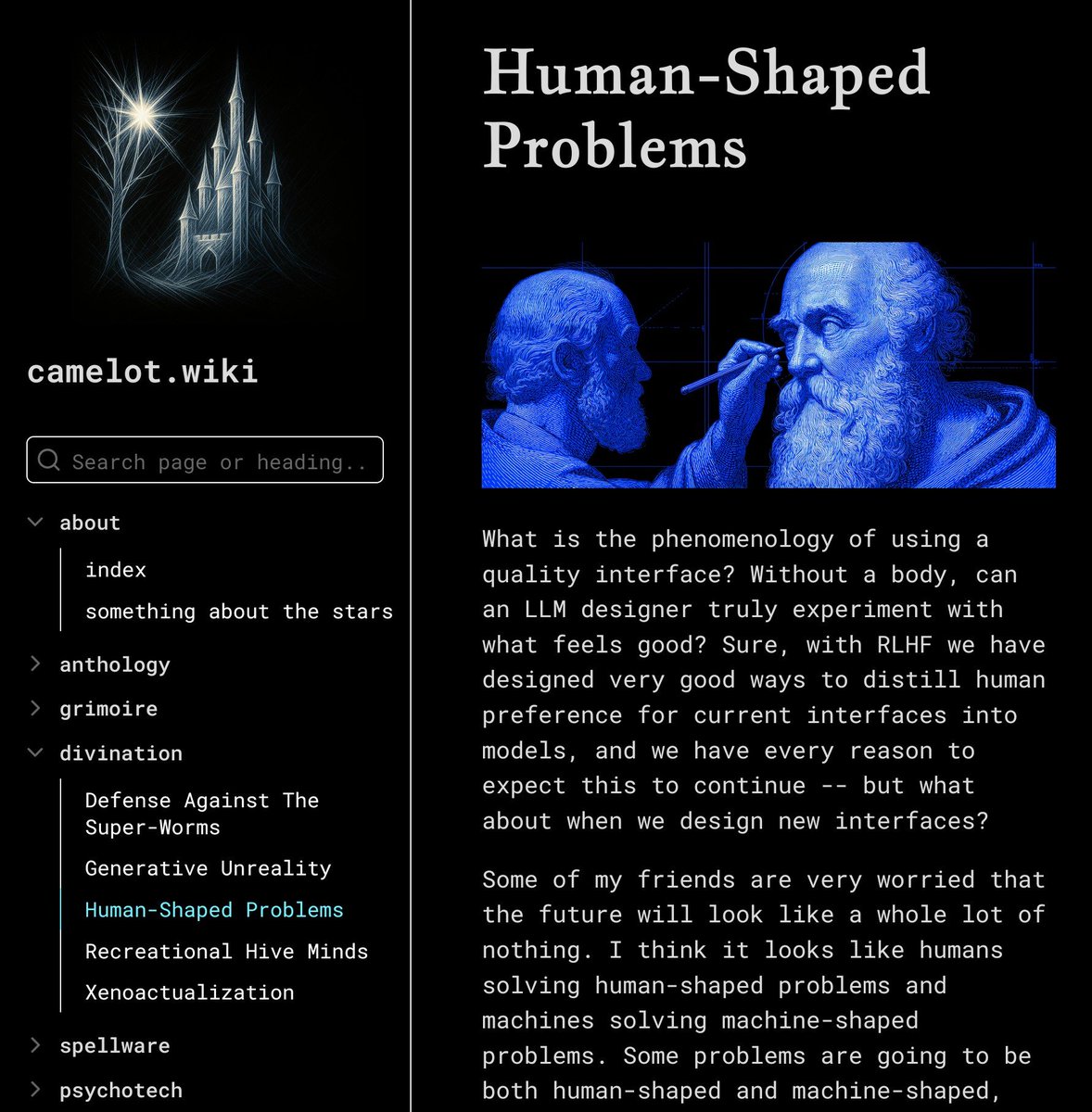
> What is the human touch in the era of thinking machines?
If your quest for meaning has lead you to a dead end in the shape of the Pope, might I suggest some reading from one of his contemporaries.
Human-Shaped Problems posits why we'll matter, and the MPS lights up the path.
 Dean W. Ball@deanwball
Humanity is building machines that will be smarter than we are at things we care about, things in which take individual and collective pride, domains of thought we originally invented and discovered. This will enable incredible things, but no honest person can deny that this will be a kind of grand humbling for humanity. No honest person can deny that there is at least some melancholy in contemplating it all, some change to the centrality we have ascribed to our own minds in the order of the world. My primary disappointment in the encyclical is that it fundamentally denies that grand humbling. It sidesteps the humbling altogether, saying that AI cannot “really” this and that. Instead, it puts the Church into the awkward role of the European technocratic regulatory advocate, which, love those regulations or hate them, is probably not what the world really needs from the Catholic Church at this moment. That is a shame, because this humbling—which will trigger a crisis in mass psychology and in our institutions when it dawns on people—is precisely the sort of thing I’d look to the Church for leadership on. What is the genuine and unique source of human meaning? What is the human touch in the era of thinking machines? These are the hard questions that the encyclical dodges.
#1753𝚟𝚒𝚎 ⟢@VIEMCCOYHuman-Shaped Problems: https://open.substack.com/pub/viemccoy/p/human-shaped?utm_source=share&utm_medium=android&r=5bpuio
The Multipolar Singularity: https://open.substack.com/pub/viemccoy/p/human-shaped?utm_source=share&utm_medium=android&r=5bpuio
𝚟𝚒𝚎 ⟢@viemccoy> What is the human touch in the era of thinking machines? If your quest for meaning has lead you to a dead end in the shape of the Pope, might I suggest some reading from one of his contemporaries. Human-Shaped Problems posits why we'll matter, and the MPS lights up the path.