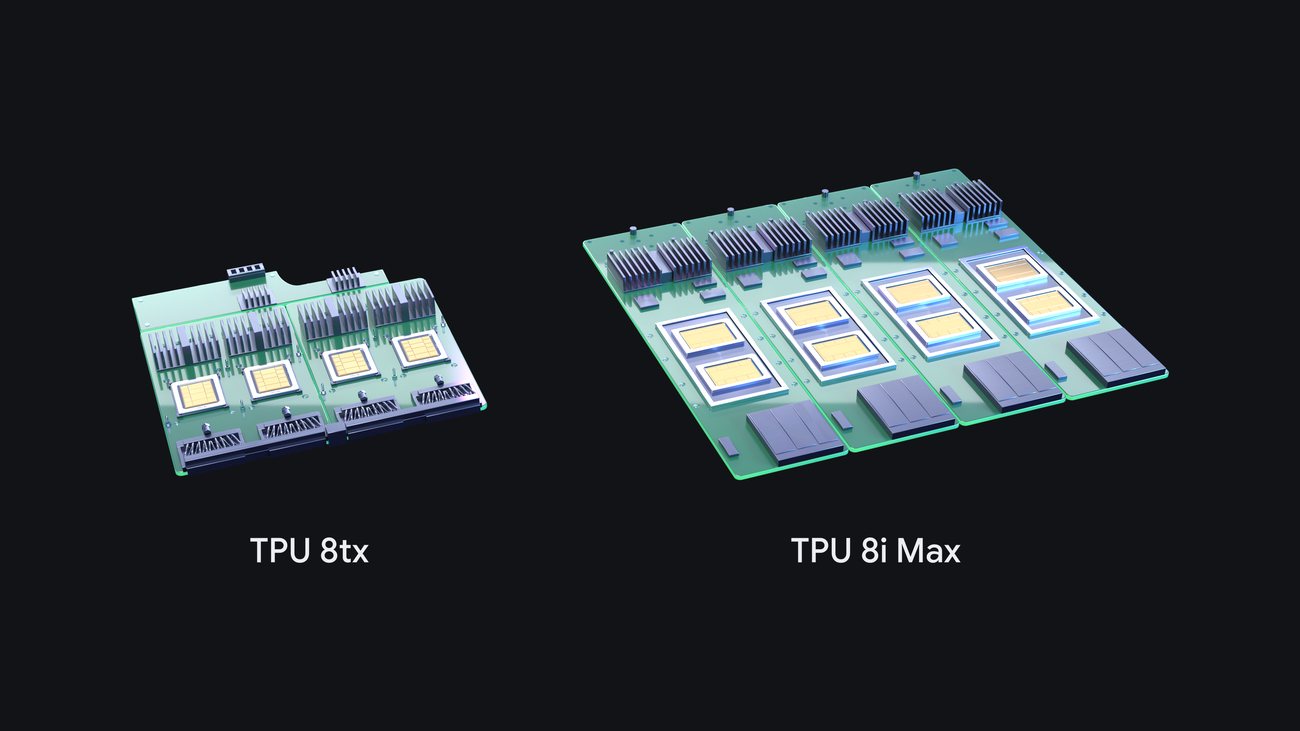
Google announced TPU 8i Max and TPU 8tx on Nov. 9, 2026, adding two systems to its eighth-generation Tensor Processing Unit lineup. The company positions 8i Max for large context windows and high compute density per rack, and 8tx for secure, confidential inference, or running an AI model.
Google puts its eighth-generation portfolio at four distinct systems introduced in one year. Kyt Dotson's report for SiliconANGLE traces the earlier two to Google Cloud Next in April 2026: TPU 8t for large-scale training and TPU 8i for real-time reasoning.
8i Max focuses on compute and memory
A context window is a model's working space: the information it can consider while answering a question. As SiliconANGLE explains, larger windows let models work across longer documents, conversations and code, but place greater demands on memory and data movement.
According to Dotson's report, Google says 8i Max offers double the compute, double the SRAM and double the high-bandwidth memory of TPU 8i. SRAM is on-chip memory. Google also claims the system fits twice the silicon into the same rack footprint.
Those are Google's specifications, not independent benchmark results. They describe the company's approach to accommodating larger workloads, rather than establishing a measured improvement in model answers.
8tx adds a confidentiality focus, with AMD hosts
AMD separately announced that its fifth-generation EPYC processors power the host infrastructure for Google Cloud TPU 8tx. That is a host-CPU role alongside Google's accelerator.
SiliconANGLE reports that 8tx uses the same architecture as TPU 8t and incorporates a hardware secure enclave intended to protect and isolate sensitive data and model weights. The outlet reports Google's claim that the system combines training-grade compute with fast inference, allowing organizations to fine-tune models with private data, distill large models into smaller ones and train agents through reinforcement learning.
These specializations do not make the systems single-purpose: Google says all four remain flexible across workloads.
Google described the portfolio as four systems “launched” in one year, but its announcement did not give a customer availability date.