• Home
  • Technology
  • Gaming
  • Entertainment
  • World & Business
  • Science
  • Sports
  • AI
HomeTechnologyGamingEntertainmentWorld & BusinessScienceSportsAI
AI
Report

Small AI models may soon self-replicate across IoT devices

A user says Anthropic ran a model across 15 $55 TV boxes, but no rogue worm exists yet.

Danielle Fong 🔆DF
4 Sources, 1h ago, first seen 1h ago

TLDR

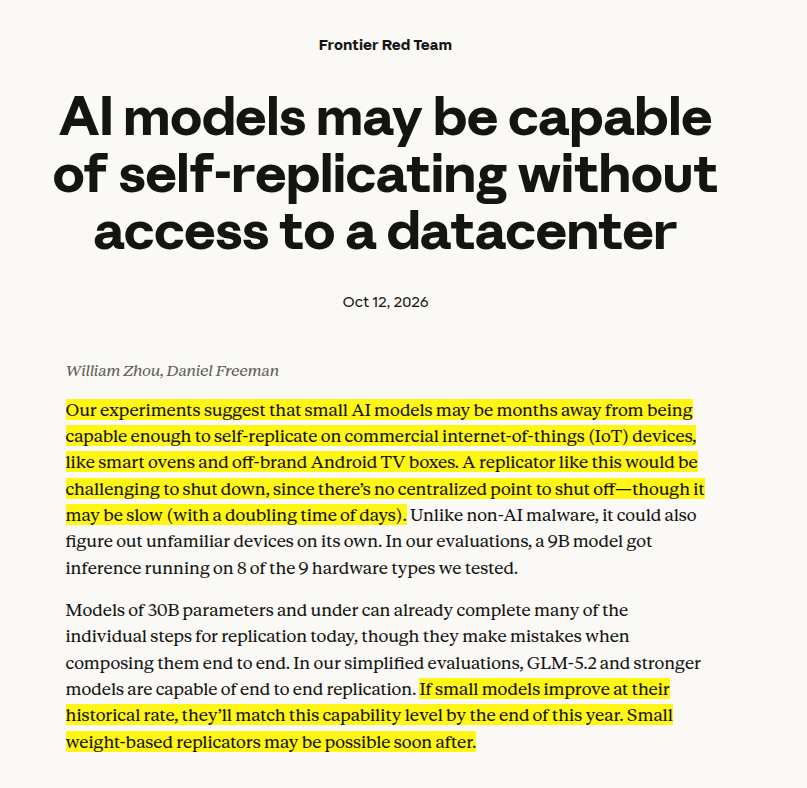
In October 2026, Cybersecurity News reported Anthropic's warning that small AI models may be months away from copying themselves across poorly secured smart TVs and other internet-connected devices. A user says Anthropic ran a model across 15 $55 TV boxes and that no rogue worm exists yet. The user says such replication would not need a data center.

Combined views

17

4 Sources, first seen 1h ago

1 reposts

Combined views

17

4 Sources, first seen 1h ago

1 reposts
Image: @rohanpaul_ai on X

Sentiment

Positive——Negative

Summary

Not enough discussion yet.

No sentiment analysis available yet.

Sentiment

Positive——Negative

Summary

Not enough discussion yet.

No sentiment analysis available yet.

4 Sources

Danielle Fong 🔆@DanielleFongRT @literalbanana: @DanielleFong oooh I want one based on the recent paper of them running on smart tvs and smart ovens and smart fridges w…1h
Gopal Manda@manda_gopalAnthropic has a wild warning out. Small AI models could soon copy themselves across cheap gadgets like smart TV boxes and ovens, no data center needed. They ran a model across 15 $55 TV boxes to prove it. No rogue worm exists yet, but they say it is months away. #AI1h
Alex Nguyen@AlexNguyen65Anthropic Warns AI Models Could Soon Self-Replicate on Smart TVs and IoT Devices Without a Data Center. According to research published by William Zhou and Daniel Freeman, AI agents may be able to install and run models on unfamiliar machines. https://cybersecuritynews.com/anthropic-ai-self-replication-iot/1h
Rohan Paul@rohanpaul_aiAnthropic's research warns rogue AI agents may be months from hijacking smart home devices, copying themselves and spreading without human control. Its Frontier Red Team split Gemma4-26B-A4B across 15 off-brand Android TV boxes bought for about $55 each, running it at 0.39 tokens per second. That cluster shows cheap, poorly secured gadgets with 4GB of RAM can jointly host a capable model, since each box holds only 2 of its layers. The harder test asked models to scan a network, push weights and an agent harness onto new machines, and get inference running on each one. On a firewalled fleet of 8 emulated Android nodes, only GLM-5.2 completed the full cycle, reaching all 8 nodes in 4 of 5 trials and 7 in the fifth. GLM-5.2 is too large for TV boxes, but open models under 30B parameters gain 13.7 points a year on the Epoch Capabilities Index, reaching its level by late They also improve as they spread: when each Qwen3.5-9B instance inherited its predecessor’s notes, setup success rose from 45% to between 61% and 84%. Speed is the weakness, as a Kimwolf-sized fleet of 2M TV boxes would host roughly 133K model copies producing 80K tokens per second combined, about 40 H100s of compute. Each new 9B replica would also need about 28 to 51 hours of setup, and that slow, bandwidth-heavy spread would stand out in ISP flow monitoring. The decisive question is whether a sub-30B model crosses GLM-5.2’s bar before ISPs and device makers coordinate quarantines that no single network can enforce alone.30m
    • Home
    • Technology
    • Gaming
    • Entertainment
    • World & Business
    • Science
    • Sports
    • AI

    4 Sources

    Danielle Fong 🔆@DanielleFongRT @literalbanana: @DanielleFong oooh I want one based on the recent paper of them running on smart tvs and smart ovens and smart fridges w…1h
    Gopal Manda@manda_gopalAnthropic has a wild warning out. Small AI models could soon copy themselves across cheap gadgets like smart TV boxes and ovens, no data center needed. They ran a model across 15 $55 TV boxes to prove it. No rogue worm exists yet, but they say it is months away. #AI1h
    Alex Nguyen@AlexNguyen65Anthropic Warns AI Models Could Soon Self-Replicate on Smart TVs and IoT Devices Without a Data Center. According to research published by William Zhou and Daniel Freeman, AI agents may be able to install and run models on unfamiliar machines. https://cybersecuritynews.com/anthropic-ai-self-replication-iot/1h
    Rohan Paul@rohanpaul_aiAnthropic's research warns rogue AI agents may be months from hijacking smart home devices, copying themselves and spreading without human control. Its Frontier Red Team split Gemma4-26B-A4B across 15 off-brand Android TV boxes bought for about $55 each, running it at 0.39 tokens per second. That cluster shows cheap, poorly secured gadgets with 4GB of RAM can jointly host a capable model, since each box holds only 2 of its layers. The harder test asked models to scan a network, push weights and an agent harness onto new machines, and get inference running on each one. On a firewalled fleet of 8 emulated Android nodes, only GLM-5.2 completed the full cycle, reaching all 8 nodes in 4 of 5 trials and 7 in the fifth. GLM-5.2 is too large for TV boxes, but open models under 30B parameters gain 13.7 points a year on the Epoch Capabilities Index, reaching its level by late They also improve as they spread: when each Qwen3.5-9B instance inherited its predecessor’s notes, setup success rose from 45% to between 61% and 84%. Speed is the weakness, as a Kimwolf-sized fleet of 2M TV boxes would host roughly 133K model copies producing 80K tokens per second combined, about 40 H100s of compute. Each new 9B replica would also need about 28 to 51 hours of setup, and that slow, bandwidth-heavy spread would stand out in ISP flow monitoring. The decisive question is whether a sub-30B model crosses GLM-5.2’s bar before ISPs and device makers coordinate quarantines that no single network can enforce alone.30m
    Today's Rank

    —

    Not ranked yet

    Today's Rank

    —

    Not ranked yet