Robotic World Model (RWM) coauthor Chenhao Li praised SuperMimic’s training-efficiency results in a November 13 post—and urged the robotics community to keep its longer history in view. He was responding to Qiayuan Liao’s announcement that SuperMimic had won CoRL’s best-paper award. SourceSource
Li says SuperMimic properly credited RWM and Uncertainty-Aware Robotic World Model (RWM-U). “SuperMimic handled its relationship to RWM and RWM-U very respectfully,” he wrote. He said the paper, presentation and code release provided “sufficient and thoughtful acknowledgment of our work,” and that Liao personally expressed gratitude for the inspiration. He isn’t asking SuperMimic for a belated thank-you. SourceSource
SuperMimic’s README lists robotic_world_model alongside ControlVAE and DreamerV3 as projects that inspired its code. The code is available under the Apache 2.0 license. Source
Why the efficiency result draws applause
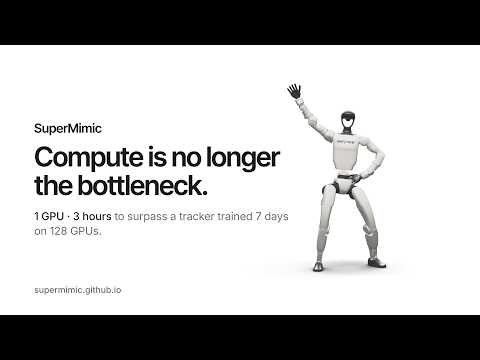
The SuperMimic team reports that its humanoid motion controller surpasses the normalized return of SONIC’s released motion-tracking model after three hours on one NVIDIA H100 GPU. Both are evaluated on the same 129,514 motions. Normalized return is a reward score scaled from zero to one; SONIC’s released model, or checkpoint, scores 0.90. The project compares its result with SONIC’s reported training run of seven days on 128 NVIDIA L40 GPUs. Source
The hardware and training data aren’t identical, though. SONIC used a reported 611 hours of motion data, while SuperMimic uses the 264.56-hour BONES-SEED public subset. SuperMimic’s three-hour figure includes collecting simulator data, fitting the world model and updating the controller, but excludes checkpoint evaluations. The evaluated motions are training motions for both methods, not a held-out test of unfamiliar movements. Source
According to the project, SuperMimic collects transitions from MuJoCo Warp, a physics simulator, and learns a world model that predicts robot dynamics. It trains the controller through short sequences of predicted states, using gradients through that learned model rather than through the simulator. The training loop updates the world model and controller together. Simulation hasn’t been fired; it’s supplying the experience the model learns from. Source
The team also reports running a single controller on a physical Unitree G1 humanoid robot without per-motion tuning. That hardware deployment is separate from the 129,514-motion simulation benchmark—not evidence that every benchmark motion succeeded on a physical robot. Source
A bigger spotlight, with room for the earlier work
Li coauthored the 2025 RWM and RWM-U papers with Andreas Krause and Marco Hutter at ETH Zurich. Their project descriptions report training controllers in learned models and deploying resulting policies on physical robots. RWM-U adds estimates of prediction uncertainty to help prevent controllers from exploiting errors in the learned model. SourceSource
Li calls SuperMimic’s focus on training efficiency timely and practically important, and singles out policy optimization using first-order gradients through learned dynamics. He also says his own work taught him how challenging it is to make backpropagation through time—the technique used to propagate learning signals through a sequence—work reliably in this setting. Source
But he cautions against treating the result as the beginning of the field. Neither SuperMimic nor RWM/RWM-U was the first effort to make model-based reinforcement learning (MBRL) work on real robots, he writes, pointing to earlier differentiable-simulation and model-based-control research. His request for recognition extends beyond his own papers. Source
“I believe MBRL deserves much more attention than it has historically received,” Li wrote, welcoming its growing recognition. Source




Comments