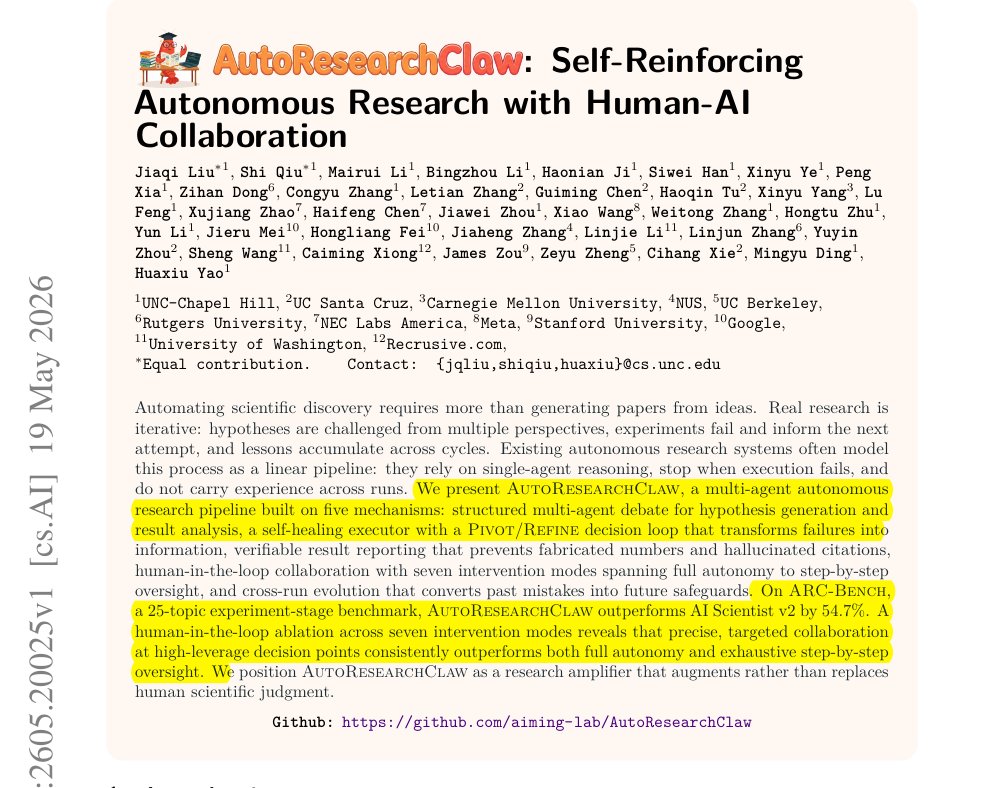
New Meta, Stanford, Google and many other top labs paper proposes AutoResearchClaw.
Shows that automated research improves when AI can fail, recover, and ask humans at the right moments.
The paper is less about an “AI scientist” than about turning research into a governed loop.
Most systems still treat science like a production line: generate an idea, run code, write a paper, then stop when the chain breaks.
AutoResearchClaw treats failure as evidence, using debate, repair, verification, memory, and selective human input as parts of the same machine.
That is the main point: autonomy gets better when it is constrained by process, not when it is simply given more freedom.
On ARC-Bench, the system beat AI Scientist v2 by 54.7%, with its sharpest gains in result analysis, where claims had to match measurements rather than merely sound plausible.
The human result is more interesting: CoPilot reached an 87.5% accept rate, while full autonomy reached 25% and step-by-step oversight reached 50%, suggesting that too little judgment and too much supervision can both degrade science.
The most revealing failure was a case where every cross-validation method returned identical zero-bias outputs, which passed numeric verification but failed scientific meaning.
That is the boundary this paper exposes: machines can verify that numbers are real, but humans still notice when the experiment has stopped asking the right question.
----
Paper Link – arxiv. org/abs/2605.20025
Paper Title: "AutoResearchClaw: Self-Reinforcing Autonomous Research with Human-AI Collaboration"