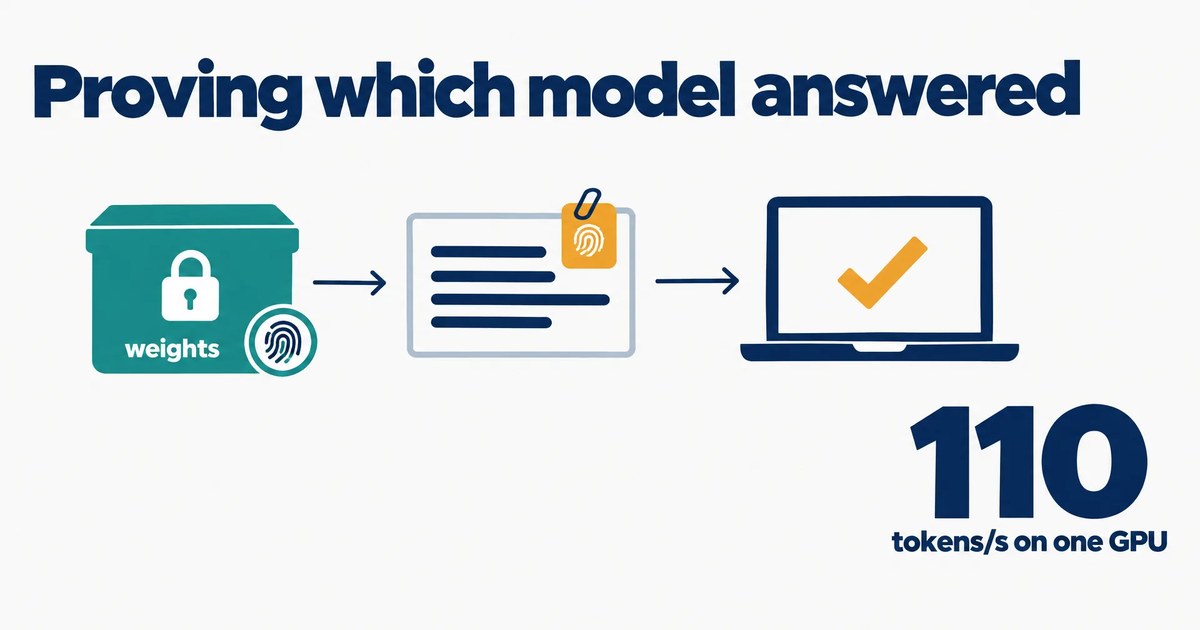
Anthropic has released FlashProve, an open-source research prototype intended to prove a response came from a model to which its provider committed. The idea is for a provider to commit to a model and generate a cryptographic proof for each reply. According to the project’s repository, someone else could check that proof on an ordinary CPU without access to the model’s weights. Anthropic says the commitment and proofs hide the weights, though the system is not designed to hide the model’s architecture.
That distinction could matter to someone using a third-party service to reach a particular model: Anthropic identifies checking that the service delivered the requested model as one potential use. But generating the proof takes considerably more computing time than generating the response in Anthropic’s reported test. With 4-bit-quantized Llama 4 Maverick, a 400-billion-parameter mixture-of-experts model, and integer arithmetic during prefill, Anthropic reports that one H100 GPU generated proofs at around 110 tokens per second. The repository specifies a batch of 24 requests and a 1,024-token context window for its roughly 110-token-per-second prefill figure. Anthropic puts each proof at roughly 19 MB per 1,024-token request and says proof generation used about 70 to 95 times the GPU time of running the model on vLLM.
Alongside code for a prover and two verifiers, Anthropic lists a technical report, a protocol description and Lean proofs of top-level mathematical statements. It released the code, proofs and documentation under the Apache 2.0 license. Anthropic calls the work “intermediate progress, and not a completed research agenda.” The repository labels version 0.16.0 a research artifact that is “not maintained, not accepting contributions.”